
SAE 100 R12 hydraulic hose — 4 spiral steel wire reinforcement
TECTUL · Dispatch across Colombia · Exports to Central & South America
High-pressure hydraulic hose with a nitrile inner tube, 4 high-tensile spiral steel wire reinforcement layers and a nitrile cover, under SAE 100 R12. Covers 1/2″ to 2″, with working pressure from 2500 to 4000 psi (172.4 to 275.8 bar) depending on diameter and a 1:4 safety factor across the range. The spiral reinforcement (unlike the one- or two-layer braid of R1/R2) sustains constant working pressure at large diameters, where braided reinforcement loses capacity.
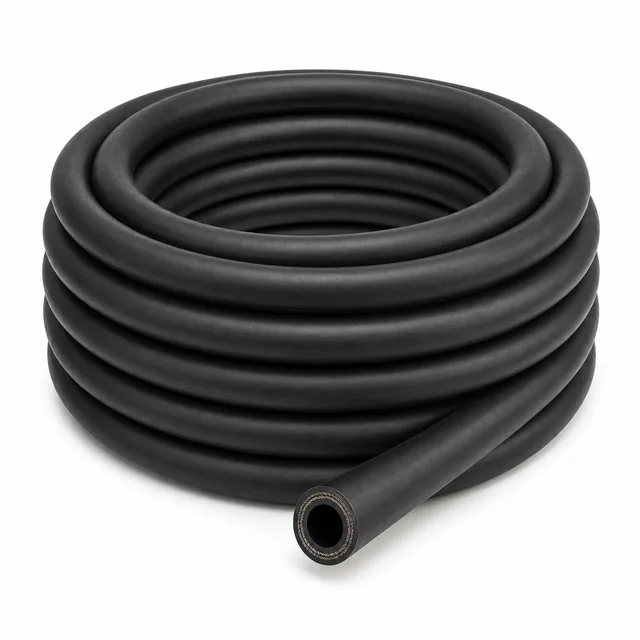
IMPORTANT: reference data — may differ from the physical product; verify with an advisor before buying.
SKU VT-142236 (SAE 100 R12 hose) · 50 m rolls, 1/2″–2″
1. Technical specifications
Materials by component
| Component | Material | Function |
|---|---|---|
| Inner tube | Nitrile (NBR) | Oil resistant; smooth inner surface for low friction with the fluid |
| Reinforcement | 4 high-tensile spiral steel wire layers | Provides constant working pressure at large diameters, where a braided hose (R1/R2) would lose allowable pressure |
| Cover | Nitrile (NBR) | Resistance to external abrasion and weathering |
Dimensional and pressure data
| Nominal diameter | ID (mm) | OD (mm) | Working pressure | Burst pressure | Min. bend radius (mm) |
|---|---|---|---|---|---|
| 1/2″ | 12.7 | 23.6 | 4000 psi · 275.8 bar | 16000 psi · 1103.2 bar | 175 |
| 5/8″ | 15.9 | confirmed on quotation | 4000 psi · 275.8 bar | 16000 psi · 1103.2 bar | 205 |
| 3/4″ | 19.0 | 30.7 | 4000 psi · 275.8 bar | 16000 psi · 1103.2 bar | 240 |
| 1″ | 25.4 | 38.0 | 4000 psi · 275.8 bar | 16000 psi · 1103.2 bar | 300 |
| 1-1/4″ | 31.8 | 47.0 | 3000 psi · 206.8 bar | 12000 psi · 827.4 bar | 420 |
| 1-1/2″ | 38.1 | 53.5 | 2500 psi · 172.4 bar | 10000 psi · 689.5 bar | 500 |
| 2″ | 50.8 | 66.7 | 2500 psi · 172.4 bar | 10000 psi · 689.5 bar | 635 |
IMPORTANT
This technical data sheet is a reference guide to the properties of this product type; it is not a quality certificate for the product you are buying. The measurements, dimensions and physical or geometric characteristics of the product supplied may vary by manufacturer, heat and lot, and may even fall outside the cited standards. If any of these figures is critical to your design or build, verify it with one of our advisors against the physical product or the lot's mill certificate, so you can be fully certain of what you are buying. · Original data sheet: tectul.com/en/conduccion-de-fluidos/mangueras/ficha-tecnica-manguera-sae-100-r12.html
The 5/8″ outer diameter is declared "confirmed on quotation": the manufacturer sheet shows 57.4 mm on that row, a value that breaks the table's progression (23.6 mm at 1/2″ and 30.7 mm at 3/4″) and is not used here as it is not verifiable. Bar values were calculated from psi using the factor 1 bar = 14.5038 psi.
General specifications
| Product | High-pressure hydraulic hose, 4 spiral steel wire reinforcement layers |
| Material | Nitrile inner tube · 4 high-tensile spiral steel wire layers · nitrile cover |
| Presentation | 50 m rolls |
| Dimensional range | 1/2″–2″ (7 diameters) |
| Applicable standards | SAE J517 (current edition 2020-07) — Hydraulic Hose (100R12 designation) |
2. Engineering criterion: working-to-burst pressure ratio
What the 1:4 factor means
The declared burst pressure is exactly 4 times the working pressure across the 7 catalog sizes (for example, 1/2″: 4000 psi working and 16000 psi burst). That margin covers the pressure spikes typical of a hydraulic system —pump start-up, shock loads when closing a valve, cyclic impulses— and the fatigue aging of the steel reinforcement; it does not authorize sustained operation above the tabulated working pressure.
Why spiral instead of braided
A braided hose (R1: 1 braid, R2: 2 braids) loses allowable pressure as diameter grows, because the braid angle optimal for resisting pressure degrades at large diameters. Spiral wire reinforcement (wound, not braided, wire layers) solves that: by design it sustains a more stable working pressure at medium and large diameters, and additionally adds resistance to fatigue from cyclic pressure impulses, common in construction equipment and agricultural machinery.
When R12 is chosen
R12 is specified when the required working pressure falls within 2500–4000 psi and the diameter is 1/2″ to 2″: that is the point where a braided hose (R1/R2, usual practical limit up to 3/8″–1″ at those pressures) no longer reaches and a 6-spiral hose (R13) would be a cost over-specification for the required pressure. It is the typical reference for hydraulic systems of construction equipment and agricultural machinery running on mineral or synthetic oil.
3. Construction and chemical/thermal compatibility
Nitrile tube and cover
The nitrile (NBR) inner tube is the standard choice for mineral hydraulic oil: good resistance to oil swelling, reasonable cost and flexibility adequate for the bend radius in the table. The cover, also nitrile, protects the steel reinforcement from external abrasion and moisture; once the cover is punctured, water can reach the wire and rust it, so a damaged cover compromises service life even if the hose keeps "working".
Fluid compatibility
Suitable for common mineral and synthetic hydraulic oils and for non-corrosive water-based hydraulic fluids. It is not the first choice for concentrated aromatic fuels or fluids with high ester content, where nitrile can swell or lose properties; in those cases verify specific compatibility with the supplier before quoting.
Installation and maintenance
Respect the minimum bend radius per diameter: on spiral reinforcement, bending below that radius concentrates stress on the wire and accelerates fatigue, even if the hose shows no immediately visible damage. Periodically inspect the cover for cuts, abrasion or exposed wire: these are early failure indicators on spiral-reinforced hoses, before a leak or burst occurs.
4. Frequently asked questions
What is the working pressure of the SAE 100 R12 hose?
It depends on diameter: 4000 psi (275.8 bar) from 1/2″ to 1″, 3000 psi (206.8 bar) at 1-1/4″ and 2500 psi (172.4 bar) at 1-1/2″ and 2″, with a constant 1:4 safety factor, per the manufacturer data sheet.
Why is the reinforcement 4 spirals instead of braided?
Because at these diameters (1/2″–2″) and pressures (up to 4000 psi), braided reinforcement (R1/R2) no longer sustains allowable pressure efficiently. Spiral wire gives a more stable working pressure at medium and large diameters, and better fatigue resistance under cyclic impulses.
Can it be used with water-based fluids?
Yes, with non-corrosive water-based hydraulic fluids. For concentrated aromatic fuels or fluids with high ester content, specific compatibility of the nitrile must be confirmed with the supplier before quoting.
How does it differ from the R13?
The R12 has 4 spiral wire layers and reaches up to 4000 psi; the R13 has 6 spiral layers and reaches 5000 psi with a 1:3 safety factor. Move to R13 when the required pressure exceeds what R12 covers, not as a general substitute.
5. Application notes
Feasibility
Specify this hose for 2500–4000 psi depending on diameter, in hydraulic systems of construction equipment and agricultural machinery running on mineral or synthetic oil. Do not specify it for concentrated aromatic fuels or high-ester-content fluids without confirming the nitrile's compatibility with the supplier.
Installation
Respect the minimum bend radius per diameter: bending below that radius concentrates stress on the spiral wire and accelerates fatigue. Periodically inspect the cover for cuts or abrasion exposing the steel reinforcement.
Design
The 1:4 factor is a design margin against pressure spikes, not a license to operate above the tabulated working pressure. For diameter or pressure outside this range, evaluate R1/R2 (lower pressure/diameter) or R13 (higher pressure). Final selection is the responsibility of the hydraulic system designer.
6. Technical notice and limitation of liability
The pressures, dimensions, weights and other characteristics in this sheet are theoretical calculation values obtained from nominal properties published in the standards cited (ASME B36.10-2022, ASME B31.3-2024, ASTM A106/A106M-19a, ASTM A53/A53M-24, API Spec 5L 46th ed.). They guide selection; they are not a certificate of conformity for any given lot.
The actual behavior of each lot varies with manufacturing — wall tolerance (up to −12.5%), out-of-roundness, residual stresses — and with the raw material — chemical composition within the ranges the standard allows, heat-to-heat differences. To certify a lot, the tests defined by its product standard are required: tensile test, flattening test and hydrostatic test, documented in the manufacturer's mill test certificate (MTC), which TECTUL supplies upon request; testing of the lot in an independent laboratory can also be arranged.
These values must not be used as the sole criterion in critical or safety applications, or wherever failure of the line may compromise people, property or the environment: in such cases the design belongs to the project's responsible engineer under the applicable code (ASME B31.3, B31.1 or the one governing the installation), with the design temperature, corrosion allowance and load cases of the actual service. Before deciding with these data, consult our technical team.
Sources
- SAE J517_202007 (edición vigente, julio 2020) — Hydraulic Hose, SAE International (designación 100R12: 4 espirales de alambre de acero)
- Ficha técnica de fabricante (archivo interno TECTUL) — Manguera SAE 100 R12: tabla dimensional, W/P, B/P, radio de curvado y características adicionales
This data sheet is the property of TECTUL, part of the Industrias IMR group. Reproduction without attribution is prohibited. Original document and updates: tectul.com/en/conduccion-de-fluidos/mangueras/ficha-tecnica-manguera-sae-100-r12.