
SAE 100 R13 hydraulic hose (6 spirals) and ultra high pressure hose — two distinct constructions
TECTUL · Dispatch across Colombia · Exports to Central & South America
This sheet covers TWO very-high-pressure hydraulic hose constructions that the TECTUL catalog sells as sibling references but which are technically distinct and not interchangeable: (A) SAE 100 R13, nitrile tube with 6 spiral steel wire layers, 3/4″–2″, constant 5000 psi (344.7 bar) and a 1:3 safety factor; and (B) ultra high pressure hose, nylon tube with steel reinforcement layers and a polyurethane cover, 1/4″–3/4″, from 10000 to 14500 psi (689.5 to 999.7 bar) depending on diameter and a 1:2.5 safety factor. The diameter ranges barely overlap (only 3/4″ is shared) and, at that single common diameter, the ultra high pressure hose delivers double the working pressure of the R13 — that is why they are documented as two separate variants with no figures merged between them.
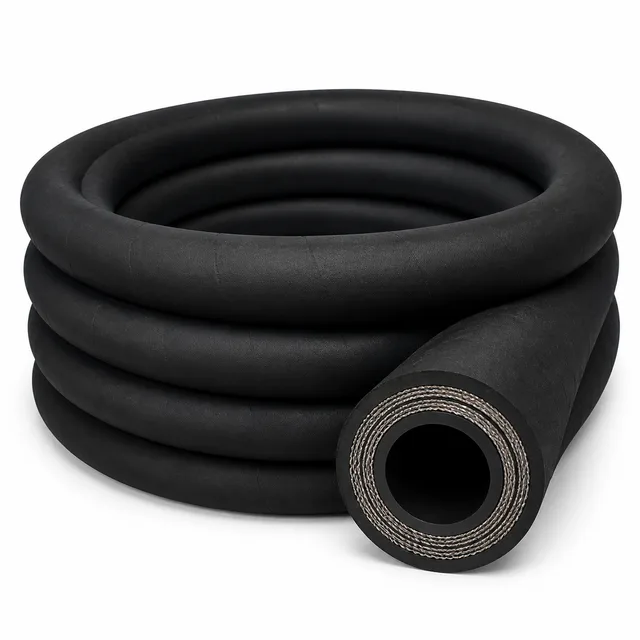
IMPORTANT: reference data — may differ from the physical product; verify with an advisor before buying.
SKU VT-142238 (SAE 100 R13 hose) · sibling reference "ultra high pressure" SKU VT-manguera-para-ultra-alta-presion · 36–50 m rolls (R13) and 100 m rolls (ultra high pressure)
1. Technical specifications
Structure notice: this section documents TWO constructions that the TECTUL catalog groups under the same commercial family but which are technically distinct. No figures are merged between them: each variant carries its own table and its own materials.
Variant A — SAE 100 R13 (6 spiral steel wire layers)
| Component | Material |
|---|---|
| Inner tube | Nitrile (NBR) |
| Reinforcement | 6 high-tensile spiral steel wire layers |
| Cover | Nitrile (NBR) |
| Nominal diameter | ID (mm) | OD (mm) | Working pressure | Burst pressure | Min. bend radius (mm) |
|---|---|---|---|---|---|
| 3/4″ | 19.0 | 33.2 | 5000 psi · 344.7 bar | 15000 psi · 1034.2 bar | 240 |
| 1″ | 25.4 | 36.4 | 5000 psi · 344.7 bar | 15000 psi · 1034.2 bar | 300 |
| 1-1/4″ | 31.8 | 51.3 | 5000 psi · 344.7 bar | 15000 psi · 1034.2 bar | 420 |
| 1-1/2″ | 38.1 | 58.8 | 5000 psi · 344.7 bar | 15000 psi · 1034.2 bar | 500 |
| 2″ | 50.8 | 72.7 | 5000 psi · 344.7 bar | 15000 psi · 1034.2 bar | 635 |
IMPORTANT
This technical data sheet is a reference guide to the properties of this product type; it is not a quality certificate for the product you are buying. The measurements, dimensions and physical or geometric characteristics of the product supplied may vary by manufacturer, heat and lot, and may even fall outside the cited standards. If any of these figures is critical to your design or build, verify it with one of our advisors against the physical product or the lot's mill certificate, so you can be fully certain of what you are buying. · Original data sheet: tectul.com/en/conduccion-de-fluidos/mangueras/ficha-tecnica-manguera-sae-100-r13.html
Service temperature: −40 °C to +100 °C (−40 °F to 212 °F). Safety factor 1:3 (15000 = 3 × 5000 psi, constant across all 5 sizes). Presentation in 36 to 50 m rolls depending on diameter.
Variant B — Ultra high pressure hose (steel wire layers, nylon tube, polyurethane cover)
| Component | Material |
|---|---|
| Inner tube | Nylon |
| Reinforcement | Steel wire layers |
| Cover | Polyurethane |
| Nominal diameter | ID (mm) | OD (mm) | Working pressure | Burst pressure | Min. bend radius (mm) |
|---|---|---|---|---|---|
| 1/4″ | 6.3 | 13.0 | 14500 psi · 999.7 bar | ~36250 psi · ~2499.4 bar (calculated) | 130 |
| 3/8″ | 10.0 | 17.0 | 10000 psi · 689.5 bar | ~25000 psi · ~1723.7 bar (calculated) | 200 |
| 1/2″ | 13.0 | 21.5 | 10000 psi · 689.5 bar | ~25000 psi · ~1723.7 bar (calculated) | 260 |
| 3/4″ | 19.5 | 36.0 | 10000 psi · 689.5 bar | ~25000 psi · ~1723.7 bar (calculated) | 510 |
IMPORTANT: reference data — may differ from the physical product; verify with an advisor before buying.
Service temperature: −40 °C to +120 °C (−40 °F to 248 °F). Manufacturer-declared safety factor: 1:2.5. The manufacturer sheet does NOT tabulate burst pressure for this reference; the "calculated" value in the table is obtained by applying the manufacturer's own 1:2.5 factor to the W/P (it is not a published figure nor an actual burst test) and must be treated as an estimate, not a certified specification. Presentation in 100 m rolls.
Why they are not merged into one table
The diameter ranges barely overlap (R13: 3/4″–2″; ultra high pressure: 1/4″–3/4″; only 3/4″ is shared) and, at that single common diameter, the ultra high pressure hose declares 10000 psi working pressure versus the R13's 5000 psi: double, at the same nominal diameter. Merging both tables under a single pressure range would have hidden that real difference in construction and performance.
2. Engineering criterion: working-to-burst pressure ratio
R13: tabulated 1:3 factor
The R13 declares 15000 psi burst versus 5000 psi working across its 5 diameters: a constant 1:3 factor published directly by the manufacturer, just as traceable as the R12's 1:4 but more conservative, consistent with the higher number of reinforcement layers (6 spirals) working at a higher absolute pressure.
Ultra high pressure: declared 1:2.5 factor, no tabulated burst
The manufacturer declares the design factor (1:2.5) but does not publish a burst pressure per diameter: only the working pressure is given. The burst value shown in the section 1 table is our own calculation (W/P × 2.5) from that declared factor, not a manufacturer figure nor a test result — it is explicitly marked as such and must not be cited as if it were a certified data point.
When each one is chosen
The R13 is specified in very-high-pressure hydraulic systems of medium-to-large diameter (3/4″ to 2″): mining equipment, hydraulic presses, heavy machinery, where 5000 psi is the target working pressure and the required diameter exceeds what R12 covers. The ultra high pressure hose, in contrast, is small-diameter (1/4″ to 3/4″) and much higher pressure (10000–14500 psi): it is the typical line for high-tonnage hydraulic jacks and tensioners, hydraulic torque tools and test benches, where the required flow is low but pump pressure is extreme. They are not interchangeable by diameter or by pressure: using an ultra high pressure hose where an R13 is needed would be a cost over-specification at a diameter the ultra high pressure hose does not cover (it does not go past 3/4″); using an R13 where ultra high pressure is needed would under-size the line and risk a burst.
3. Construction and chemical/thermal compatibility
R13: nitrile and six spirals
The nitrile tube and cover give the same compatibility with mineral and synthetic oil as the R12; what changes is the reinforcement, from 4 to 6 spiral wire layers, to sustain a constant 5000 psi at diameters up to 2″. It is suitable for mineral and synthetic oils and non-corrosive water-based hydraulic fluids; it is not formulated for concentrated aromatic hydrocarbons without verifying compatibility.
Ultra high pressure: nylon, steel and polyurethane
The nylon tube and polyurethane cover are a different construction from rubber hoses: polyurethane gives better external abrasion resistance per unit weight, which explains the "low weight" the manufacturer declares for this ultra high pressure line. The manufacturer sheet explicitly declares resistance to oils, acids and alkalis, a broader chemical compatibility than a nitrile tube — consistent with its use in hydraulic torque tools and test benches, where occasional contact with cleaning agents or degreasers may occur.
Why they must not be confused in the field
Both hoses are sold under the catalog's "hydraulic high pressure" category and share the 3/4″ diameter, so the risk of warehouse mix-up is real. Always verify the physical construction before installing: the R13 has a nitrile (rubber) cover over visibly spiral wire layers when cut; the ultra high pressure hose has a stiffer-feeling polyurethane cover over steel layers with a smaller outer diameter relative to its pressure. When in doubt, confirm the exact reference with the supplier before pressurizing the line.
4. Frequently asked questions
Are the ultra high pressure hose and the SAE 100R13 the same reference?
No. They are two distinct constructions: the R13 is nitrile rubber with 6 steel spirals, 3/4″–2″, 5000 psi; the ultra high pressure hose is nylon with steel layers and a polyurethane cover, 1/4″–3/4″, 10000–14500 psi. Although the catalog sells them as sibling references, they are not interchangeable.
What is the maximum pressure of the ultra high pressure hose?
Per the manufacturer data sheet consulted for this data sheet, 14500 psi (999.7 bar) at 1/4″, dropping to 10000 psi (689.5 bar) from 3/8″ to 3/4″. Market figures citing up to 60000 psi correspond to other ultra high pressure lines (for example, pressure washing or water-jet cutting) and not to the reference documented here; they should not be assumed to apply to this product without the corresponding manufacturer data sheet.
What is the burst pressure of the SAE 100R13?
15000 psi (1034.2 bar), constant across its 5 diameters (3/4″ to 2″), with a manufacturer-declared 1:3 safety factor.
Why doesn't the ultra high pressure hose publish a burst pressure?
Because the manufacturer sheet only tabulates working pressure and the design safety factor (1:2.5); it does not include a burst-pressure table per diameter. The value shown in section 1 is a calculation from that factor, not test data, and is confirmed on quotation if the project requires it certified.
5. Application notes
Feasibility
Specify the R13 for a constant 5000 psi at diameters from 3/4″ to 2″ (mining, hydraulic presses, heavy machinery). Specify the ultra high pressure hose for 10000–14500 psi at diameters from 1/4″ to 3/4″ (high-tonnage jacks and tensioners, hydraulic torque tools). Do not treat them as substitutes for each other.
Installation
Verify the physical construction before installing (nitrile vs. polyurethane cover) to avoid confusing the two references in the warehouse. Respect the minimum bend radius from each table and do not reuse fittings on the ultra high pressure line.
Design
The ultra high pressure burst value shown in this sheet is calculated, not test-certified: if the project requires a certified burst pressure, request it from the actual manufacturer before specifying. Final selection between R13 and ultra high pressure is the responsibility of the hydraulic system designer, based on the actual required pressure and diameter.
6. Technical notice and limitation of liability
The pressures, dimensions, weights and other characteristics in this sheet are theoretical calculation values obtained from nominal properties published in the standards cited (ASME B36.10-2022, ASME B31.3-2024, ASTM A106/A106M-19a, ASTM A53/A53M-24, API Spec 5L 46th ed.). They guide selection; they are not a certificate of conformity for any given lot.
The actual behavior of each lot varies with manufacturing — wall tolerance (up to −12.5%), out-of-roundness, residual stresses — and with the raw material — chemical composition within the ranges the standard allows, heat-to-heat differences. To certify a lot, the tests defined by its product standard are required: tensile test, flattening test and hydrostatic test, documented in the manufacturer's mill test certificate (MTC), which TECTUL supplies upon request; testing of the lot in an independent laboratory can also be arranged.
These values must not be used as the sole criterion in critical or safety applications, or wherever failure of the line may compromise people, property or the environment: in such cases the design belongs to the project's responsible engineer under the applicable code (ASME B31.3, B31.1 or the one governing the installation), with the design temperature, corrosion allowance and load cases of the actual service. Before deciding with these data, consult our technical team.
Sources
- SAE J517_202007 (edición vigente, julio 2020) — Hydraulic Hose, SAE International (designación 100R13: 6 espirales de alambre de acero)
- Ficha técnica de fabricante (archivo interno TECTUL) — Manguera SAE 100 R13: tabla dimensional, W/P, B/P, radio de curvado y características adicionales
- Ficha técnica de fabricante (archivo interno TECTUL) — Manguera para ultra alta presión: tabla dimensional, W/P, radio de curvado y características adicionales (sin tabla de B/P)
This data sheet is the property of TECTUL, part of the Industrias IMR group. Reproduction without attribution is prohibited. Original document and updates: tectul.com/en/conduccion-de-fluidos/mangueras/ficha-tecnica-manguera-sae-100-r13.