
Heavy-duty PVC suction hose — reinforcement spiral, 1″–6″
TECTUL · Dispatch across Colombia · Exports to Central & South America
Hose made of PVC with a reinforcement spiral, in diameters from 1″ to 6″ and presented in rolls of 30 to 50 m depending on diameter. Working pressure ranges from 3.1 to 5.5 bar (45 to 80 psi) and burst pressure from 7.7 to 13.8 bar (112 to 200 psi), with a real burst-to-working ratio of 2.5:1 across all diameters — different from the 3:1 of this same maker's rubber-canvas water line. It is intended for suction and discharge of liquids, solids and abrasive materials in civil works, mining and industry: vacuum pumps, powder transfer, granulated material, cement, concrete and liquids.
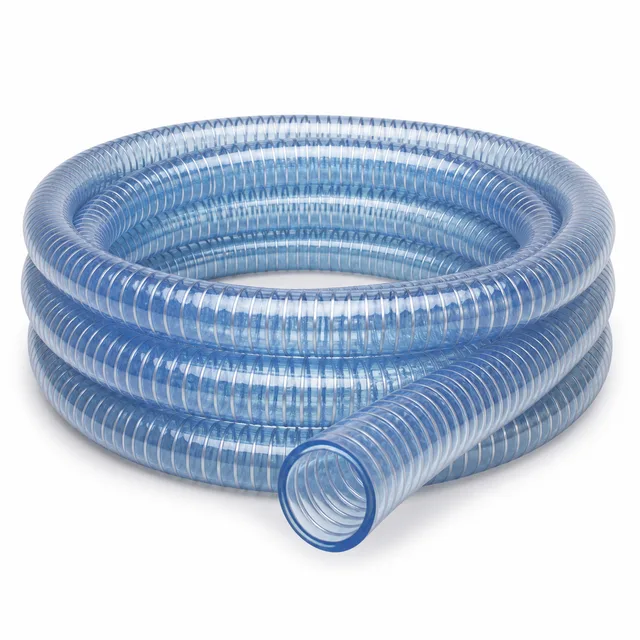
IMPORTANT: reference data — may differ from the physical product; verify with an advisor before buying.
SKU VT-manguera-succion-trabajo-pesado-pvc · 1 reference, 1″–6″ · sold by the roll
1. Technical specifications
Dimensional and pressure data
| Nominal size [in] | ID mm (in) | Working pressure | Burst pressure | Roll length |
|---|---|---|---|---|
| 1″ | 25 (0.98) | 4.1 bar (60 psi) | 10.3 bar (150 psi) | 50 m (164 ft) |
| 1-1/4″ | 32 (1.26) | 4.1 bar (60 psi) | 10.3 bar (150 psi) | 50 m (164 ft) |
| 1-1/2″ | 38 (1.50) | 3.4 bar (50 psi) | 8.6 bar (125 psi) | 50 m (164 ft) |
| 2″ | 50 (1.97) | 5.5 bar (80 psi) | 13.8 bar (200 psi) | 50 m (164 ft) |
| 2-1/2″ | 65 (2.56) | 5.5 bar (80 psi) | 13.8 bar (200 psi) | 50 m (164 ft) |
| 3″ | 75 (2.95) | 4.8 bar (70 psi) | 12.1 bar (175 psi) | 50 m (164 ft) |
| 4″ | 100 (3.94) | 4.8 bar (70 psi) | 12.1 bar (175 psi) | 50 m (164 ft) |
| 5″ | 125 (4.92) | 3.4 bar (50 psi) | 8.6 bar (125 psi) | 30 m (98 ft) |
| 6″ | 150 (5.91) | 3.1 bar (45 psi) | 7.7 bar (112 psi) | 30 m (98 ft) |
IMPORTANT
This technical data sheet is a reference guide to the properties of this product type; it is not a quality certificate for the product you are buying. The measurements, dimensions and physical or geometric characteristics of the product supplied may vary by manufacturer and production lot, and may even fall outside the cited standards. If any of these figures is critical to your design or build, verify it with one of our advisors against the physical product or the lot's mill certificate, so you can be fully certain of what you are buying. · Original data sheet: tectul.com/en/conduccion-de-fluidos/mangueras/ficha-tecnica-manguera-succion-trabajo-pesado-pvc.html
The manufacturer's sheet publishes no outer diameter (OD), wall thickness or weight per meter for this reference; see confirmarAlCotizar.
General specifications
| Product | Heavy-duty PVC suction hose with reinforcement spiral, for liquids, solids and abrasive materials |
| Material | PVC with reinforcement spiral; the manufacturer does not specify the spiral material in this sheet (confirmed on quotation) |
| Ends | No permanent factory coupling; confirmed on quotation |
| Rating | Working 3.1–5.5 bar (45–80 psi) by diameter; burst 7.7–13.8 bar (112–200 psi); real burst/working ratio 2.5:1 across all diameters |
| Commercial range | 1″–6″, 1 active reference |
| Sale | By the roll, per diameter (30 or 50 m) |
| Applicable standards | ASTM D380-94(2020) (rubber and plastic hose test methods) |
2. Engineering criterion: suction of solids and abrasive materials
Why the reinforcement spiral matters as much here as in liquid suction
Just as in a water suction hose, the spiral embedded in the PVC wall is what prevents collapse when a vacuum pump or pneumatic conveying system creates negative pressure inside the hose. The difference from a water hose is that here the suctioned material —dust, granulated material, cement or concrete— also erodes the inner wall by friction on every pass, especially at elbows and at points where the hose bends.
Why the burst-to-working ratio is 2.5:1, not 3:1
The manufacturer's table gives a constant 2.5:1 ratio between burst and working pressure across all nine diameters (for example, 2″: 200 psi burst over 80 psi working = 2.5). That is a different margin from the 3:1 declared by this same maker's rubber-canvas water line (see FT-TC-MAN-SUCC-AGUA-001): each hose family carries its own factory margin, and safety factors from one line should not be mixed with another's when specifying.
Worked example: margin available at the 2″ size
- Starting figure: declared working pressure at 2″ = 5.5 bar (80 psi); declared burst pressure = 13.8 bar (200 psi).
- Gross margin: 200 − 80 = 120 psi (8.3 bar) between the operating point and catastrophic failure.
- Ratio: 200 / 80 = 2.5 — the real factory safety factor for this diameter.
- Consequence: operating above 80 psi at 2″ directly reduces that margin; the manufacturer publishes no derating curve for abrasion or temperature, so internal abrasion from the conveyed material (not quantified) further reduces that margin over time in use, with no published figure to estimate by how much.
3. Declared applications and use limits
Application declared by the manufacturer
Ideal for civil works, mining and industry, for suction and discharge of liquids, solids and abrasive materials: vacuum pumps, powder transfer, granulated material, cement, concrete and liquids in general. The sheet highlights "flexibility and resistance against abrasive and chemical materials" as an additional feature, without quantifying that chemical resistance against any specific reagent or standard.
What this sheet does not cover
- Service temperature: the manufacturer publishes no thermal range for this reference — unlike the rubber-canvas water line (-20 °C to +85 °C), there is no equivalent figure here. Do not assume the same range without confirming it.
- Quantified chemical resistance: the sheet mentions resistance to "abrasive and chemical materials" generically, without a compatibility table or a reference concentration. For specific aggressive chemicals, specify the UHMW chemical suction line (FT-TC-MAN-QUIMICOS-UHMW-001), which does carry a pressure and temperature table by diameter.
- Fuels and hydrocarbons: this is not the declared construction for that service; see FT-TC-MAN-COMBUSTIBLE-001.
4. Frequently asked questions
What working pressure does the heavy-duty PVC suction hose withstand?
Between 3.1 and 5.5 bar (45 to 80 psi) depending on diameter: the maximum (80 psi) is on 2″ and 2-1/2″, and the minimum (45 psi) is on 6″. Burst pressure is always 2.5 times the working pressure.
Can it carry solids and abrasive material, or only liquids?
Yes, the manufacturer declares both uses: liquids, and solids or abrasive materials such as powders, granulated material, cement and concrete, plus vacuum pumps.
What is the service temperature range?
Not published by the manufacturer in this sheet — confirmed on quotation. Do not assume the -20 °C to +85 °C range of this same maker's rubber-canvas water line; they are different constructions.
What material is the reinforcement spiral made of?
The manufacturer's sheet says "spiral for reinforcement" without specifying the material; confirmed on quotation with the real supplier.
How long is the commercial roll?
50 m on diameters from 1″ to 4″, and 30 m on 5″ and 6″.
5. Application notes
Feasibility
Specify this hose for suction and discharge of liquids, solids and abrasive materials in civil works, mining and industry: powders, granulates, cement and concrete. Do not specify it for fuels, hydrocarbons or concentrated aggressive chemicals, services covered by other sheets in this family with published compatibility data. The chemical resistance the manufacturer mentions is generic and does not replace a compatibility table.
Installation
Check the spiral before every suction use: a local deformation collapses the hose under vacuum even if the rest of the wall is intact. In abrasive solids transport, inspect elbows and fixed bend points more frequently, where internal erosion is fastest due to direct impact from the conveyed material.
Design
Do not mix this line's safety factor (2.5:1) with the 3:1 of this same maker's rubber-canvas water line when calculating design margins. If the project requires service temperature or quantified chemical resistance, do not assume it from this sheet: both figures are pending confirmation with the real supplier.
6. Technical notice and limitation of liability
The pressures, dimensions, weights and other characteristics in this sheet are theoretical calculation values obtained from nominal properties published in the standards cited (ASME B36.10-2022, ASME B31.3-2024, ASTM A106/A106M-19a, ASTM A53/A53M-24, API Spec 5L 46th ed.). They guide selection; they are not a certificate of conformity for any given lot.
The actual behavior of each lot varies with manufacturing — wall tolerance (up to −12.5%), out-of-roundness, residual stresses — and with the raw material — chemical composition within the ranges the standard allows, heat-to-heat differences. To certify a lot, the tests defined by its product standard are required: tensile test, flattening test and hydrostatic test, documented in the manufacturer's mill test certificate (MTC), which TECTUL supplies upon request; testing of the lot in an independent laboratory can also be arranged.
These values must not be used as the sole criterion in critical or safety applications, or wherever failure of the line may compromise people, property or the environment: in such cases the design belongs to the project's responsible engineer under the applicable code (ASME B31.3, B31.1 or the one governing the installation), with the design temperature, corrosion allowance and load cases of the actual service. Before deciding with these data, consult our technical team.
Sources
- Ficha técnica de fabricante (archivo interno TECTUL): Manguera Succión Trabajo Pesado en PVC (fichas-rescate/ft-mang-trabajo-pesado-pvc.pdf)
- ASTM D380-94(2020) — Standard Test Methods for Rubber Hose
This data sheet is the property of TECTUL, part of the Industrias IMR group. Reproduction without attribution is prohibited. Original document and updates: tectul.com/en/conduccion-de-fluidos/mangueras/ficha-tecnica-manguera-succion-trabajo-pesado-pvc.