
Flexible transparent PVC hose — unreinforced braided and steel-spiral reinforced
TECTUL · Dispatch across Colombia · Exports to Central & South America
Crystal-clear (transparent) PVC hose available in two constructions that this sheet documents separately because they are NOT the same hose with the same rating: (a) braided/smooth with textile nylon reinforcement, no metal spiral, for water and pneumatic tools under positive pressure (200 psi / 13.8 bar working, 600 psi / 41.4 bar burst, 1/4″–2″); and (b) reinforced with an electrogalvanized steel spiral, engineered for suction and vacuum service without collapsing (declared vacuum rating 29.8 in Hg) in exchange for a lower positive-pressure rating (50–100 psi working depending on diameter, 1/2″–2″). Four commercial references in the TECTUL catalog hang off this sheet as siblings of the same type+material; their exact materials and ratings per reference are detailed in the reference table.
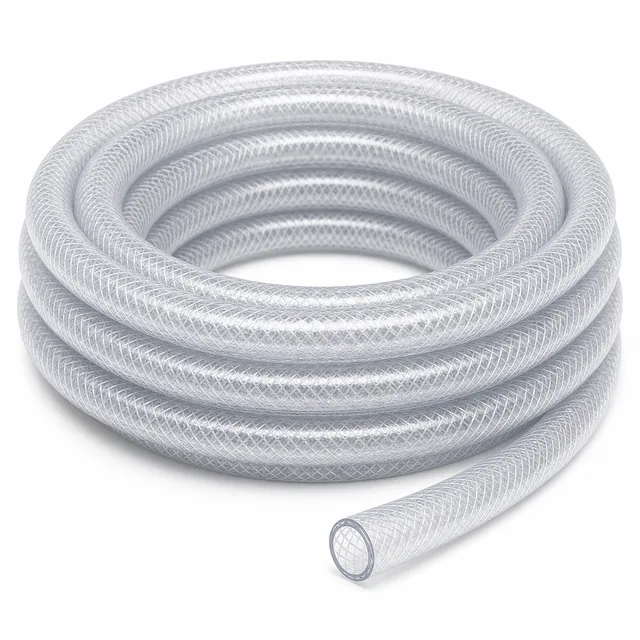
IMPORTANT: reference data — may differ from the physical product; verify with an advisor before buying.
SKU VT-142245 (transparent braided hose / Superflex) · 4 sibling references in transparent PVC · sold by roll or by meter depending on reference
1. Technical specifications
Two constructions, two ratings: not the same hose
"Transparent PVC hose" commercially groups two physically different constructions. The braided/smooth one carries a woven nylon textile reinforcement under the PVC wall and is intended for positive pressure. The steel-spiral reinforced one carries an electrogalvanized steel wire coiled inside the wall and is intended to keep the hose from collapsing under suction/vacuum. Their pressure figures are NOT averaged or merged: each construction has its own table, its own source and its own row in the comparison.
(a) Nylon-braided/smooth — no metal reinforcement
| Nominal [in] | ID [mm / in] | OD [mm / in] | Wall thickness [mm] | Working pressure (W/P) | Burst pressure (B/P) |
|---|---|---|---|---|---|
| 1/4″ | 6 mm (0.24″) | 11 mm (0.43″) | 2.5 | 200 psi (13.8 bar) | 600 psi (41.4 bar) |
| 5/16″ | 8 mm (0.31″) | 13 mm (0.51″) | 2.5 | 200 psi (13.8 bar) | 600 psi (41.4 bar) |
| 3/8″ | 10 mm (0.39″) | 14 mm (0.55″) | 2.0 | 200 psi (13.8 bar) | 600 psi (41.4 bar) |
| 1/2″ | 13 mm (0.51″) | 17 mm (0.67″) | 2.0 | 200 psi (13.8 bar) | 600 psi (41.4 bar) |
| 5/8″ | 16 mm (0.63″) | 22 mm (0.87″) | 3.0 | 200 psi (13.8 bar) | 600 psi (41.4 bar) |
| 3/4″ | 19 mm (0.75″) | 25 mm (0.98″) | 3.0 | 200 psi (13.8 bar) | 600 psi (41.4 bar) |
| 1″ | 25 mm (0.98″) | 32 mm (1.26″) | 3.5 | 200 psi (13.8 bar) | 600 psi (41.4 bar) |
| 1-1/4″ | 32 mm (1.26″) | 40 mm (1.57″) | 4.0 | 200 psi (13.8 bar) | 600 psi (41.4 bar) |
| 1-1/2″ | 38 mm (1.50″) | 47 mm (1.85″) | 4.5 | 200 psi (13.8 bar) | 600 psi (41.4 bar) |
| 2″ | 50 mm (1.97″) | 61 mm (2.40″) | 5.5 | 200 psi (13.8 bar) | 600 psi (41.4 bar) |
IMPORTANT
This technical data sheet is a reference guide to the properties of this product type; it is not a quality certificate for the product you are buying. The measurements, dimensions and physical or geometric characteristics of the product supplied may vary by manufacturer and production lot, and may even fall outside the cited standards. If any of these figures is critical to your design or build, verify it with one of our advisors against the physical product or the lot's mill certificate, so you can be fully certain of what you are buying. · Original data sheet: tectul.com/en/conduccion-de-fluidos/mangueras/ficha-tecnica-manguera-trenzada-transparente.html
Material: PVC with nylon braiding. Presentation: rolls of 50 and 100 m. No vacuum rating published by the manufacturer — the textile reinforcement is not designed to prevent collapse under suction. Source: manufacturer sheet "Transparent Braided Hose" (internal TECTUL file).
(b) Reinforced with electrogalvanized steel spiral
| Nominal [in] | Approx. OD [in / mm] | Maximum vacuum | Working pressure (W/P) | Burst pressure (B/P) | Weight [kg/m / lb/ft] |
|---|---|---|---|---|---|
| 1/2″ | 0.71″ (18.0 mm) | 29.8 in Hg | 100 psi (6.9 bar) | 300 psi (20.7 bar) | 0.19 (0.13) |
| 3/4″ | 1.06″ (26.9 mm) | 29.8 in Hg | 100 psi (6.9 bar) | 300 psi (20.7 bar) | 0.36 (0.24) |
| 1″ | 1.31″ (33.3 mm) | 29.8 in Hg | 75 psi (5.2 bar) | 225 psi (15.5 bar) | 0.51 (0.34) |
| 1-1/4″ | 1.61″ (40.9 mm) | 29.8 in Hg | 75 psi (5.2 bar) | 225 psi (15.5 bar) | 0.74 (0.50) |
| 1-1/2″ | 1.85″ (47.0 mm) | 29.8 in Hg | 50 psi (3.4 bar) | 150 psi (10.3 bar) | 0.82 (0.55) |
| 2″ | 2.36″ (59.9 mm) | 29.8 in Hg | 50 psi (3.4 bar) | 150 psi (10.3 bar) | 1.25 (0.84) |
IMPORTANT: reference data — may differ from the physical product; verify with an advisor before buying.
Material: flexible crystal PVC with spring-loaded spiral in electrogalvanized steel. Temperature: −26 °C to 60 °C (−14.8 °F to 140 °F). Catalog connection couplings: Cam-Lock and nipples (spigot). Presentation: rolls of 30, 50 and 100 m. The 29.8 in Hg vacuum equals ≈1.01 bar and is within 0.5% of the theoretical perfect vacuum at sea level (29.92 in Hg / 1.013 bar) — in practice, total suction. Source: manufacturer sheet "PVC Hose Reinforcement Wire" (internal TECTUL file).
Direct comparison at shared diameters (1/2″–2″) — figures not merged
| Nominal diameter | Construction | Working pressure | Burst pressure | Vacuum |
|---|---|---|---|---|
| 1/2″ to 2″ | (a) Braided/smooth, nylon | 200 psi (13.8 bar) | 600 psi (41.4 bar) | Not declared by manufacturer |
| 1/2″–3/4″ | (b) Reinforced, steel spiral | 100 psi (6.9 bar) | 300 psi (20.7 bar) | 29.8 in Hg |
| 1″–1-1/4″ | (b) Reinforced, steel spiral | 75 psi (5.2 bar) | 225 psi (15.5 bar) | 29.8 in Hg |
| 1-1/2″–2″ | (b) Reinforced, steel spiral | 50 psi (3.4 bar) | 150 psi (10.3 bar) | 29.8 in Hg |
IMPORTANT: reference data — may differ from the physical product; verify with an advisor before buying.
At the same diameters, the braided/smooth hose sustains MORE positive pressure than the steel-spiral reinforced one, and the reinforced one is the only one with a declared vacuum rating. This is the expected result of the design: circumferential textile reinforcement resists internal pressure; the metal spiral gives radial stiffness against suction collapse, not additional internal pressure. See section 2.
TECTUL catalog references and which construction each one matches
| Reference (slug) | Construction per its product page | Remark |
|---|---|---|
| manguera-superflex (SKU VT-142245) | (a) Braided/smooth, PVC + nylon | Main reference of this sheet; matches table (a) |
| manguera-pvc-refuerzo-alambre | (b) Reinforced, steel spiral | Matches table (b); its product page describes it for suction and visible conveyance |
| manguera-plastica-flexible-x-metro | Protective sheath/covering for gas pipe (does not convey pressurized fluid) | Its product page describes it as a polyethylene covering for gas pipe, not a pressurized hose; it does not share the ratings of (a) or (b) — this reference's exact material and thickness are confirmed on quotation |
| tectul-manguera-neumatica-transparente | Polyurethane (PU) pneumatic tubing, not PVC | Its product page declares polyurethane, not PVC; it shares the commercial "transparent air hose" family but its material and rating are not those of this sheet — confirmed on quotation |
General specifications
| Product | Crystal (transparent) PVC hose in two constructions: nylon-braided/smooth and electrogalvanized steel-spiral reinforced |
| Material | Flexible PVC; nylon textile reinforcement (construction a) or electrogalvanized steel spiral (construction b) |
| Dimensional range | 1/4″–2″ (braided/smooth) · 1/2″–2″ (reinforced) |
| Pressure | 200/600 psi W/P·B/P (braided/smooth, constant) · 50–100/150–300 psi W/P·B/P depending on diameter (reinforced) — not interchangeable with each other |
| Vacuum | 29.8 in Hg only in the steel-spiral reinforced construction; not declared in the braided/smooth one |
| Temperature | −26 °C to 60 °C (reinforced); not published by the manufacturer for the braided/smooth one — confirmed on quotation |
| Catalog couplings | Cam-Lock and nipples (spigot) for the reinforced construction; hose clamp for both constructions |
| Presentation | Rolls of 30, 50 and 100 m depending on reference and diameter |
2. Engineering criterion: positive pressure or vacuum, not both at once
The counterintuitive finding: the "reinforced" one is not the higher-pressure one
It is tempting to assume that adding a metal reinforcement always raises the pressure rating. In this family the opposite happens at equal diameter: the nylon-braided/smooth hose sustains 200 psi working and 600 psi burst, while the steel-spiral reinforced one sustains only 50–100 psi working and 150–300 psi burst depending on diameter. The reason lies in what each reinforcement is designed for.
Why nylon braiding gives more positive pressure
A circumferential textile braid (nylon) wraps the PVC wall in crossed fibers that work in tension when internal pressure pushes the wall outward. It is the same principle as a firefighting hose: continuous fiber, no discontinuities, resisting hoop stress. By design, this construction does not need its own radial stiffness because it is never asked to resist inward collapse.
Why the steel spiral gives vacuum, not pressure
The "spring-loaded spiral in electrogalvanized steel" is a metal wire coiled helically and embedded in the wall, not a continuous braid. Its function is to provide localized radial stiffness: when a vacuum pump or a suction system drops the internal pressure below atmospheric, an unreinforced PVC hose flattens like a straw. The spiral acts as a spring that keeps the circular section open under that external-internal pressure difference. That same wire, coiled rather than continuously braided, does not provide the same hoop-stress resistance against positive internal pressure — hence its lower pressure rating compared with the braided one.
- Starting data: the pump requires a hose that does not collapse at 25 in Hg of vacuum, in 3/4″.
- Construction (a), braided/smooth: publishes no vacuum rating. Without that figure, it cannot be specified for this service without risking collapse — ruled out until confirmed with the manufacturer.
- Construction (b), steel-spiral reinforced, 3/4″: declares 29.8 in Hg maximum vacuum, above the 25 in Hg required.
- Conclusion: construction (b) is specified. Its working pressure (100 psi / 6.9 bar) is more than sufficient for the discharge line of the same pump, so nothing is lost by choosing it.
Practical selection rule
- Shop compressed air, mains water pressure, pneumatic tools → construction (a) braided/smooth (200/600 psi).
- Lab suction, vacuum-pump transfer, siphoning, industrial liquid aspiration → construction (b) steel-spiral reinforced (declared 29.8 in Hg vacuum).
- Neither replaces a thick-wall industrial suction hose for abrasive solids — see the suction/discharge spiral hose sheet for that (FT-TC-MAN-PU-COBRE-001, among others).
3. PVC chemical compatibility and installation with Cam-Lock and nipple couplings
General chemical compatibility of plasticized PVC
Both constructions share the same base polymer: transparent plasticized PVC. The manufacturer sheets state "abrasion resistant" (construction a) and "excellent chemical resistance" and "resistant to common chemicals and adverse environmental conditions" (construction b), without publishing a reagent-by-reagent chemical compatibility chart. Plasticized PVC generally has good resistance to dilute acids and bases, alcohols and water; limited resistance to ketones, esters, and aromatic or chlorinated hydrocarbons, which can leach the plasticizer and harden or crack the wall over time. The industry reference method for verifying a plastic compound's chemical resistance against a specific reagent is ASTM D543-21 (immersion and stress testing). For a specific fluid or solvent not covered in the manufacturer sheets, confirmation on quotation is required before specifying the hose for that service.
Installing the reinforced construction with Cam-Lock and nipples
The construction (b) manufacturer sheet states the catalog couplings: Cam-Lock (cam-and-groove quick-disconnect coupling) and nipples (spigot, barbed fitting). For the spigot-type nipple:
- Cut the hose square; an angled cut leaves a leak point at the first barb crest.
- Push the hose fully onto the spigot, covering every visible barb crest of the fitting.
- Secure with a hose clamp positioned over the last barb crest, never over the smooth body of the nipple.
- For the Cam-Lock, verify the coupling's o-ring is intact before locking the cams: it is the o-ring, not the cam, that seals.
Installing the braided/smooth construction
No catalog couplings are declared by the manufacturer for this construction: use a threaded spigot or smooth nipple of matching diameter with a hose clamp, verifying that the hose's inner diameter (ID) matches the spigot's outer diameter without excessive play.
What NOT to do
Do not use the braided/smooth construction in vacuum/suction service: lacking radial reinforcement, it collapses. Do not use the reinforced construction expecting the same positive-pressure rating as the braided one: at equal diameter, its working pressure is lower. Do not connect either one to a fluid outside PVC's general chemical resistance without confirming compatibility.
4. Frequently asked questions
Does the steel-spiral reinforced hose withstand more pressure than the braided one?
No. At equal diameter, the nylon-braided/smooth hose withstands more positive pressure (200 psi working, 600 psi burst) than the steel-spiral reinforced one (50–100 psi working, 150–300 psi burst depending on diameter). The steel spiral is designed to keep the hose from collapsing under vacuum/suction, not to raise positive pressure. These are two constructions with two different functions.
Can I use the braided/smooth hose on a vacuum pump?
Not recommended: its manufacturer sheet declares no maximum vacuum, and lacking radial reinforcement (it only carries textile braiding, meant for hoop stress from internal pressure) it tends to collapse under suction. For vacuum, specify the steel-spiral reinforced construction, which declares 29.8 in Hg.
How close to a perfect vacuum are the declared 29.8 in Hg?
Very close: the theoretical perfect vacuum at sea level is 29.92 in Hg (1.013 bar). The declared 29.8 in Hg equals ≈1.01 bar, less than 0.5% below total vacuum — in practice, complete suction.
Are "flexible plastic hose by the meter" and "transparent pneumatic hose" the same hose as this sheet?
They share a commercial family but not the material or construction documented here. Per its own product page, "manguera-plastica-flexible-x-metro" is a polyethylene covering to protect gas pipe, not a pressurized hose; and "tectul-manguera-neumatica-transparente" is polyurethane (PU) tubing, not PVC. Their exact specifications are not in this sheet and are confirmed on quotation.
What couplings does the steel-spiral reinforced construction use?
Cam-Lock (cam-and-groove quick-disconnect coupling) and spigot-type nipples, per the manufacturer sheet. The braided/smooth one declares no catalog couplings; it is installed with a smooth nipple and a hose clamp, verifying diameter.
Is either one suitable for solvents or aggressive chemicals?
Only in general terms: both are plasticized PVC with "chemical resistance" declared generically, without a reagent-by-reagent compatibility chart. Ketones, esters and aromatic or chlorinated hydrocarbons can degrade plasticized PVC over time. For a specific fluid, verify compatibility before specifying — the industry reference method is ASTM D543-21.
5. Application notes
Feasibility
Specify the braided/smooth one for positive pressure (water, shop compressed air) up to 200 psi/13.8 bar working, and the steel-spiral reinforced one for suction, vacuum or pump transfer up to 29.8 in Hg. Do not interchange them: at equal diameter, the reinforced one allows less positive pressure than the braided one. Neither replaces a thick-wall industrial hose for abrasive solids.
Installation
Always cut square. On the reinforced one, use a Cam-Lock or spigot-type nipple with the clamp over the last barb crest; verify the Cam-Lock's o-ring before locking the cams. On the braided/smooth one, use a smooth nipple of matching diameter with a hose clamp. Do not force the reinforced hose below its practical minimum bend radius: the spiral can deform and lose its anti-collapse function.
Design
Do not treat these two constructions as one hose with two presentations: they have different pressure and vacuum ratings, and only the reinforced one declares vacuum. For the braided/smooth hose's service temperature, the manufacturer sheet publishes no figure — confirm it before specifying in a hot environment. For the references "manguera-plastica-flexible-x-metro" (pipe covering) and "tectul-manguera-neumatica-transparente" (PU tubing), do not assume this sheet's ratings: verify material and pressure with the actual supplier before specifying.
6. Technical notice and limitation of liability
The pressure, vacuum and temperature ratings in this sheet come from the manufacturer data sheets (internal TECTUL file) for each construction and are not a certificate of conformance for any lot. The two documented constructions (nylon-braided/smooth and steel-spiral reinforced) have different pressure and vacuum ratings and must not be confused with each other or with the commercial references "manguera-plastica-flexible-x-metro" (gas pipe covering) or "tectul-manguera-neumatica-transparente" (polyurethane tubing), whose material and specifications are not covered by this sheet's tables.
Final selection of construction, diameter, coupling and chemical compatibility for a specific fluid or service is the responsibility of the system designer, verifying with the actual supplier the data marked "confirmed on quotation".
Sources
- Ficha técnica de fabricante (archivo interno TECTUL): «Manguera Trenzada Transparente / Transparent Braided Hose» — PVC con trenzado de nylon, tabla dimensional 1/4″–2″, W/P 200 psi, B/P 600 psi
- Ficha técnica de fabricante (archivo interno TECTUL): «Manguera PVC Refuerzo Alambre / PVC Hose Reinforcement Wire» — PVC cristal con espiral de acero electrogalvanizado, tabla dimensional 1/2″–2″, vacío 29,8 in Hg, W/P 50–100 psi, B/P 150–300 psi, temperatura −26 °C a 60 °C
- ASTM D543-21 — Standard Practices for Evaluating the Resistance of Plastics to Chemical Reagents (método de referencia industrial para compatibilidad química de compuestos plásticos, citado en la sección 3)
- Página de producto TECTUL «manguera-plastica-flexible-x-metro» (dist/conduccion-de-fluidos/mangueras/manguera-plastica-flexible-x-metro.html): describe la referencia como recubrimiento de polietileno para tubería de gas, no como manguera presurizada
- Página de producto TECTUL «tectul-manguera-neumatica-transparente» (dist/conduccion-de-fluidos/mangueras/tectul-manguera-neumatica-transparente.html): describe la referencia como tubing neumático de poliuretano (PU)
- Constante física: vacío perfecto teórico a nivel del mar = 29,92 in Hg = 1,013 bar (referencia estándar de presión atmosférica, NIST)
This data sheet is the property of TECTUL, part of the Industrias IMR group. Reproduction without attribution is prohibited. Original document and updates: tectul.com/en/conduccion-de-fluidos/mangueras/ficha-tecnica-manguera-trenzada-transparente.