
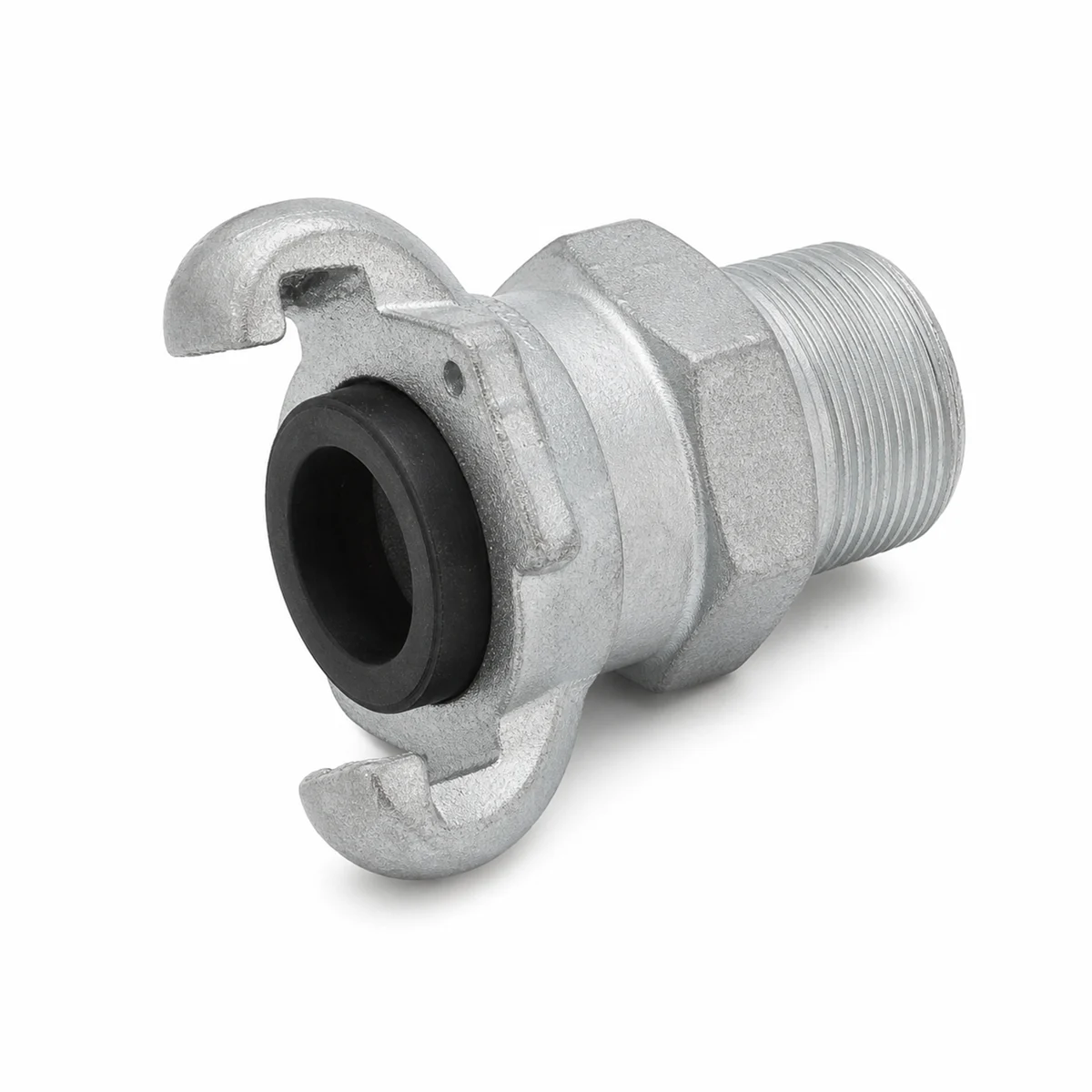
Universal two-lug Chicago claw coupling — male NPT, female NPT and hose shank
TECTUL · Dispatch across Colombia · Exports to Central & South America
The "Chicago" claw coupling is a quarter-turn quick-connect system with two lugs (2-lug), an industry standard in compressed air: any Chicago coupling from 1/2″ to 1″ mates with any other in that range, regardless of the hose diameter or thread on the opposite end — that universality is its defining trait. The TECTUL catalog offers it with male NPT thread, female NPT thread and a hose shank. Rated for 150 psi at ambient temperature; not suitable for steam. Includes a safety clip to prevent accidental disconnection.
Important: Before using these data in engineering, design or installation decisions on systems exposed to mechanical, pressure, rupture, fatigue, impact or water-hammer risk, it is essential to read the technical notice and limitation of liability at the end of this sheet.
Male NPT (VT-86877), female NPT (VT-86876) and hose shank (VT-86878) · 1/2″–1″ heads · sold by the unit
1. Technical specifications
| Product | Chicago-style claw coupling, two rotating lugs, with male NPT, female NPT or hose shank end |
| Mechanism | Press the two ends together and turn a quarter turn to lock; additional safety clip against accidental disconnection |
| Interchangeability | Any Chicago coupling with a 1/2″ to 1″ head connects to any other in that range, regardless of the opposite end's thread or hose diameter — a de facto industry standard, not a numbered ASME/ISO standard |
| Thread | NPT per ASME B1.20.1 (male and female references) |
| Pressure rating | 150 psi (10.3 bar) maximum at ambient temperature, per industry catalogs — not suitable for steam |
| Head range | 1/2″ to 1″ interchangeable |
| Sale | By the unit, per end type (male, female or shank) |
Exact dimensions of each reference (length, claw diameter, weight) not published in a dedicated manufacturer sheet; confirmed on quotation.
2. Frequently asked questions
Does a 1/2″ male Chicago connect to a 3/4″ female Chicago?
Yes, that is the system's defining feature: the claw head is universal up to 1″ regardless of the opposite end's thread or hose diameter.
Is it suitable for steam?
No. The 150 psi rating is for air, water and non-aggressive fluids at ambient temperature; it is not designed for steam service.
What is the safety clip?
An additional lock that prevents the lugs from opening due to vibration or an accidental hose pull; verify it is correctly installed after every connection.
3. Application notes
Feasibility
Suitable for compressed air, pneumatic tools and water lines up to 150 psi at ambient temperature. Do not specify for steam or pressures above 150 psi.
Installation
Press the two ends together and turn a quarter turn until the lugs lock; verify the safety clip is correctly seated. Seal the NPT thread with PTFE tape or a compatible sealant before installing the threaded end.
Design
Do not exceed 150 psi or specify for steam. Confirm exact dimensions and safety clip compatibility with the supplier before detailing installation drawings.
4. Technical notice and limitation of liability
The pressures, dimensions, weights and other characteristics in this sheet are theoretical calculation values obtained from nominal properties published in the standards cited (ASME B36.10-2022, ASME B31.3-2024, ASTM A106/A106M-19a, ASTM A53/A53M-24, API Spec 5L 46th ed.). They guide selection; they are not a certificate of conformity for any given lot.
The actual behavior of each lot varies with manufacturing — wall tolerance (up to −12.5%), out-of-roundness, residual stresses — and with the raw material — chemical composition within the ranges the standard allows, heat-to-heat differences. To certify a lot, the tests defined by its product standard are required: tensile test, flattening test and hydrostatic test, documented in the manufacturer's mill test certificate (MTC), which TECTUL supplies upon request; testing of the lot in an independent laboratory can also be arranged.
These values must not be used as the sole criterion in critical or safety applications, or wherever failure of the line may compromise people, property or the environment: in such cases the design belongs to the project's responsible engineer under the applicable code (ASME B31.3, B31.1 or the one governing the installation), with the design temperature, corrosion allowance and load cases of the actual service. Before deciding with these data, consult our technical team.
Sources
- ASME B1.20.1-2013 (R2018) — Pipe Threads, General Purpose, Inch (rosca NPT)
- Chicago Coupling Co. — especificaciones de acoples de uña tipo Chicago de 2 garras (chicagocoupling.com, consultado ago. 2026): interacoplabilidad universal hasta 1″, 150 psi máx. a temperatura ambiente, no apto para vapor, clip de seguridad
- Página de producto TECTUL "Acople Chicago Macho" (SKU VT-86877, previews/conduccion-de-fluidos/racores-y-acoples/acople-una-chicago-macho.html): 150 psi, rosca NPT ASME B1.20.1, cabezas 1/2″–1″
This data sheet is the property of TECTUL, part of the Industrias IMR group. Reproduction without attribution is prohibited. Original document and updates: tectul.com/en/conduccion-de-fluidos/racores-y-acoples/ficha-tecnica-acople-una-chicago-macho.