
Bronze reducing bushing, male outer / female inner NPT thread — class 125 (B110)
TECTUL · Dispatch across Colombia · Exports to Central & South America
Reducing bushing in brass bronze: male NPT thread on the outside (screws into a larger female port) and female NPT thread on the inside (receives a smaller pipe or fitting), in one compact component. It is the most economical alternative to replacing an entire tee or elbow with a reduced version when only one port needs a smaller diameter. The catalog covers 6 combinations between 1/4″ and 1/2″.
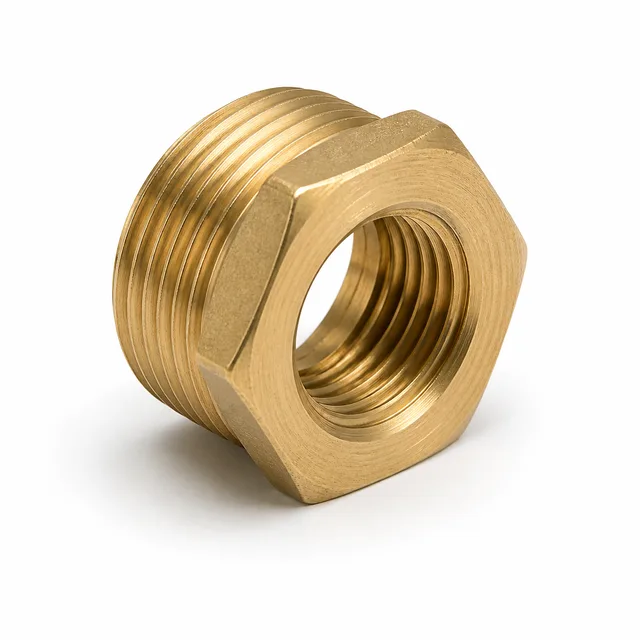
IMPORTANT: reference data — may differ from the physical product; verify with an advisor before buying.
SKU VT-59156 (B110 bronze bushing) · 6 combinations 1/4″x1/8″ to 1/2″x3/8″ · sold by the unit
1. Technical specifications
Dimensions by combination
| Size (male x female) | A [mm] | Wrench B [in] | C (length) [mm] | Weight [g] |
|---|---|---|---|---|
| 1/4″ x 1/8″ | 4.5 | 9/16″ | 17.0 | 9 |
| 3/8″ x 1/8″ | 5.0 | 11/16″ | 17.0 | 22 |
| 3/8″ x 1/4″ | 5.5 | 11/16″ | 17.0 | 15 |
| 1/2″ x 1/8″ | 7.5 | 7/8″ | 22.0 | 55 |
| 1/2″ x 1/4″ | 7.5 | 7/8″ | 22.0 | 44 |
| 1/2″ x 3/8″ | 7.5 | 7/8″ | 22.0 | 38 |
IMPORTANT
This technical data sheet is a reference guide to the properties of this product type; it is not a quality certificate for the product you are buying. The measurements, dimensions and physical or geometric characteristics of the product supplied may vary by manufacturer, heat and lot, and may even fall outside the cited standards. If any of these figures is critical to your design or build, verify it with one of our advisors against the physical product or the lot's mill certificate, so you can be fully certain of what you are buying. · Original data sheet: tectul.com/en/conduccion-de-fluidos/racores-y-acoples/ficha-tecnica-b110-buje-bronce.html
Complete, verified table from the bronze reducing bushings manufacturer sheet (March 2022 revision). The source document internally labels this part "B116 - Bushing", a code that collides with the current catalog's B116 (90° street elbow, see FT-TC-RAC-CODOCALLE-BRONCE-001 sheet); this sheet publishes the dimensional table under the real catalog code, B110.
General specifications
| Product | Bronze reducing bushing: outer male NPT thread, inner female NPT thread |
| Material | Cast brass bronze |
| Thread | NPT per ANSI/ASME B1.20.1, both faces |
| Pressure rating | Class 125 (ASME B16.15): 200 psi (13.8 bar) ≤66 °C with water/oil/non-flammable gas · 125 psi saturated steam |
| Commercial range | 6 combinations between 1/4″ and 1/2″ |
| Applicable standards | ASME B16.15 · ANSI/ASME B1.20.1 |
2. Frequently asked questions
How do I read the "1/2″ x 1/4″" size?
The first number (1/2″) is the outer male thread, the one that screws into the existing larger port. The second number (1/4″) is the inner female thread, which receives the smaller pipe or fitting.
Can I stack two bushings to reduce two sizes at once?
Not recommended: each additional threaded joint is a potential leak point and the intermediate bushing is left without lateral support. Use the direct combination from the starting size to the final one if it exists in the catalog.
Why does the sheet flag a "B116" code different from B110?
The manufacturer's source document internally labels this part B116, a code that in the current catalog belongs to the 90° street elbow. This sheet uses the real catalog code (B110) and notes the discrepancy so as not to propagate the error.
3. Application notes
Feasibility
Suitable for reducing an existing port's diameter in water, compressed air and low-pressure oil, without replacing the whole fitting. Do not stack more than one bushing on the same joint.
Installation
Seal both threads with PTFE tape or a fluid-compatible sealant. Tighten the outer thread holding the wrench hex (B in the table); tighten the inner pipe/fitting holding the bushing by the same hex, never by the already-installed port.
Design
Rating valid cold (≤66 °C); for steam, 125 psi. Verify the diameter reduction does not create excessive flow velocity at the smaller port for the design flow rate.
4. Technical notice and limitation of liability
The pressures, dimensions, weights and other characteristics in this sheet are theoretical calculation values obtained from nominal properties published in the standards cited (ASME B36.10-2022, ASME B31.3-2024, ASTM A106/A106M-19a, ASTM A53/A53M-24, API Spec 5L 46th ed.). They guide selection; they are not a certificate of conformity for any given lot.
The actual behavior of each lot varies with manufacturing — wall tolerance (up to −12.5%), out-of-roundness, residual stresses — and with the raw material — chemical composition within the ranges the standard allows, heat-to-heat differences. To certify a lot, the tests defined by its product standard are required: tensile test, flattening test and hydrostatic test, documented in the manufacturer's mill test certificate (MTC), which TECTUL supplies upon request; testing of the lot in an independent laboratory can also be arranged.
These values must not be used as the sole criterion in critical or safety applications, or wherever failure of the line may compromise people, property or the environment: in such cases the design belongs to the project's responsible engineer under the applicable code (ASME B31.3, B31.1 or the one governing the installation), with the design temperature, corrosion allowance and load cases of the actual service. Before deciding with these data, consult our technical team.
Sources
- ASME B16.15-2020 — Cast Bronze Threaded Fittings: Classes 125 and 250
- ANSI/ASME B1.20.1-2013 (R2018) — Pipe Threads, General Purpose, Inch (rosca NPT)
- Ficha de fabricante "B116 - Buje/Bushing" (catálogo de accesorios roscados de bronce, IMR/TECTUL, revisión marzo 2022; código interno del documento en conflicto con el B116 = codo calle del catálogo vigente): tabla completa A, B, C y peso para las 6 combinaciones 1/4″x1/8″–1/2″x3/8″
This data sheet is the property of TECTUL, part of the Industrias IMR group. Reproduction without attribution is prohibited. Original document and updates: tectul.com/en/conduccion-de-fluidos/racores-y-acoples/ficha-tecnica-b110-buje-bronce.