
Bronze street elbows, male-female NPT thread — 90° (B116) and 45° (B124)
TECTUL · Dispatch across Colombia · Exports to Central & South America
"Street" elbows in brass bronze: one end with male NPT thread and the other with female NPT thread, allowing them to be screwed directly into another fitting (tee, union, valve) without an intermediate nipple — saving one threaded joint and installation space compared to a conventional female-female elbow. The catalog groups the 90° angle (reference B116) and the 45° angle (B124); both share material, thread standard and pressure rating, differing only in angle and in the dimensions specific to each geometry.
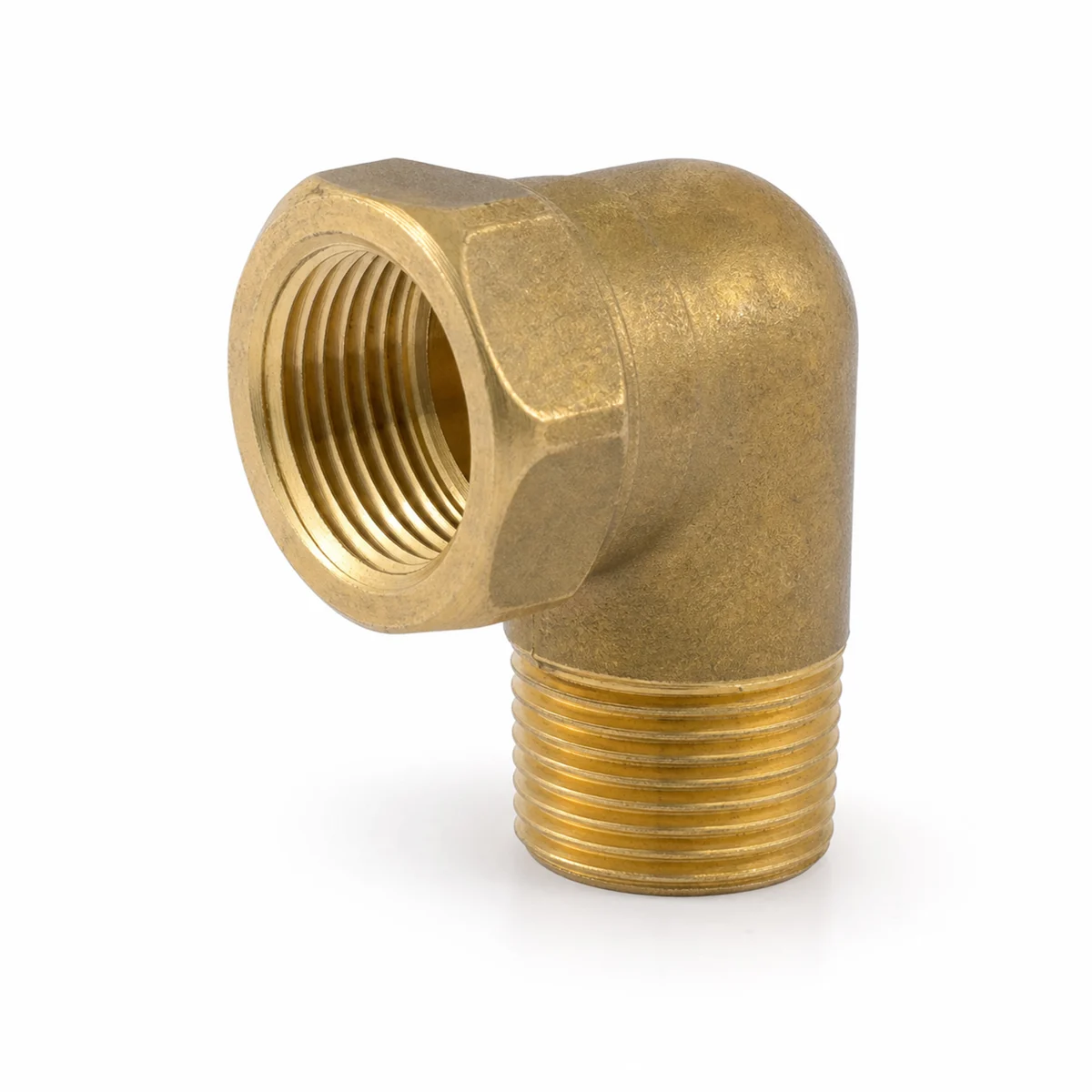
IMPORTANT: reference data — may differ from the physical product; verify with an advisor before buying.
B116 (90°) and B124 (45°) · 1/8″–3/8″ range with dimensional sheet; TECTUL catalog up to 1/2″ · sold by the unit
1. Technical specifications
B116 — 90° street elbow, dimensions
| NPT size | D1 (female thread Ø) [mm] | D2 [mm] | A [mm] | B [mm] | L [mm] | Weight [g] |
|---|---|---|---|---|---|---|
| 1/8″ | 14.5 | Confirmed on quotation | 18 | |||
| 1/4″ | 17.5 | 10.5 | 10.5 | 11.0 | 18.5 | 29 |
| 3/8″ | 20.0 | Confirmed on quotation | 50 | |||
| 1/2″ (TECTUL catalog) | No manufacturer dimensional sheet — confirmed on quotation | — | ||||
IMPORTANT
This technical data sheet is a reference guide to the properties of this product type; it is not a quality certificate for the product you are buying. The measurements, dimensions and physical or geometric characteristics of the product supplied may vary by manufacturer, heat and lot, and may even fall outside the cited standards. If any of these figures is critical to your design or build, verify it with one of our advisors against the physical product or the lot's mill certificate, so you can be fully certain of what you are buying. · Original data sheet: tectul.com/en/conduccion-de-fluidos/racores-y-acoples/ficha-tecnica-b116-90-codo-calle-bronce.html
B124 — 45° street elbow, dimensions
| NPT size | A [mm] | L [mm] | Weight [g] |
|---|---|---|---|
| 1/8″ | Confirmed on quotation | 18 | |
| 1/4″ | 15.0 | 24.0 | 42 |
| 3/8″ | Confirmed on quotation | 43 | |
IMPORTANT: reference data — may differ from the physical product; verify with an advisor before buying.
"Confirmed on quotation" cells correspond to values the manufacturer's source table does not print unambiguously for those sizes (March 2022 revision); only unambiguously legible values are published.
General specifications
| Product | Bronze street elbows: male NPT thread on one end, female NPT on the other, at 90° (B116) or 45° (B124) |
| Material | Cast brass bronze |
| Thread | NPT per ANSI/ASME B1.20.1 |
| Pressure rating | Class 125 (ASME B16.15): 200 psi (13.8 bar) ≤66 °C with water/oil/non-flammable gas · 125 psi saturated steam |
| Commercial range | 1/8″–3/8″ with manufacturer dimensional sheet; TECTUL catalog up to 1/2″ |
| Applicable standards | ASME B16.15 · ANSI/ASME B1.20.1 |
2. Engineering calculations: when a street elbow saves a joint
- With a female-female elbow (B100): to change direction coming out of a tee or valve with female thread, you need a nipple plus the B100 elbow (two threaded joints, two potential leak points).
- With a street elbow (B116/B124): the elbow's male end threads directly into the tee's or valve's female outlet. One threaded joint, one fewer leak point, and 15 to 20 mm less installed length depending on size (comparing L from the table above against L plus an equivalent nipple length).
- Practical conclusion: the street elbow is preferred in compact assemblies (pneumatic panels, manifolds, headers) where space and joint count matter; the female-female elbow is preferred when both ends must accept pipe (neither threads directly into another fitting).
3. Frequently asked questions
What is the difference between the B116 and the B124?
The angle: B116 is 90° and B124 is 45°. Both are "street" elbows (male-female NPT), same material and pressure rating; they are documented together in this sheet because they are the same construction family.
Does the male end of a street elbow connect directly to a hose?
No. The male end is tapered NPT thread, meant to screw into a fitting or valve with female thread — it is not a hose barb. For hose connections use the bronze hose-barb family (B2/B3 series).
Why do several sizes say "confirmed on quotation"?
Because the available manufacturer sheet does not print those cells legibly for every size; only unambiguously readable values are published here, per the policy of never inventing technical data.
4. Application notes
Feasibility
Suitable for water, compressed air and low-pressure oil where installation space is limited or reducing the number of threaded joints is a priority. Do not use when both ends of the direction change must accept pipe or hose, where a female-female elbow or a hose-barb elbow is the correct choice.
Installation
Seal the male end with PTFE tape or a fluid-compatible sealant before threading it into the female fitting. Tighten by holding the body's hex, never the already-installed end. Verify that the fitting it threads into has a compatible female NPT thread in diameter and pitch.
Design
Rating valid only cold (≤66 °C) for water/oil/non-flammable gas; for steam, 125 psi. For sizes marked "confirmed on quotation", do not assume linear proportionality with the adjacent size: request the exact dimension from the supplier before detailing tight installation drawings.
5. Technical notice and limitation of liability
The pressures, dimensions, weights and other characteristics in this sheet are theoretical calculation values obtained from nominal properties published in the standards cited (ASME B36.10-2022, ASME B31.3-2024, ASTM A106/A106M-19a, ASTM A53/A53M-24, API Spec 5L 46th ed.). They guide selection; they are not a certificate of conformity for any given lot.
The actual behavior of each lot varies with manufacturing — wall tolerance (up to −12.5%), out-of-roundness, residual stresses — and with the raw material — chemical composition within the ranges the standard allows, heat-to-heat differences. To certify a lot, the tests defined by its product standard are required: tensile test, flattening test and hydrostatic test, documented in the manufacturer's mill test certificate (MTC), which TECTUL supplies upon request; testing of the lot in an independent laboratory can also be arranged.
These values must not be used as the sole criterion in critical or safety applications, or wherever failure of the line may compromise people, property or the environment: in such cases the design belongs to the project's responsible engineer under the applicable code (ASME B31.3, B31.1 or the one governing the installation), with the design temperature, corrosion allowance and load cases of the actual service. Before deciding with these data, consult our technical team.
Sources
- ASME B16.15-2020 — Cast Bronze Threaded Fittings: Classes 125 and 250
- ANSI/ASME B1.20.1-2013 (R2018) — Pipe Threads, General Purpose, Inch (rosca NPT)
- Ficha de fabricante "B116 - Codo 90° Rosca Macho-Hembra" (catálogo de accesorios roscados de bronce, IMR/TECTUL, revisión marzo 2022): D1, D2, A, B, L y peso para 1/4″; D1 y peso para 1/8″ y 3/8″
- Ficha de fabricante "B124 - Codo 45° Rosca Macho-Hembra" (mismo catálogo, revisión marzo 2022): A, L y peso para 1/4″; peso para 1/8″ y 3/8″
This data sheet is the property of TECTUL, part of the Industrias IMR group. Reproduction without attribution is prohibited. Original document and updates: tectul.com/en/conduccion-de-fluidos/racores-y-acoples/ficha-tecnica-b116-90-codo-calle-bronce.