
Pressure-washer nozzles — 0°, 15°, 25°, 40°, fan and threaded stainless
TECTUL · Dispatch across Colombia · Exports to Central & South America
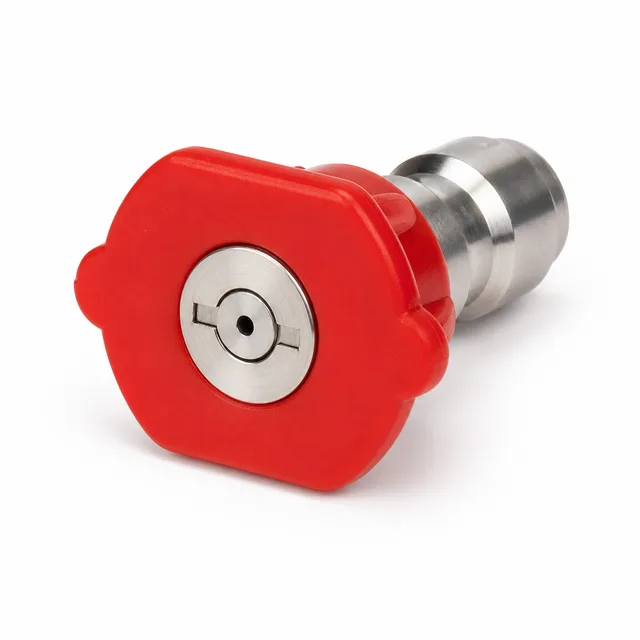
Family of pressure-washer nozzles classified by the fan angle of water they produce: 0° concentrates all the pressure into a pencil jet for heavily embedded dirt or hard surfaces (most aggressive use, higher risk of surface damage); 15° for embedded dirt with a narrow fan; 25° for general washing; 40° for rinsing and delicate surfaces with a wide fan. The bronze "fan" version produces a specific flat pattern for spraying or applications requiring uniform coverage. The threaded stainless version is fixed by thread instead of the typical quick-connect used on the others.
Important: Before using these data in engineering, design or installation decisions on systems exposed to mechanical, pressure, rupture, fatigue, impact or water-hammer risk, it is essential to read the technical notice and limitation of liability at the end of this sheet.
0° (VT-86883) · 15° (VT-222020) · 25° (VT-86882) · 40° (VT-86880) · bronze fan (VT-86884) · threaded stainless (VT-86885) · sold by the unit
1. Technical specifications
| 0° (VT-86883) | Pencil jet, no fan; maximum impact pressure concentration — use with caution, can damage soft surfaces |
| 15° (VT-222020) | Narrow fan, for embedded dirt |
| 25° (VT-86882) | Intermediate fan, general washing use |
| 40° (VT-86880) | Wide fan, for rinsing and delicate surfaces |
| Bronze fan (VT-86884) | Specific flat pattern for spraying or uniform coverage, distinct from the conical jet of the others |
| Threaded stainless (VT-86885) | Thread mounting instead of quick-connect trigger; angle not specified in the available product sheet |
| Mounting (0°–40° and fan) | Standard pressure-washer quick-connect trigger mount (verify exact lance compatibility) |
| Dimensions and flow (GPM/L·min) | Confirmed on quotation — no manufacturer dimensional or flow sheet available |
Degree coding (0°, 15°, 25°, 40°) is a standard pressure-washing industry convention for the water fan's angle; it does not imply a fixed flow rate or operating pressure, which depend on each nozzle's internal orifice and the pressure washer's pump.
2. Frequently asked questions
Which nozzle do I use to wash a car without damaging the paint?
Prefer 25° or 40°; the 0° concentrates too much pressure on one spot and can damage paint or soft surfaces at close range.
Do they all fit any pressure-washer lance?
The 0°–40° and fan versions use the sector's standard quick-connect trigger mount, but verify exact compatibility with your equipment before purchasing; the threaded stainless version uses thread, not a quick connect.
Does the degree number indicate the flow rate?
Not directly; it indicates the fan angle. Actual flow depends on the nozzle's internal orifice and the pressure/flow your pressure washer's pump delivers.
3. Application notes
Feasibility
Suitable for washing, rinsing and dirt removal with a domestic or industrial pressure washer, depending on the chosen angle. Do not use 0° on delicate surfaces or at close range without prior experience.
Installation
Verify quick-connect or thread compatibility with your lance before purchasing. Insert until locked (quick connect) or seal the thread with PTFE tape (threaded version).
Design
Confirm each nozzle's flow rate and maximum allowable pressure with the supplier before using with high-pressure equipment. Always start with the widest available angle and narrow it only if necessary.
4. Technical notice and limitation of liability
The pressures, dimensions, weights and other characteristics in this sheet are theoretical calculation values obtained from nominal properties published in the standards cited (ASME B36.10-2022, ASME B31.3-2024, ASTM A106/A106M-19a, ASTM A53/A53M-24, API Spec 5L 46th ed.). They guide selection; they are not a certificate of conformity for any given lot.
The actual behavior of each lot varies with manufacturing — wall tolerance (up to −12.5%), out-of-roundness, residual stresses — and with the raw material — chemical composition within the ranges the standard allows, heat-to-heat differences. To certify a lot, the tests defined by its product standard are required: tensile test, flattening test and hydrostatic test, documented in the manufacturer's mill test certificate (MTC), which TECTUL supplies upon request; testing of the lot in an independent laboratory can also be arranged.
These values must not be used as the sole criterion in critical or safety applications, or wherever failure of the line may compromise people, property or the environment: in such cases the design belongs to the project's responsible engineer under the applicable code (ASME B31.3, B31.1 or the one governing the installation), with the design temperature, corrosion allowance and load cases of the actual service. Before deciding with these data, consult our technical team.
Sources
- Páginas de producto TECTUL "Boquilla Hidrolavadora 0°" (VT-86883), "15°" (VT-222020), "25°" (VT-86882), "40°" (VT-86880), "Boquilla Abanico Bronce" (VT-86884) e "Inoxidable Roscada" (VT-86885), previews/conduccion-de-fluidos/racores-y-acoples/: clasificación por ángulo y uso recomendado
This data sheet is the property of TECTUL, part of the Industrias IMR group. Reproduction without attribution is prohibited. Original document and updates: tectul.com/en/conduccion-de-fluidos/racores-y-acoples/ficha-tecnica-boquilla-hidrolavadora-0g.