
Aluminum camlock couplings — parts A, B, C, D, E, F, universal and dust cap
TECTUL · Dispatch across Colombia · Exports to Central & South America
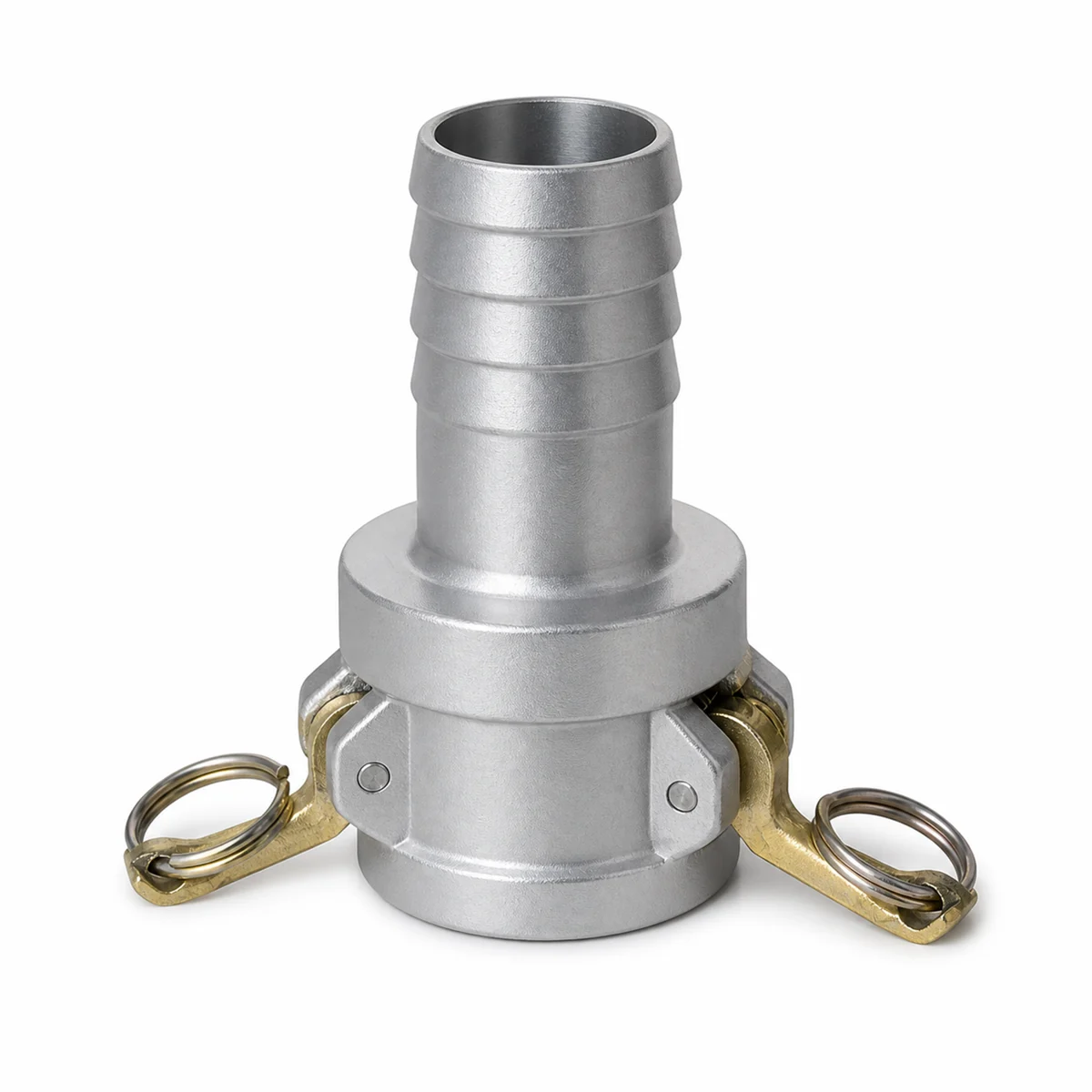
Camlock is a two-lug quick-connect coupling system that connects and disconnects tool-free in seconds, standardized under US federal standard A-A-59326D (which replaced the older MIL-C-27487 in 1998) to guarantee interchangeability between manufacturers. The system is identified by a part letter based on its end configuration: Part A (male camlock adapter x female thread), Part B (female camlock coupler x male thread), Part C (female camlock coupler x hose shank), Part D (female camlock coupler x female thread), Part E (male camlock adapter x hose shank), Part F (male camlock adapter x male thread), plus the "universal" piece (male camlock on both sides, joins two female couplers) and the dust cap (female protector with lugs to close off a male adapter). In aluminum, the TECTUL catalog covers all six parts, their reduced versions (A, C, D and F), the C x F, and the universal.
IMPORTANT: reference data — may differ from the physical product; verify with an advisor before buying.
Parts A–F, reduced, C x F, universal and dust cap in aluminum · sold by the unit
1. Technical specifications
Camlock system part identification
| Part | Configuration | Typical function |
|---|---|---|
| A | Male camlock adapter x female thread | Connect a hose with a D coupler to piping with male thread |
| B | Female camlock coupler (with lugs) x male thread | Connect to a tank or piping with female thread |
| C | Female camlock coupler (with lugs) x hose shank | Terminate a hose in a female lugged end |
| D | Female camlock coupler (with lugs) x female thread | Connect to male-threaded piping via an A adapter |
| E | Male camlock adapter x hose shank | Terminate a hose in a male end |
| F | Male camlock adapter x male thread | Connect to a female coupler with female thread or a tank |
| C x F | Reducer: one end C (shank), the other F (male, different diameter) | Go from hose to male thread while changing diameter in one part |
| Universal | Male camlock on both ends (same function as two opposing F/A males) | Join two female couplers (parts B, C or D) together |
| Dust cap (DC) | Female protector with lugs, no flow path | Close a male adapter (A, E or F) when not in use |
Working pressure rating
| Diameter | Aluminum |
|---|---|
| 1/2″ (15 mm) | 150 psi |
| 3/4″–2″ (20–50 mm) | 250 psi |
| 2-1/2″ and larger (65 mm+) | 75–150 psi |
IMPORTANT
This technical data sheet is a reference guide to the properties of this product type; it is not a quality certificate for the product you are buying. The measurements, dimensions and physical or geometric characteristics of the product supplied may vary by manufacturer, heat and lot, and may even fall outside the cited standards. If any of these figures is critical to your design or build, verify it with one of our advisors against the physical product or the lot's mill certificate, so you can be fully certain of what you are buying. · Original data sheet: tectul.com/en/conduccion-de-fluidos/racores-y-acoples/ficha-tecnica-parte-c-aluminio.html
Reference ratings from industry catalogs (not a single manufacturer); the exact rating of each lot is confirmed on quotation with the supplier. Exact dimensions (length, width, weight) per part and diameter: not published in a dedicated manufacturer sheet — confirmed on quotation.
| Product | Two-lug quick-connect coupling system, interchangeable across parts A–F by end configuration |
| Material | Aluminum alloy |
| Mechanism | Two rotating lugs that lock over the opposite end's groove; tool-free connect and disconnect |
| Commercial range | 1/2″ to 4″ typical in the industry (confirm the exact available range per part with the supplier) |
| Standard | A-A-59326D (US Federal), successor to MIL-C-27487 |
2. Frequently asked questions
Does an aluminum camlock from one brand connect with another brand's?
Yes, that is precisely the point of the A-A-59326D standard (formerly MIL-C-27487): it standardizes critical connection dimensions so parts are interchangeable between manufacturers declaring conformance to the standard.
Which part do I need to connect a hose to a tank with a male-threaded spout?
It depends on whether you prefer to terminate the hose in camlock (use Part C on the hose end and Part B on the tank) or leave the hose with a direct barb (use Part A or E depending on the application). Check the exact combination for your case with the supplier.
Is "universal" a different letter from A through F?
It is not a letter of the standard: it is a practical male-male piece (functionally equivalent to facing two F or A males) to join two female couplers without an intermediate pipe.
Are "Threaded Aluminum Camlock Male" and "Threaded Aluminum Camlock Female" the same as Parts A–F?
Yes. Their product sheets confirm they are parts of the same A-A-59326D camlock system (the commercial name simply omits the part letter); they are grouped in this same sheet because they are the same type+material, not a separate threaded family.
Can I use aluminum camlock with aggressive chemicals?
Not without verifying compatibility: aluminum is suitable for water, fuels and many neutral liquids, but corrodes with acids and some bases. For aggressive chemical service the stainless version is specified (see the FT-TC-RAC-CAMLOCK-INOXIDABLE-001 sheet) or another material.
3. Application notes
Feasibility
Aluminum is the lightweight, economical option in the camlock system, suitable for water, fuels, air and many neutral low-to-medium pressure liquids (up to 250 psi depending on diameter). It is not specified for fluids that corrode aluminum (acids, some bases, prolonged seawater exposure) nor for sanitary/pharmaceutical service requiring polished stainless steel.
Installation
Insert the male end into the female one fully and close both lugs of the female coupler until they lock; no tool is required. Verify the female coupler's internal gasket is present and intact before connecting: without a gasket, the system does not seal even though it is locked. To disconnect, lift both lugs simultaneously.
Design
Confirm the exact lot pressure rating and per-diameter dimensions with the supplier before specifying on a critical line. Verify the aluminum's chemical compatibility with the service fluid. In outdoor or marine installations, consider the stainless version to avoid galvanic corrosion if combined with other metals.
4. Technical notice and limitation of liability
The pressures, dimensions, weights and other characteristics in this sheet are theoretical calculation values obtained from nominal properties published in the standards cited (ASME B36.10-2022, ASME B31.3-2024, ASTM A106/A106M-19a, ASTM A53/A53M-24, API Spec 5L 46th ed.). They guide selection; they are not a certificate of conformity for any given lot.
The actual behavior of each lot varies with manufacturing — wall tolerance (up to −12.5%), out-of-roundness, residual stresses — and with the raw material — chemical composition within the ranges the standard allows, heat-to-heat differences. To certify a lot, the tests defined by its product standard are required: tensile test, flattening test and hydrostatic test, documented in the manufacturer's mill test certificate (MTC), which TECTUL supplies upon request; testing of the lot in an independent laboratory can also be arranged.
These values must not be used as the sole criterion in critical or safety applications, or wherever failure of the line may compromise people, property or the environment: in such cases the design belongs to the project's responsible engineer under the applicable code (ASME B31.3, B31.1 or the one governing the installation), with the design temperature, corrosion allowance and load cases of the actual service. Before deciding with these data, consult our technical team.
Sources
- A-A-59326D — Commercial Item Description, Couplings, Hose, Cam Locking Type (norma federal EE. UU. de intercambiabilidad, sucesora de MIL-C-27487)
- Camlock Fittings Technical Specifications, camlockfittings.com.au (Pacific Fittings, consultado ago. 2026): definición de partes A–F, DC/DP y tabla de rating de presión por material y diámetro (aluminio: 150 psi a 1/2″, 250 psi de 3/4″ a 2″, 75–150 psi desde 2-1/2″)
- Página de producto TECTUL "Adaptador camlock tipo A" en acero inoxidable 304 (previews/conduccion-de-fluidos/racores-y-acoples/parte-a-inoxidable.html): confirma intercambiabilidad A-A-59326D y rango 1/2″–4″ para esa referencia
- Páginas de producto TECTUL "Macho Camlock Aluminio Roscado" (VT-58615), "Camlock Hembra Aluminio Roscada" (VT-58616), "Unión camlock de aluminio... familia camlock A-A-59326D" (VT-58617, rango 1/2″–6″ confirmado) y "Tapón Camlock Aluminio" (VT-58631): confirman que estos cuatro slugs de nomenclatura genérica (sin la palabra «parte») son en realidad piezas del mismo sistema camlock, no una familia de rosca aparte
This data sheet is the property of TECTUL, part of the Industrias IMR group. Reproduction without attribution is prohibited. Original document and updates: tectul.com/en/conduccion-de-fluidos/racores-y-acoples/ficha-tecnica-parte-c-aluminio.