
Double-ferrule compression tube fittings in stainless steel — union, elbow, tee, male/female OD x NPT, bulkhead and spares
TECTUL · Dispatch across Colombia · Exports to Central & South America
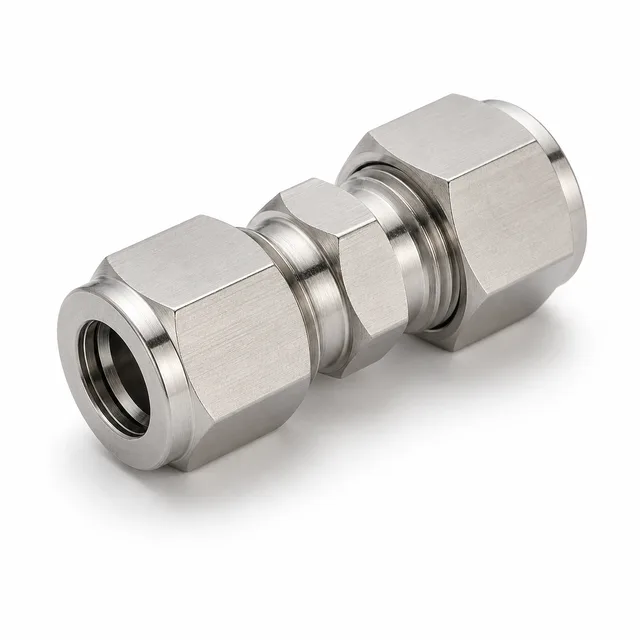
Double-ferrule (front + back ferrule) compression fitting system for instrumentation OD (outer diameter) tube, with no welding: as the nut is tightened, the two ferrules bite and seal against the tube wall. It is the de facto industry standard in instrumentation (ASTM F1387-type dimensions, compatible with the Swagelok and Parker CPI systems, though each brand is its own patented part). The TECTUL stainless steel catalog covers union, elbow, tee, male and female OD x NPT connectors, a panel bulkhead, and the ferrule set and hex nut spares.
Important: Before using these data in engineering, design or installation decisions on systems exposed to mechanical, pressure, rupture, fatigue, impact or water-hammer risk, it is essential to read the technical notice and limitation of liability at the end of this sheet.
Union (VT-86974) · female OD x NPT (VT-86973) · male OD x NPT (VT-86969) · ferrule set (VT-86970) · hex nut (VT-86971) · elbow, tee and bulkhead · sold by the unit
1. Technical specifications
System components
| OD union | Splices two tube sections of the same diameter (VT-86974) |
| OD elbow | 90° direction change in tubing |
| OD tee | Three-way branch with no reduction |
| Male OD x NPT connector | Transitions tube to male NPT thread (VT-86969) |
| Female OD x NPT connector | Transitions tube to female NPT thread (VT-86973) |
| OD bulkhead | Panel pass-through with a fixing nut on both sides |
| Ferrule set | Spare: front + back ferrule per tube diameter (VT-86970) |
| Hex nut | Spare compression nut (VT-86971) |
Mechanism and standards basis
| Sealing | Double ferrule: the back ferrule forces the front one to bite the tube wall as the nut is tightened against the body |
| Material | Stainless steel (grade 304 or 316 depending on reference, confirm with the supplier) |
| Fitting type reference dimensions | Compatible with the industry's ASTM F1387 dimensional standard (same principle as Swagelok/Parker CPI, without necessarily being piece-for-piece interchangeable between brands) |
| Allowable pressure | Calculated per ASME B31.3 with ASTM A269 tube, allowable stress S=20,000 psi (1378 bar) at −28/37 °C — actual rating depends on the specific tube's wall thickness and whether the end is male or female |
| Exact dimensions per diameter | Confirmed on quotation — no dedicated manufacturer dimensional sheet published |
Do not mix this system's body and ferrules with those of another patented brand without confirming exact dimensional compatibility: although the double-ferrule principle is generic, each manufacturer defines its own ferrule geometry.
2. Frequently asked questions
Can I use another brand's ferrule on this body?
Not recommended without confirming exact dimensional compatibility: although the double-ferrule principle is common across the industry, each manufacturer patents its own ferrule geometry, and mixing may not seal reliably.
How much pressure does it withstand?
It depends on the diameter and wall thickness of the installed tube, calculated per ASME B31.3 with ASTM A269 stainless steel; there is no single number valid for the whole system. Confirm the specific calculation with the supplier.
Can I reuse the ferrule when disassembling the joint?
Generally yes, if it was not overtightened on first assembly: the ferrule retains the bite mark and can be reinstalled on the same tube. If the tube is removed and swapped, using new tube or checking the bite mark's condition is recommended.
3. Application notes
Feasibility
Suitable for instrumentation, analysis, sampling, instrument air and process gas/liquid tubing compatible with stainless steel, where a removable, weld-free joint is required. Allowable pressure depends on the specific tube's diameter and wall thickness, calculated per ASME B31.3.
Installation
Insert the tube fully into the body, verifying it seats against the internal stop. Hand-tighten the nut and then use a wrench for the number of turns indicated by the manufacturer (typically 1-1/4 turns from hand-tight on first assembly; fewer on reassembly). Insufficient tightening does not seal; excessive tightening damages the ferrule or the tube.
Design
Calculate the allowable pressure per ASME B31.3 using the actual properties of the installed tube; do not assume a generic value. Confirm the exact stainless steel grade (304 or 316) and dimensional compatibility if combining components from different brands.
4. Technical notice and limitation of liability
The pressures, dimensions, weights and other characteristics in this sheet are theoretical calculation values obtained from nominal properties published in the standards cited (ASME B36.10-2022, ASME B31.3-2024, ASTM A106/A106M-19a, ASTM A53/A53M-24, API Spec 5L 46th ed.). They guide selection; they are not a certificate of conformity for any given lot.
The actual behavior of each lot varies with manufacturing — wall tolerance (up to −12.5%), out-of-roundness, residual stresses — and with the raw material — chemical composition within the ranges the standard allows, heat-to-heat differences. To certify a lot, the tests defined by its product standard are required: tensile test, flattening test and hydrostatic test, documented in the manufacturer's mill test certificate (MTC), which TECTUL supplies upon request; testing of the lot in an independent laboratory can also be arranged.
These values must not be used as the sole criterion in critical or safety applications, or wherever failure of the line may compromise people, property or the environment: in such cases the design belongs to the project's responsible engineer under the applicable code (ASME B31.3, B31.1 or the one governing the installation), with the design temperature, corrosion allowance and load cases of the actual service. Before deciding with these data, consult our technical team.
Sources
- ASME B31.3 — Process Piping (base de cálculo de presión admisible para tubing de instrumentación)
- ASTM A269 — Standard Specification for Seamless and Welded Austenitic Stainless Steel Tubing for General Service (tubo de referencia, S=20 000 psi a −28/37 °C)
- ASTM F1387 — Standard Specification for Performance of Piping and Tubing Mechanically Attached Fittings (estándar dimensional de referencia de la industria para racores de compresión de doble férula)
- Fppoutlet.com / Titan Fittings / Hydraxio — especificaciones comerciales de racores de compresión de doble férula en acero inoxidable 304/316L (consultado ago. 2026)
This data sheet is the property of TECTUL, part of the Industrias IMR group. Reproduction without attribution is prohibited. Original document and updates: tectul.com/en/conduccion-de-fluidos/racores-y-acoples/ficha-tecnica-union-inoxidable-instrumentacion.