 TECTULby IMR
PTFE thread seal tape — standard density and full density for gas
TECTUL · Dispatch across Colombia · Exports to Central & South America
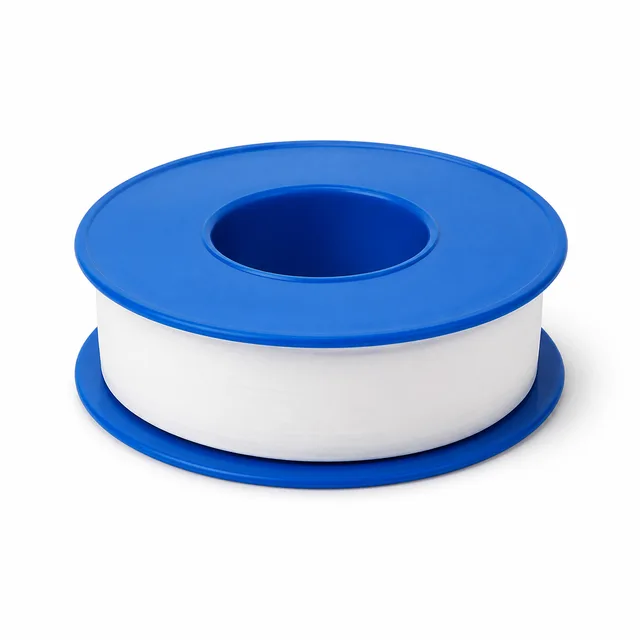
100% virgin PTFE thread seal tape: white, standard-density (SKU VT-58705, 1/2″–1″) for water, air and oil, and yellow, full-density for natural gas or LPG (SKU VT-58703, 3/4″), required by Colombia's gas code NTC 2505 under BS 7786 or MIL-T-27730-A. Density — not color — is what certifies the yellow tape for gas.
Important: Before using these data in engineering, design or installation decisions on systems exposed to mechanical, pressure, rupture, fatigue, impact or water-hammer risk, it is essential to read the technical notice and limitation of liability at the end of this sheet.
SKU VT-58705 (white industrial tape, 1/2″–3/4″–1″) and SKU VT-58703 (yellow gas tape, 3/4″ in two roll lengths) · sold by the unit
1. Technical specifications
Two products, one polymer, different density
TECTUL sells two references of 100% virgin, unsintered polytetrafluoroethylene (PTFE) thread seal tape: the white industrial tape (SKU VT-58705), standard density, for water, compressed air, oil and compatible general services; and the yellow gas tape (SKU VT-58703), full density, color-coded for natural gas or LPG installations. What certifies gas use is the density of the compacted PTFE in the tape, not the color: yellow is only the visual signal of that density.
| Reference | TECTUL SKU | Color | Reference density | Intended use |
|---|---|---|---|---|
| PTFE industrial tape | VT-58705 | White | Standard — typically 0.5–0.9 g/cm³ depending on manufacturer | Water, compressed air, oil and compatible general threads |
| Yellow gas PTFE tape | VT-58703 | Yellow (gas color code) | Full density — ≥ 1.2 g/cm³ reference | Natural gas or LPG installation threads |
TECTUL catalog presentations
| SKU | Width | Reported size | Sale unit |
|---|---|---|---|
| VT-58705-01 | 1/2″ (12.7 mm) | 1/2″ | Unit |
| VT-58705-02 | 3/4″ (19.1 mm) | 3/4″ | Unit |
| VT-58705-03 | 1″ (25.4 mm) | 1″ | Unit |
| VT-58703-01 | 3/4″ (19.1 mm) | 3/4″ | Unit |
| VT-58703-02 | 3/4″ (19.1 mm) | 3/4″ | Unit |
IMPORTANT
This data sheet is a reference guide to the properties of this product type. The measurements, dimensions and physical or geometric characteristics of the product actually supplied may vary by manufacturer and lot, and may even fall outside the cited standards. If any of these figures is critical to your design or build, it is essential to verify it with one of our advisors against the physical product, so you can be fully certain of what you are buying. · Original data sheet: tectul.com/en/conduccion-de-fluidos/sellado-y-union-de-tuberias/ficha-tecnica-cinta-teflon-industrial.html
The Cellux factory catalog for the yellow line publishes two roll lengths at the same 3/4″ width: code C-TG-001808 (8 m, box of 500 units) and code C-TG-001815 (15 m, box of 250 units). TECTUL's product page does not state the roll length of each SKU (VT-58703-01 and VT-58703-02): mapping each SKU to its factory roll length is confirmed on quotation.
General specifications
| Product | Thread seal tape in 100% virgin, unsintered polytetrafluoroethylene (PTFE), in two densities: standard (white) and full density (yellow, for gas) |
| Material | Virgin PTFE, polytetrafluoroethylene resin |
| Thickness | Cellux yellow line (TECTUL): 100 µm · 0.1 mm · ≈ 3.9 mils (factory data sheet value). White line: not published by the manufacturer in TECTUL's data sheet — confirmed on quotation; commercial practice places standard tape at 0.075–0.09 mm (3–3.5 mils) |
| Thermal service range | PTFE as a polymer: −200 °C to +260 °C (−328 °F to 500 °F) continuous use, decomposing above that. Declared Cellux yellow line: −170 °C to +260 °C (−274 °F to 500 °F) |
| Pressure behavior | Cellux yellow line: factory data sheet value "deformation under pressure, from absolute vacuum (≈ −1 bar / −14.7 psi) up to 200 bar (≈ 2,901 psi)" — this is a property of the tape as a material, not a certified service pressure of the threaded joint, which depends on the thread, tightening torque and fitting |
| Reference standards | BS 7786:2006 (unsintered PTFE tape, general use) · EN 751-3:2022+A1:2023 (PTFE tape and string for 1st, 2nd and 3rd family gas threads and hot water) · ASTM D3308-12(2022) (skived PTFE tape) · NTC 2505 (residential and commercial gas supply installations, Colombia) |
| Sale | By the unit, per SKU and presentation |
IMPORTANT
This data sheet is a reference guide to the properties of this product type. The measurements, dimensions and physical or geometric characteristics of the product actually supplied may vary by manufacturer and lot, and may even fall outside the cited standards. If any of these figures is critical to your design or build, it is essential to verify it with one of our advisors against the physical product, so you can be fully certain of what you are buying. · Original data sheet: tectul.com/en/conduccion-de-fluidos/sellado-y-union-de-tuberias/ficha-tecnica-cinta-teflon-industrial.html
⚠ Important: this technical data sheet is a reference guide to the product's properties; it is not a quality certificate for the product you are buying. Heats vary from one another and may differ from the values stated here, or even depart from the standards. If your application requires compliance with a standard, always check the quality certificate (mill certificate) of the lot you are buying. If in doubt, ask one of our technical advisors →
2. Standard density vs. full density: the real difference between white and yellow tape
What "full density" means in a PTFE tape
The unsintered PTFE in a seal tape is not a homogeneous material: it is manufactured by compressing the resin, and the degree of compression sets its density. Lower density makes the tape more porous, softer and bulkier per gram; higher density makes it more compact, more resistant to gas permeation through its own structure, and better at filling the clearance of a tapered NPT thread. The industry commercially classifies these densities in several tiers — standard, medium, high and full — with no single universal number: each manufacturer sets the cutoff of each tier at somewhat different values.
The one figure that is standardized: 1.2 g/cm³ minimum
US federal specification A-A-58092 (January 7, 1997, superseding MIL-T-27730A ASG), originally written for PTFE tape in liquid and gaseous oxygen systems, requires a minimum density of 1.2 g/cm³ and a minimum thickness of 3.5 mils (0.089 mm), over an application range of −54 °C to 149 °C. The gas tape industry — including manufacturers that market yellow "full density" tape — uses that same threshold as the full-density reference, although gas-specific certification in the US runs through the UL Component Recognition listing category 31RO, not through A-A-58092 itself. By contrast, standard general-use white tape has no density floor mandated by a standard: manufacturer catalogs report typical values between 0.5 and 0.9 g/cm³ depending on the commercial line, well below the gas tape threshold.
The European gas standard distinguishes by thread class, not only by density
EN 751-3:2022+A1:2023 (unsintered PTFE tapes and strings for metallic threaded joints in contact with 1st, 2nd and 3rd family gases — town gas, natural gas and LPG — and hot water) defines two classes by thread type: class F for fine thread and class G for coarse thread, with test limits up to 500 kPa (≈ 5 bar / 72.5 psi) in gas, 700 kPa (≈ 7 bar / 101.5 psi) in heating hot water, and 20 kPa (≈ 0.2 bar / 2.9 psi) in appliances and their auxiliary equipment. British standard BS 7786:2006, by contrast, covers unsintered PTFE tape for general use — not gas-specific — with mass per area of 25 to 300 g/m² and thickness of 0.05 to 0.25 mm, over a temperature range of −270 °C to +260 °C.
Why this matters in Colombia: the gas installation code requires it
NTC 2505 (residential and commercial gas supply installations) explicitly prohibits hemp and paint as sealant on threaded gas joints, and requires that the PTFE tape used on those joints comply with BS 7786 or MIL-T-27730-A (or the corresponding Colombian technical standard). In commercial practice, that regulatory requirement is not met by just any general-use white tape: it is met by a tape identified and manufactured for that density, commercially the yellow gas tape.
Thickness: the other half of the difference
Besides density, tape thickness also changes with grade: commercial practice reports standard white tape in the 0.075 to 0.09 mm range (3 to 3.5 mils) and yellow gas tape at 0.09 to 0.1 mm (3.5 to 4 mils). The verified factory figure for the yellow line TECTUL distributes (Cellux, codes C-TG-001808 and C-TG-001815) is 100 µm · 0.1 mm, at the high end of that range. TECTUL has no equivalent factory data sheet for the white industrial line (SKU VT-58705): its exact thickness and density are confirmed on quotation.
3. Correct application: direction, turns and when to use tape instead of liquid sealant
Wrap direction and number of turns
The tape is always wrapped in the tightening direction of the thread, never the opposite way: if wrapped backward, the tightening rotation itself unwinds the tape instead of compressing it against the thread crest. Cellux's gas line factory data sheet recommends 3 to 5 turns, adjusted by tape width and thread size; small NPT threads (up to 3/4″) usually need only 2 to 3 turns, while larger threads need more to cover the full engagement. Excess tape does not improve the seal: it acts as a wedge, makes hand-threading harder and can crack the body or female thread on brittle materials (cast bronze, PVC) when the final tightening forces past it.
Leave the first thread free
Leave the first thread — the one closest to the part's end — free of tape: if the tape reaches the edge, tightening can shear off shreds into the bore, which end up as loose debris inside the line. Cover the rest of the thread evenly and press the tape against the crests with your fingers before assembling the joint, so it stays in place and does not shift while threading. Do not reuse tape that already served on another joint: it loses tension and usable thickness.
Tape or liquid sealant: the short rule
Use PTFE tape when the joint will be disassembled with some frequency (maintenance, instrumentation, test lines) and on any gas thread, where the code specifically requires certified PTFE tape or string, not a generic liquid sealant. Use liquid thread sealant when the thread has larger clearances, damaged threads, or when the joint must stay permanently rigid and vibration-resistant without depending on the thickness of a hand wrap. TECTUL's liquid sealant data sheet covers that second product family in detail; this sheet only sets the selection criterion between the two.
4. Frequently asked questions
Does white tape work for gas?
No. Standard-density white tape (typically 0.5–0.9 g/cm³) does not reach the full-density threshold (≥ 1.2 g/cm³) the industry uses as the gas reference, and in Colombia NTC 2505 requires that tape on threaded gas joints comply with BS 7786 or MIL-T-27730-A. For gas, the yellow tape identified for that service is specified, not general-use white tape.
How many turns of PTFE tape should be used?
3 to 5 turns is Cellux's factory recommendation for the gas line, adjusted by tape width and thread size: small NPT threads usually need 2 to 3 turns, larger ones more. More turns than needed do not improve the seal: they act as a wedge and can crack brittle-material parts when tightening forces past the excess.
Does PTFE tape withstand gasoline or diesel?
Yes, PTFE is chemically inert to virtually all industrial fuels, oils and solvents, so the tape does not degrade chemically in contact with them. That alone does not certify the joint for that service: the suitability of the full connection — thread, fitting, tape density required by the applicable code — is confirmed on quotation per the project's standard.
What is the difference between industrial tape and gas tape?
The density of the compacted PTFE, not just the color: yellow is full density (≥ 1.2 g/cm³ reference) and white is standard density (typically 0.5–0.9 g/cm³). Yellow's higher density resists gas permeation through the tape itself better, and it is what the gas installation code requires.
What standard requires PTFE gas tape in Colombia?
NTC 2505, the residential and commercial gas supply installation standard, requires tape conforming to BS 7786 or MIL-T-27730-A (or the corresponding Colombian technical standard) and explicitly prohibits hemp and paint as gas thread sealant. The equivalent gas-specific European standard is EN 751-3.
Can I use yellow gas tape on a water line instead of white?
Technically yes: being higher density, gas tape also seals water, air or oil threads. It is not the usual economical choice — it costs more per roll than white — and in practice it is reserved for gas, leaving white for the rest of compatible general services.
5. Application notes
Feasibility
PTFE tape is the usual solution for demountable tapered threaded joints (NPT and similar) on water, air, oil and gas, within the density and color ranges stated in this sheet. It does not replace a flange gasket, an o-ring, or a structural sealant on joints that must stay rigid or carry mechanical loads beyond thread tightening. On threads with damaged crests or large clearances, tape alone does not compensate for the defect: thread repair or a liquid sealant with greater gap-filling capacity is required.
Installation
Clean the thread before applying. Wrap in the tightening direction, leaving the first thread free, with 3 to 5 turns depending on tape width and thread size (fewer turns on small threads, more on large ones). Press the tape against the crests before assembling the joint, and always run a system leak test, especially on gas installations, before commissioning.
Design
The choice between standard and full density is not an installer's preference: on gas it is set by the applicable code (in Colombia, NTC 2505 pointing to BS 7786 or MIL-T-27730-A; under European jurisdiction, EN 751-3). Do not assume equivalent density, thickness or pressure rating across different manufacturers' lines just because they share the same color: verify the real manufacturer's data sheet for the specific reference to be installed, especially on gas service.
6. Technical notice and limitation of liability
The density, thickness and thermal range values in this sheet combine factory data sheet values from the yellow gas line's supplier (Cellux, codes C-TG-001808 and C-TG-001815) with thresholds from publicly available technical standards (A-A-58092, BS 7786, EN 751-3) used by the industry as the full-density reference; they guide selection and are not a certificate of conformance for any lot. The white industrial line (SKU VT-58705) has no verified factory data sheet in this process: its density and thickness values are stated as general commercial practice, not as certified data from TECTUL's actual supplier.
Certifying compliance of a gas installation requires the certificate of the actual manufacturer of the installed tape and, when the project requires it, the applicable listing or certification (UL 31RO in the US, AGA/CSA or another equivalent national recognition). Final selection of material, density and thread sealing method is the responsibility of the line's designer or installer per the project code (NTC 2505 or other) and its current edition.
Sources
- NTC 2505 — Instalaciones de suministro de gas residencial y comercial (ICONTEC, Colombia): exige cinta de teflón conforme a BS 7786 o MIL-T-27730-A (o norma técnica colombiana correspondiente) en uniones roscadas de gas; prohíbe cáñamo y pinturas como sellante
- BS 7786:2006 — Specification for unsintered PTFE tapes for general use (masa 25–300 g/m², espesor 0,05–0,25 mm, rango −270 °C a +260 °C)
- EN 751-3:2022+A1:2023 — Sealing materials for metallic threaded joints in contact with 1st, 2nd and 3rd family gases and hot water — Part 3: Unsintered PTFE tapes and PTFE strings (clases F y G; límites de ensayo 500 kPa gas / 700 kPa agua caliente / 20 kPa aparatos)
- ASTM D3308-12(2022) — Standard Specification for PTFE Resin Skived Tape
- A-A-58092 (7 de enero de 1997), Commercial Item Description — Tape, Antiseize, Polytetrafluoroethylene, sustituye a MIL-T-27730A (ASG): densidad mínima 1,2 g/cm³, espesor mínimo 3,5 mils (0,089 mm), rango de aplicación −54 °C a 149 °C
- UL — Component Recognition, categoría 31RO (cinta antiadherente para línea de gas): listado de referencia citado por fabricantes de cinta amarilla en EE. UU.
- ASME B1.20.1-2013 (R2018) — Pipe Threads, General Purpose, Inch (geometría de la rosca NPT sobre la que se aplica la cinta)
- Cellux — Ficha técnica de fábrica «Cinta Teflón Gas», códigos C-TG-001808 (3/4″×8 m) y C-TG-001815 (3/4″×15 m): color amarillo según normativa de gas, 100 µm de espesor, temperatura de servicio −170 °C a +260 °C, deformación bajo presión de vacío hasta 200 bar, 3 a 5 vueltas recomendadas
- Propiedades generales del PTFE (politetrafluoroetileno): rango de servicio continuo −200 °C a +260 °C, punto de fusión ≈ 327 °C — literatura de propiedades de polímeros de ingeniería
This data sheet is the property of TECTUL, part of the Industrias IMR group. Reproduction without attribution is prohibited. Original document and updates: tectul.com/en/conduccion-de-fluidos/sellado-y-union-de-tuberias/ficha-tecnica-cinta-teflon-industrial.html.