 TECTULby IMR
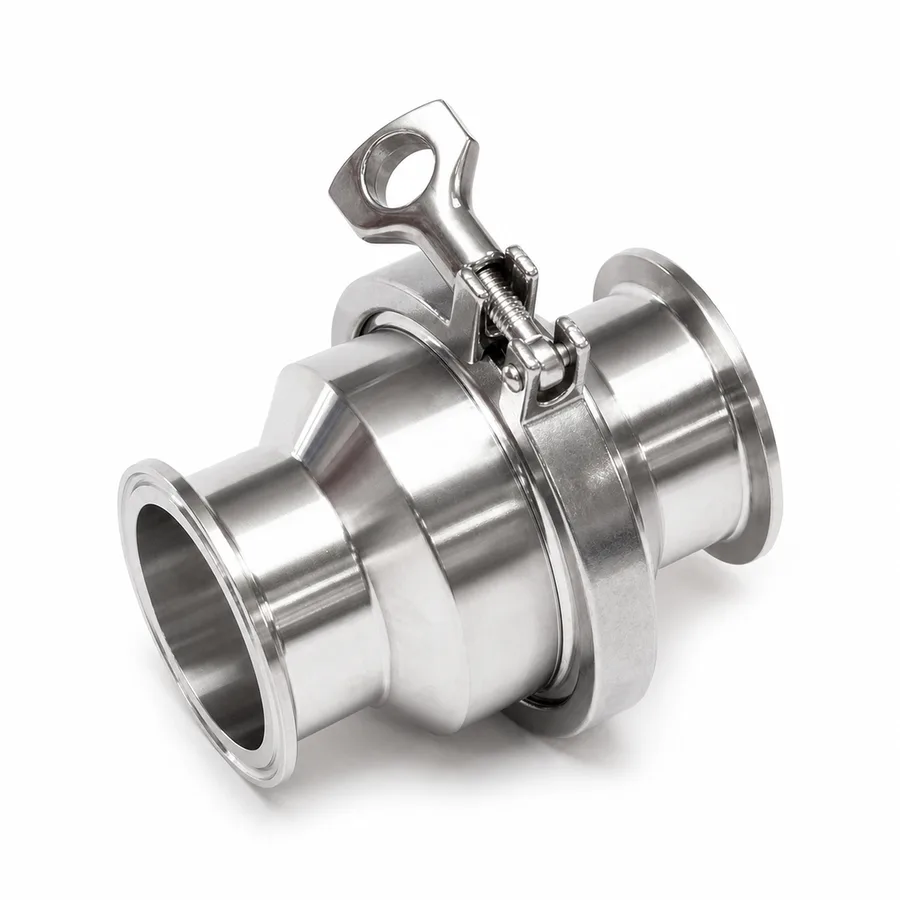
Sanitary stainless check valve with clamp ends — stainless steel, spring-loaded disc, for food, beverage and pharmaceutical service
TECTUL · Dispatch across Colombia · Exports to Central & South America
The sanitary stainless check valve in the TECTUL catalog, in 1″, 1-1/2″ and 2″, with ISO 2852 clamp ends and a polished stainless steel spring-loaded disc. It is intended for food, beverage and pharmaceutical lines where the valve itself is part of the clean-in-place (CIP) and sterilize-in-place (SIP) system, and where a dead zone or a rough finish is a cross-contamination risk, not merely a cosmetic defect. This sheet publishes the reference surface finish in Ra, the dead-zone-free geometry, the three usual sanitary elastomers (EPDM, silicone, FKM) with their real CIP/SIP temperature limit, the disc's cracking pressure and the tool-free disassembly procedure for cleaning. The clamp coupling system itself —ISO 2852 ferrule dimensions, clamp and gasket— belongs to the catalog's sanitary piping data sheet; here only the check valve's row is published, with its designation.
Important: Before using these data in engineering, design or installation decisions on systems exposed to mechanical, pressure, rupture, fatigue, impact or water-hammer risk, it is essential to read the technical notice and limitation of liability at the end of this sheet.
SKU VT-87066 (sanitary stainless check valve) · 3 catalog sizes: 1″, 1-1/2″ and 2″
1. Technical specifications
Materials by component
| Component | Material | Designation / source of the data |
|---|---|---|
| Body | Stainless steel, equivalent to 316L (low carbon, better weldability and lower sensitization than standard 316) | Equivalent to ASTM A270 (sanitary tubing and fittings) — exact grade of this figure: manufacturer data |
| Disc | 300-series stainless steel, polished | Manufacturer data |
| Closing spring | 300-series austenitic stainless steel | Exact grade: manufacturer data |
| End gasket | Sanitary, food-contact-approved elastomer, see section 3 | Exact grade per order: EPDM, silicone or FKM |
| Ends | Clamp (Tri-Clamp type ferrule) | ISO 2852 — dimensions in the catalog's sanitary piping data sheet |
| Surface finish | Sanitary polish, free of visible pores or cracks on inspection | Reference Ra: see section 2 |
Reference composition of sanitary stainless steel per the 316L equivalent. The exact casting or forging grade of the body, disc and spring for this figure are manufacturer data and are confirmed on quotation or in the PDF sheet attached to the product.
Regulatory framework and supply conditions
| Valve type | Check (non-return): operates on its own, driven by the flow, with a spring-loaded disc |
| Body material | Stainless steel, equivalent to 316L |
| Ends | Clamp (ferrule) per ISO 2852 — the coupling system belongs to the catalog's sanitary piping data sheet |
| Sanitary design | Free-draining, dead-zone-free geometry — see section 2 |
| Cracking pressure | Of the order of 0.1–0.3 psi (low, typical of light-spring sanitary design); exact value per size is confirmed on quotation — see section 4 |
| Catalog sizes | 1″, 1-1/2″ and 2″ |
| Usual fluids | Milk and dairy products, beer, juices, treated process water, pharmaceutical solutions, within the chemical compatibility of the chosen elastomer |
Face-to-face dimensions and weight per size are not published in this sheet because they are not standardized uniformly for sanitary clamp check valves of this type: each manufacturer sets its own pattern within the ISO 2852 coupling envelope; confirmed on quotation.
⚠ Important: this technical data sheet is a reference guide to the product's properties; it is not a quality certificate for the product you are buying. Heats vary from one another and may differ from the values stated here, or even depart from the standards. If your application requires compliance with a standard, always check the quality certificate (mill certificate) of the lot you are buying. If in doubt, ask one of our technical advisors →
2. Surface finish, drainability and absence of dead zones
Why finish is measured in Ra, not in "polished" or "bright"
In sanitary design, surface finish is not described with adjectives: it is measured with the arithmetic mean roughness Ra, expressed in microns (µm) or microinches (µin). A surface with low Ra has fewer microscopic valleys where a microorganism can lodge and stay protected from the cleaning flow; a surface with high Ra, even if it looks shiny to the naked eye, can retain biofilm that clean-in-place (CIP) does not fully remove.
| Reference Ra of this valve | ≤ 0.8 µm (32 µin) on product-contact surfaces — typical reference value for sanitary finish on stainless steel valves; the exact certified value of this figure is confirmed on quotation |
| Usual polishing method | Electropolishing or fine mechanical polishing, depending on the manufacturer; both aim to reduce Ra and eliminate surface pores and cracks |
| Critical zones | Disc seat, spring guide and body-cap joint: these are the geometries where residue most easily builds up if the finish or design is not sanitary |
Drainability and absence of dead zones
A dead zone is any internal volume of the valve where process or cleaning fluid does not circulate at the same speed as the main bore: recesses, internal steps, threads exposed to the product or cavities behind a moving component. On a check valve, the typical risk lies in the chamber housing the spring and in the gap behind the disc at rest: if that chamber does not drain by gravity on disassembly or during CIP, stagnant liquid remains that cleaning cannot reach.
This valve's sanitary design seeks to minimise that risk with: a body geometry free of internal sharp angles, a disc and spring accessible and easy to inspect on disassembly (section 4), and no threads exposed to the product in fluid-contact zones —internal assembly is done with sliding fits or clips, not hardware threaded directly into the bore—.
Total absence of dead zones is a design goal, not an absolute guarantee on any spring-loaded disc check valve: the spring mechanism itself introduces a cavity that requires periodic disassembly for manual inspection and cleaning, unlike a purely straight-through valve with no internal moving parts. This sheet does not certify a specific 3-A or EHEDG grade for this figure: confirmed on quotation if the project requires it.
3. Sanitary elastomers and their CIP/SIP limit
The seal against the seat and the end gaskets are elastomer, and it is the elastomer, not the body's stainless steel, that fails first from temperature or chemical incompatibility during a clean-in-place (CIP) or sterilize-in-place (SIP) cycle. This valve is offered with three usual sanitary elastomers, each with a different limit and use:
| Elastomer | Typical compatibility | Reference temperature limit | Notes |
|---|---|---|---|
| EPDM | Water, steam, most dairy products and beverages; good CIP resistance with dilute alkaline and acidic solutions | Continuous service up to ≈135 °C (275 °F); brief SIP peaks somewhat higher depending on the manufacturer's compound | Not compatible with mineral oils, greases or hydrocarbons: it swells and degrades |
| Silicone | Wide temperature range, frequently used in pharmaceutical service and where low extractables/leachables are required | Continuous service up to ≈177 °C (350 °F) in sanitary-grade compounds | Lower mechanical and abrasion resistance than EPDM or FKM; not the first choice for fluids with particles |
| FKM (Viton) | Oils, greases, many solvents and CIP with more aggressive cleaner concentrations | Continuous service up to ≈204 °C (400 °F) in sanitary-grade compounds | Not compatible with sustained high-temperature saturated steam nor with some amines; verify against the actual fluid and CIP/SIP cycle of the project |
IMPORTANT
This data sheet is a reference guide to the properties of this product type. The measurements, dimensions and physical or geometric characteristics of the product actually supplied may vary by manufacturer and lot, and may even fall outside the cited standards. If any of these figures is critical to your design or build, it is essential to verify it with one of our advisors against the physical product, so you can be fully certain of what you are buying. · Original data sheet: tectul.com/en/conduccion-de-fluidos/valvulas/ficha-tecnica-check-inoxidable-sanitario.html
Temperature limits are reference values from sanitary-grade elastomer manufacturer catalogs, not a certification of this specific figure: the exact compound grade, its certified limit and its compatibility with the project's actual CIP/SIP cycle are confirmed on quotation.
Why the elastomer limits the cycle, not the body
A typical SIP cycle reaches 121–134 °C with saturated steam for a sustained time to achieve sterilization; the stainless steel body withstands that temperature without issue, but the elastomer may not if it was chosen for the process fluid without checking the thermal cleaning cycle. The most common specification error is choosing the elastomer only for product compatibility (for example EPDM for milk) without confirming it also withstands the temperature and chemistry of the plant's actual CIP/SIP, which may include hot caustic solutions or dilute nitric acid for descaling.
Elastomer service life is finite and depends on the number of thermal cycles, the cleaner's chemical concentration and exposure time: it is a spare part, not a permanent component of the valve.
4. Cracking pressure and tool-free disassembly for cleaning
Low cracking pressure by design
This valve's spring is deliberately calibrated light: on the order of 0.1 to 0.3 psi cracking pressure, well below that of a general-process industrial check valve. The reason is sanitary, not merely hydraulic: many food and beverage lines run by gravity or with low-head centrifugal pumps, and a stiff spring would leave the check valve closed —or dripping in a false close— at the small differential pressures typical of this service, affecting process flow. The exact certified value per size is confirmed on quotation; the published order of magnitude is a sanitary design reference, not a figure certified for this specific reference.
Tool-free disassembly
The clamp end of the ISO 2852 system opens and closes with a wing-nut clamp that requires no wrench or special tool: it is the same principle as the catalog's entire sanitary clamp line. For this valve, that same "tool-free" principle extends inward:
- Remove the clamp on the downstream end (or the side the manufacturer indicates) without a tool.
- Separate the body into its two halves, exposing the disc and spring.
- Remove the disc and spring for visual inspection and manual cleaning of the chamber that houses them —the valve's highest dead-zone risk point, section 2—.
- Check the condition of the end elastomeric gasket and the disc seat; replace them if they show wear, hardening or marks of chemical degradation.
- Reassemble in reverse order and close the clamp, verifying the gasket is correctly seated before operating.
This sequence is representative of demountable sanitary design practice; the exact procedure, clamp closing torque and recommended disassembly frequency are set by the manufacturer of the figure and are confirmed in the product sheet or on quotation.
Why tool-free disassembly is a requirement, not a convenience
On a line with sanitary validation (plant audit, food-safety certification), the frequency and ease of disassembly for inspection is part of the documented cleaning program, not an extra: a check valve requiring a special tool or complex disassembly tends to be inspected less often than the cleaning plan requires, precisely because of the operational friction it introduces. This valve's tool-free, two-half disassembly design exists so periodic inspection is a quick task rather than an exceptional event.
5. Frequently asked questions
What surface finish does the sanitary stainless check valve have?
The reference value for sanitary finish on stainless steel valves of this type is Ra ≤ 0.8 µm (32 µin) on product-contact surfaces. The exact certified value of this figure is confirmed on quotation with the manufacturer's sheet.
Which elastomer should I choose for my CIP/SIP?
It depends on the process fluid and the actual cleaning cycle: EPDM for water, steam and most dairy products and beverages (up to ≈135 °C); silicone where low extractables/leachables are required, typical in pharmaceutical service (up to ≈177 °C); FKM for oils, greases and CIP with more aggressive cleaners (up to ≈204 °C). The common error is choosing only for the product without verifying that the elastomer also withstands the actual temperature and chemistry of the plant's CIP/SIP.
What pressure do I need to open the check valve?
A low differential pressure, on the order of 0.1 to 0.3 psi, due to the light spring of sanitary design. The exact certified value per size is confirmed on quotation.
Do I need a tool to disassemble and clean the valve?
No. The clamp end opens with the tool-free wing-nut clamp, and the body separates into two halves to expose the disc and spring for visual inspection and manual cleaning, following the procedure in section 4.
Does this sheet cover the clamp connection itself?
Only as a row with its designation (ISO 2852). The clamp, ferrule and gasket dimensions of the clamp system belong to the TECTUL catalog's sanitary piping data sheet, which applies equally to this valve and to the other sanitary fittings with the same end type.
6. Application notes
Feasibility
Covers food, beverage and pharmaceutical lines in 1″, 1-1/2″ and 2″, with the low differential pressure typical of gravity or low-head pumping, within the chemical and thermal compatibility of the chosen elastomer (EPDM, silicone or FKM) with the process fluid and the plant's actual CIP/SIP cycle. Out of scope: services requiring a specific sanitary certification grade (3-A, EHEDG) not confirmed for this figure; high differential pressures or service with coarse abrasive particles, where the low-cracking-pressure spring-loaded disc geometry is not the best fit; and sizes above 2″, outside the catalog's published range.
Installation
Mount with the clamp per the line's ISO 2852 system, verifying the gasket seats correctly before closing. Confirm the flow direction marked on the body. Provide drainage slope in the layout to avoid liquid accumulation in the spring chamber when the line is out of service. Include the valve in the plant's documented CIP/SIP cleaning program, with periodic disassembly per the section 4 procedure for visual inspection of the disc, spring and elastomeric gaskets.
Design
Specify the elastomer by the dual condition of compatibility with the process product and with the plant's actual CIP/SIP cycle, not the first alone. Consider the spring's low cracking pressure when calculating the operating point with low-head pumps or gravity lines. Include the disassembly frequency for inspection in the plant's documented sanitary maintenance plan, taking advantage of the fact that the design requires no special tool. If the project requires a specific 3-A or EHEDG certification, confirm it with the manufacturer before specifying this figure.
7. Technical notice and limitation of liability
The framework of this sheet combines ISO 2852 (clamp ends), the sanitary stainless steel 316L equivalent and reference catalog data from sanitary elastomer manufacturers (EPDM, silicone, FKM) with the data TECTUL publishes on the product page (sizes). The Ra finish, cracking pressure and certified thermal limit of the elastomer are not published uniformly by the manufacturer of this figure: the values in this sheet are sanitary practice references and are confirmed on quotation with the factory certificate or PDF sheet.
This sheet does not certify a specific 3-A or EHEDG grade for this valve: if the project requires it under a food-safety standard or client audit, it must be confirmed separately with the manufacturer. The clamp coupling system (ferrule, clamp and gasket dimensions) belongs to the TECTUL catalog's sanitary piping data sheet: here it is only referenced as connection data.
These values must not be used as the sole criterion in regulated pharmaceutical applications, critical food safety or wherever valve failure may compromise people's health: in such cases sanitary validation and design belong to the project's responsible quality or process engineer, under the applicable regulation (FDA, local food-safety standards or others). Before deciding with these data, consult our technical team.
Sources
- ISO 2852 — Stainless steel clamp pipe couplings: sistema de acople clamp/ferrula usado en los extremos de esta válvula
- ASTM A270 — Standard Specification for Seamless and Welded Austenitic and Ferritic/Austenitic Stainless Steel Sanitary Tubing: referencia de grado sanitario del acero inoxidable equivalente 316L
- Ra (rugosidad media aritmética) — parámetro de acabado superficial de referencia en diseño sanitario, práctica consistente con estándares 3-A Sanitary Standards y EHEDG (sin certificar un grado específico para esta figura)
- Datos de catálogo de fabricantes de elastómeros de grado sanitario (EPDM, silicona, FKM) — límites térmicos y de compatibilidad química de referencia para servicio CIP/SIP
- Práctica general de limpieza en sitio (CIP) y esterilización en sitio (SIP) en plantas de alimentos, bebidas y farmacéutica: parámetros típicos de temperatura y química de ciclo, consistentes entre múltiples proveedores de equipo sanitario
- Fichas de producto TECTUL (tectul.com): Válvula Check Inoxidable Sanitario — fuente primaria de diámetros
- Curaduría interna TECTUL (data/etapas/etapa-1-conduccion-de-fluidos/curaduria.json) — diámetros, agosto 2026
This data sheet is the property of TECTUL, part of the Industrias IMR group. Reproduction without attribution is prohibited. Original document and updates: tectul.com/en/conduccion-de-fluidos/valvulas/ficha-tecnica-check-inoxidable-sanitario.html.