 TECTULby IMR
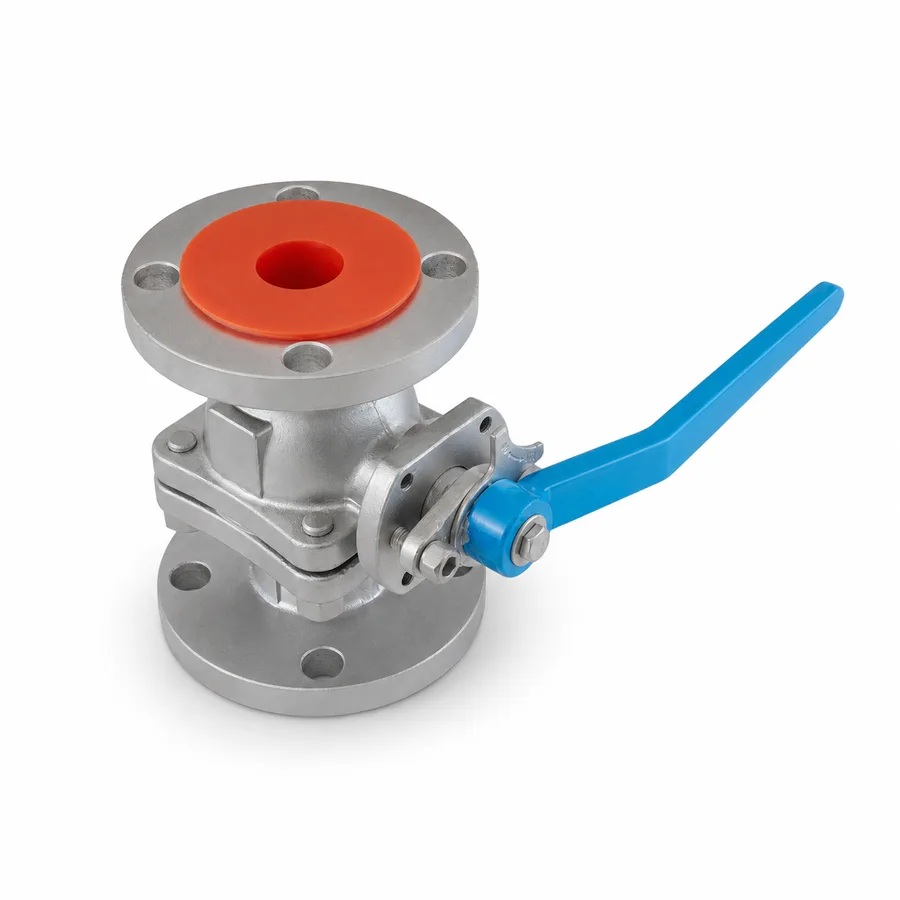
Class 150 flanged ball valve in cast carbon steel ASTM A216 WCB — full port, API 608 design
TECTUL · Dispatch across Colombia · Exports to Central & South America
Class 150 flanged ball valve in cast carbon steel ASTM A216 WCB, floating full-port ball, ends per ASME B16.5 raised face and face to face per ASME B16.10, designed and built to API 608 and factory-tested per API 598. The TECTUL catalog covers two references of this family — Válvula Bola Bridada X 150 Lb and Válvula Bola Acero al Carbón Bridada — near duplicates grouped here under a single data sheet. The accuracy correction this sheet establishes: class 150 is not the same as 150 psi; at 38 °C, class 150 in group 1.1 material (WCB) takes 285 psig per the ASME B16.34 pressure-temperature table, and that figure falls with temperature well before the PTFE seat, with a usual service thermal limit of ≈180 °C, stops being the element that governs selection.
Important: Before using these data in engineering, design or installation decisions on systems exposed to mechanical, pressure, rupture, fatigue, impact or water-hammer risk, it is essential to read the technical notice and limitation of liability at the end of this sheet.
SKU VT-valvula-bola-bridada-x-150-lb · line of 2 class 150 flanged references in cast carbon steel ASTM A216 WCB
1. Technical specifications
Materials by component
| Component | Material | Designation |
|---|---|---|
| Body and cap | Cast carbon steel, grade WCB | ASTM A216/A216M |
| Ball | Chrome-plated carbon steel or cast stainless steel CF8M, per figure | Exact grade: manufacturer data |
| Stem | 400- or 300-series stainless steel, anti-static and blow-out proof | ASTM A276/A182, grade per figure |
| Seat | PTFE or fiberglass-reinforced PTFE (RPTFE) | Usual service thermal limit ≈180 °C |
| Stem packing | PTFE or graphite, asbestos-free | Asbestos-free |
| Flange studs and nuts | High-strength alloy steel | ASTM A193 grade B7 / A194 grade 2H, typical |
| Ends | Flanged, raised face | ASME B16.5 class 150 |
Material discrepancy between the catalog's two references: the commercial sheet for Válvula Bola Bridada X 150 Lb generically labels the body as «cast iron», while Válvula Bola Acero al Carbón Bridada labels it «carbon steel». A class 150 flanged ball valve designed under API 608/ASME B16.34 requires a steel body (cast, grade WCB), not grey cast iron: cast iron is not among the B16.34 material groups. This sheet takes ASTM A216 WCB as the family's reference construction; the actual body material of each figure is confirmed on quotation with the factory certificate.
Regulatory framework and supply conditions
| Valve type | Floating full-port ball, quarter turn, two- or three-piece flanged per figure |
| Design and construction | API 608 — Metal Ball Valves: Flanged, Threaded, and Welding Ends |
| Pressure-temperature rating | ASME B16.34, class 150, material group 1.1 (WCB) |
| Ends | Flanged raised face, ASME B16.5 class 150 |
| Face to face (F2F) | ASME B16.10, short pattern for flanged ball valve |
| Factory testing | API 598 — shell and seat (section 3) |
| Catalog sizes | 1/2″ to 12″ (DN 15 to DN 300) |
| Port | Full (bore equal to pipe nominal diameter), floating ball design |
Flange and face-to-face dimensions by size
| Size | Face to face (F2F, short pattern) | Bolt circle Ø | Number of studs | Stud Ø |
|---|---|---|---|---|
| 1/2″ (DN 15) | 108 mm (4.25″) | 60.5 mm (2.38″) | 4 | 1/2″ |
| 3/4″ (DN 20) | 117 mm (4.61″) | 69.9 mm (2.75″) | 4 | 1/2″ |
| 1″ (DN 25) | 127 mm (5.00″) | 79.2 mm (3.12″) | 4 | 1/2″ |
| 1-1/4″ (DN 32) | 140 mm (5.51″) | 88.9 mm (3.50″) | 4 | 1/2″ |
| 1-1/2″ (DN 40) | 165 mm (6.50″) | 98.6 mm (3.88″) | 4 | 1/2″ |
| 2″ (DN 50) | 178 mm (7.00″) | 120.7 mm (4.75″) | 4 | 5/8″ |
| 2-1/2″ (DN 65) | 190 mm (7.48″) | 139.7 mm (5.50″) | 4 | 5/8″ |
| 3″ (DN 80) | 203 mm (7.99″) | 152.4 mm (6.00″) | 4 | 5/8″ |
| 4″ (DN 100) | 229 mm (9.02″) | 190.5 mm (7.50″) | 8 | 5/8″ |
| 6″ (DN 150) | 267 mm (10.51″) | 241.3 mm (9.50″) | 8 | 3/4″ |
| 8″ (DN 200) | 292 mm (11.50″) | 298.5 mm (11.75″) | 8 | 3/4″ |
| 10″ (DN 250) | 330 mm (12.99″) | 362.0 mm (14.25″) | 12 | 7/8″ |
| 12″ (DN 300) | 356 mm (14.02″) | 431.8 mm (17.00″) | 12 | 7/8″ |
IMPORTANT
This data sheet is a reference guide to the properties of this product type. The measurements, dimensions and physical or geometric characteristics of the product actually supplied may vary by manufacturer and lot, and may even fall outside the cited standards. If any of these figures is critical to your design or build, it is essential to verify it with one of our advisors against the physical product, so you can be fully certain of what you are buying. · Original data sheet: tectul.com/en/conduccion-de-fluidos/valvulas/ficha-tecnica-valvula-bola-bridada-x-150-lb.html
Short-pattern face to face consistent with the dimensional reference for class 150 flanged ball valves, and the bolt circle of the ASME B16.5 class 150 flange. Sizes offered per reference are confirmed on quotation: the TECTUL catalog publishes both figures without a variant list. The flow coefficient (Cv) is not published by the manufacturer for this line and is confirmed on quotation.
⚠ Important: this technical data sheet is a reference guide to the product's properties; it is not a quality certificate for the product you are buying. Heats vary from one another and may differ from the values stated here, or even depart from the standards. If your application requires compliance with a standard, always check the quality certificate (mill certificate) of the lot you are buying. If in doubt, ask one of our technical advisors →
2. Rating system: why «class 150» is not «150 psi»
The commercial name «bridada x 150 lb» invites reading 150 as a psi figure. It is not: class 150 is an ASME B16.34 designation, a pressure-temperature rating that in group 1.1 material (WCB) equals 285 psig (19.6 bar) at 38 °C and falls as temperature rises. It is the same reading error the catalog makes in other families with «WOG» instead of a class (see this series' cross-cutting rule): here the error is reading «150» as a pressure figure instead of as the name of a class.
| Temperature | Allowable pressure — class 150, group 1.1 (WCB) |
|---|---|
| −29 °C to 38 °C (−20 °F to 100 °F) | 285 psig (19.6 bar) |
| 93 °C (200 °F) | 260 psig (17.9 bar) |
| 149 °C (300 °F) | 230 psig (15.9 bar) |
| 204 °C (400 °F) | 200 psig (13.8 bar) |
| 260 °C (500 °F) | 170 psig (11.7 bar) |
| 316 °C (600 °F) | 140 psig (9.7 bar) |
| 343 °C (650 °F) | 125 psig (8.6 bar) |
IMPORTANT
This data sheet is a reference guide to the properties of this product type. The measurements, dimensions and physical or geometric characteristics of the product actually supplied may vary by manufacturer and lot, and may even fall outside the cited standards. If any of these figures is critical to your design or build, it is essential to verify it with one of our advisors against the physical product, so you can be fully certain of what you are buying. · Original data sheet: tectul.com/en/conduccion-de-fluidos/valvulas/ficha-tecnica-valvula-bola-bridada-x-150-lb.html
Pressure-temperature table of the WCB body per ASME B16.34, material group 1.1. This curve describes the strength of the metallic body: it is not the temperature at which the valve can operate safely, because the seat usually fails thermally first.
The seat governs before the body does
This line's standard seat is PTFE or reinforced PTFE (RPTFE), with a usual service thermal limit of approximately 180 °C (compound manufacturer catalog data, not a single valve standard: each manufacturer sets its own within that range). At 180 °C, the table above would still allow pressure on the WCB body — between the 149 °C and 204 °C points — but the seat is already at or near its limit. The correct reading rule: take the lower of the two limits, and in this family it is almost always the seat, not the body, that stops being reliable first.
- Cold, up to 38 °C, the WCB valve takes 285 psig. That is the only correct reading of «class 150»: it is not 150 psi.
- If the service temperature rises, the allowable pressure of the body falls per the B16.34 table — at 204 °C it is already 200 psig, not 285.
- In parallel, check the seat limit: above ≈180 °C standard PTFE stops being reliable, even if the body would still take pressure per the table.
- The design value for the project is the lower of both limits at the real service temperature, never the «150» figure read as psi.
The same reading applies to this family's stainless CF8M reference (data sheet FT-TC-VAL-BOLAB-INOX-001), whose body pressure-temperature curve is different — and, above a certain temperature, sits above the carbon steel one — even though it shares the same class designation.
3. API 608 design, API 598 testing and the API 607 fire-safe option
Standards ladder of a class 150 flanged ball valve
| API 608 | Design and construction of the flanged, threaded or welding-end metal ball valve: minimum wall thickness, internal dimensions, blow-out proof stem requirements |
| ASME B16.34 | Pressure-temperature rating by class and material group (section 2) |
| ASME B16.5 | End flange dimensions, bolt circle and stud count (section 1) |
| ASME B16.10 | Face to face of the flanged valve (section 1) |
| API 598 | Factory inspection and testing: shell and seat pressure (this section) |
| API 607 | Fire-resistance test for quarter-turn valves with a non-metallic seat — optional certification (this section) |
Factory tests per API 598
| Test | Pressure (class 150) | Minimum duration (DN ≤ 50) | Criterion |
|---|---|---|---|
| Shell, hydrostatic, valve open | 427 psig (1.5× the class rating at 38 °C) | 15 s | Zero visible leakage through the body or joints |
| Seat, hydrostatic, valve closed | 313 psig (1.1× the class rating at 38 °C) | 15 s per direction | Maximum allowable leakage per the API 598 table by size |
| Seat, pneumatic (air or nitrogen) | 100 psig, constant across all classes | Bubble-check verification | Zero visible leakage |
Reference test pressures per API 598 (11th edition), rounded from the 1.5× and 1.1× factors on the 285 psig rating of class 150 group 1.1. The actual per-lot test certificate is issued at the factory and provided upon request.
Fire-safe certification (API 607) as an option, not a line standard
API 607 defines an external fire test — burner at a minimum of 750 °C for the first 2 minutes, rising to 820 °C for the rest of a typical 30-minute period — applied to the pressurized valve, to verify it retains acceptable tightness during and after the fire despite the polymeric seat being destroyed. It specifically applies to quarter-turn valves with a non-metallic seat, such as this PTFE-seated ball line. API 607 fire-safe certification is a manufacturing option, not an implicit condition of this sheet: if the project requires it, it is requested and confirmed on quotation with the corresponding certificate.
Anti-static and blow-out proof: why the API 608 design requires them
API 608 requires an anti-static device (electrical continuity ball–stem–body, to dissipate static charge in flammable-fluid service) and a blow-out proof stem design (the stem cannot be ejected from the body even if the packing fails under pressure, because its shoulder bears against the body from inside). Both are design requirements, not optional accessories, on any flanged ball valve built to API 608.
4. Frequently asked questions
How much pressure does a class 150 flanged ball valve take?
285 psig (19.6 bar) cold, up to 38 °C, for the group 1.1 (WCB) steel body. «Class 150» does not mean 150 psi: above 38 °C the body's allowable pressure falls per the table in section 2, and in practice the PTFE seat, with a usual thermal limit of ≈180 °C, is usually the element that governs selection before the body does.
Why does the catalog call one reference «cast iron» and the other «carbon steel»?
It is a commercial labeling imprecision. A class 150 flanged ball valve design under API 608/ASME B16.34 requires a cast steel body (grade WCB), not grey cast iron, which does not appear among the B16.34 material groups. This sheet takes WCB as the reference construction for both figures; the exact material per unit is confirmed on quotation with the factory certificate.
What test pressure applies at the factory?
Per API 598: 427 psig hydrostatic shell test (1.5× the class rating) and 313 psig seat test (1.1× the rating), plus a pneumatic seat test at 100 psig. The per-lot test certificate is provided upon request.
Is this valve suitable for fire-safe service?
Not by default. The design admits API 607 certification —a 30-minute fire test at 750-820 °C— as a manufacturing option for the PTFE seat, but it is not a standard condition of this line. It is requested and confirmed on quotation.
What is the difference between this sheet and the stainless flanged ball valve one?
The body and ball material: WCB carbon steel here versus cast stainless steel CF8M in the stainless line (FT-TC-VAL-BOLAB-INOX-001). Both share ASME B16.34 class 150, but their pressure-temperature curves differ and, at high temperature, the stainless one sits above the carbon steel one.
5. Application notes
Feasibility
The line covers shut-off service in industrial water, oils, air and non-corrosive fluids compatible with carbon steel and PTFE, within 285 psig at 38 °C falling per the section 2 table, with the real thermal limit set by the seat (≈180 °C) rather than the body. Out of scope: fluids that attack carbon steel (acids, aggressive chlorides, brackish water) — for that the stainless CF8M line of this same family exists (FT-TC-VAL-BOLAB-INOX-001) —, temperatures above the seat limit without verifying a high-temperature seat, and continuous flow throttling, for which a ball valve is not the right device. For critical applications, consult our technical team before specifying.
Installation
Raised-face flanges per ASME B16.5 class 150, clean and aligned; tighten studs in a cross pattern and in stages, following bolted pressure joint assembly practice (ASME PCC-1), to avoid loading the body unevenly. Install with the valve fully open or fully closed, never mid-travel, during transport and assembly. Leave access to operate the lever and to remove the complete valve between flanges during maintenance — that is the advantage of a flanged connection over a threaded one. Verify the fluid's chemical compatibility with carbon steel and with the seat before putting the line into service.
Design
Specify the rating at the real service temperature, taking the lower of the body curve (section 2) and the seat limit (≈180 °C), never the «150» figure read as psi. Water hammer, piping loads and installation moments are not included in the B16.34 rating and belong to the project's design code (ASME B31.1 or B31.3). If the project requires fire resistance, request API 607 certification at the specification stage, not after purchase. For automation with a pneumatic or electric actuator, see data sheet FT-TC-VAL-BOLA-ACT-001, which covers the ISO 5211 mounting interface and actuator selection.
6. Technical notice and limitation of liability
The pressure-temperature values in this sheet combine the ASME B16.34 table (class 150, material group 1.1 / WCB) with the usual service thermal limit of the PTFE seat as declared by compound manufacturers (catalog data, not a single valve standard). Flange and face-to-face dimensions follow ASME B16.5 and ASME B16.10; test pressures follow API 598; valve design and construction follow API 608. API 607 fire-safe certification is optional and confirmed on quotation. The actual body material per reference (ASTM A216 WCB or other) is confirmed with the factory certificate: TECTUL's commercial catalog labels its two references inconsistently («cast iron» / «carbon steel»), and this sheet adopts WCB as the reference construction without that replacing verification of the actual lot.
The flow coefficient (Cv), the exact grade of the stem and fasteners are not published by the manufacturer for this line and are confirmed on quotation. The tables in this sheet are a dimensional and rating reference: they do not replace the factory PDF sheet or the material certificate (MTC) of a specific order.
These values must not be used as the sole criterion in critical or safety applications, fire service without verified certification, or wherever valve failure may compromise people, property or the environment: in such cases the design belongs to the project's responsible engineer under the applicable code (ASME B31.1, B31.3 or other). Before deciding with these data, consult our technical team.
Sources
- ASME B16.34-2020 — Valves: Flanged, Threaded, and Welding End: tabla 2-1.1, rating presión-temperatura de la clase 150 para grupo de material 1.1 (WCB)
- ASME B16.5-2020 — Pipe Flanges and Flanged Fittings: dimensiones de brida clase 150, círculo de pernos, número y diámetro de espárragos de 1/2″ a 12″
- ASME B16.10-2022 — Face-to-Face and End-to-End Dimensions of Valves: cara-a-cara de válvulas de bola bridadas clase 150, patrón corto
- API 608 — Metal Ball Valves: Flanged, Threaded, and Welding Ends: alcance de diseño y construcción, dispositivo antiestático y vástago antiexpulsión
- API 598, 11.ª edición (2023) — Valve Inspection and Testing: presiones de prueba de sello (1,5×) y asiento (1,1×) por clase, duración mínima de prueba
- API 607, 7.ª edición — Fire Test for Quarter-Turn Valves and Valves Equipped with Nonmetallic Seats: condiciones y duración del ensayo de resistencia al fuego
- ASTM A216/A216M — Standard Specification for Steel Castings, Carbon, Suitable for Fusion Welding, for High-Temperature Service: grado WCB del cuerpo
- ASTM A193/A193M y A194/A194M — espárragos y tuercas de alta resistencia para juntas bridadas a presión y temperatura (grados B7 / 2H, típicos)
- Datos de rango térmico de asiento de PTFE de catálogos de fabricantes del estándar, consistentes con el patrón ya usado en la ficha FT-TC-VAL-CHEQUE-INOX-001 del catálogo TECTUL
- Fichas de producto TECTUL (tectul.com): Válvula Bola Bridada X 150 Lb y Válvula Bola Acero al Carbón Bridada — fuente primaria de las dos referencias y su rotulado comercial de material
This data sheet is the property of TECTUL, part of the Industrias IMR group. Reproduction without attribution is prohibited. Original document and updates: tectul.com/en/conduccion-de-fluidos/valvulas/ficha-tecnica-valvula-bola-bridada-x-150-lb.html.