 TECTULby IMR
Threaded bronze and brass ball valves — 600 WOG (CWP) per MSS SP-110
TECTUL · Dispatch across Colombia · Exports to Central & South America
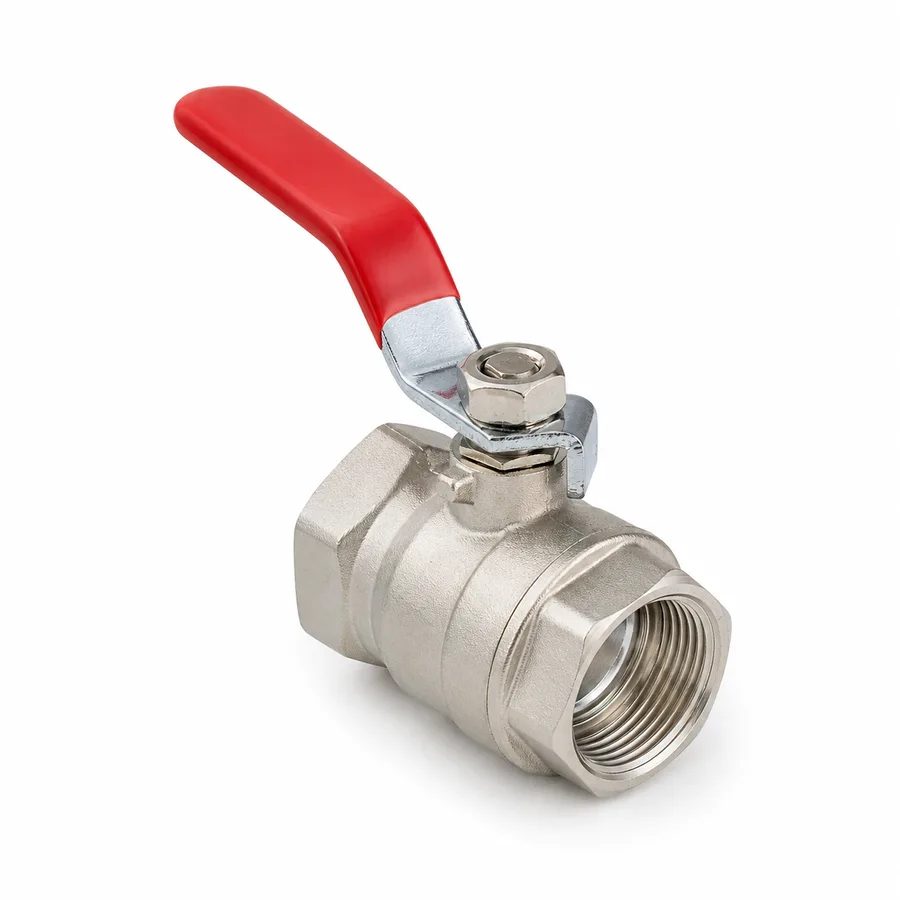
NPT threaded ball valves with a cast bronze ASTM B584 C84400 body, chrome-plated brass ball ASTM B124 C37700 or ASTM B16 C36000, silicon bronze stem ASTM B371 C69300 and reinforced PTFE seat. The line's reference rating is 600 WOG/CWP (41.4 bar) at ≤38 °C per MSS SP-110: a cold pressure certified by the manufacturer, not an ASME Class. This sheet gathers the dimensional table of the two-piece full-port threaded pattern, the dual point of 150 psi saturated steam at 185.5 °C, and the difference between the full-port references (Napoli, 1/4″–4″) and the compact reduced-port ones (yellow handle, mini female-female, mini male-female, terminal).
Important: Before using these data in engineering, design or installation decisions on systems exposed to mechanical, pressure, rupture, fatigue, impact or water-hammer risk, it is essential to read the technical notice and limitation of liability at the end of this sheet.
SKU VT-59187 (bronze Napoli ball valve) · 6 bronze and brass references, full and reduced port, 1/4″–4″ · sold by the unit
1. Technical specifications
Materials by component
| Component | Material | Designation | Remark |
|---|---|---|---|
| Body and cap | Cast bronze | ASTM B584 alloy C84400 | Sand-cast leaded tin-zinc bronze; the standard body alloy in this family |
| Ball | Hard chrome-plated brass | ASTM B124 alloy C37700 or ASTM B16 alloy C36000 | The plating reduces wear against the seat and improves sealing after thousands of cycles |
| Stem | Silicon bronze | ASTM B371 alloy C69300 | Higher mechanical strength and dezincification resistance than plain brass; blowout-proof assembly |
| Seat and seals | Reinforced PTFE (RPTFE) | PTFE compound with 15–25 % glass fiber | Sets the valve's real thermal limit — see section 2 |
| Handle | Coated steel lever on the two-piece references; short handle on the compact ones | Confirmed on quotation | Handle finish and material vary by lot and by reference |
TECTUL catalog references in bronze and brass
| Reference | Construction | Port | Catalog diameters |
|---|---|---|---|
| Bronze Napoli ball valve (VT-59187) | Two pieces threaded together, lever handle | Full port | 1/4″ · 3/8″ · 1/2″ · 3/4″ · 1″ · 1-1/4″ · 1-1/2″ · 2″ · 2-1/2″ · 3″ · 4″ (11 diameters) |
| Yellow handle ball valve | Compact body, short handle | Reduced port on several diameters | 1/4″ · 3/8″ · 1/2″ · 3/4″ · 1″ · 1-1/4″ · 1-1/2″ · 2″ (8 diameters) |
| Mini female-female ball valve | Compact body, mini format, two female ends | Reduced port | 1/4″ · 3/8″ · 1/2″ (3 diameters) |
| Mini male-female ball valve | Compact body, mini format, one male end | Reduced port | 1/4″ · 3/8″ · 1/2″ (3 diameters) |
| Napoli terminal ball valve | Compact body, male hose outlet | Reduced port | 1/2″ (2 catalog presentations) |
| Bronze shutoff cock | Bronze shutoff for service connections | Confirmed on quotation | Confirmed on quotation |
IMPORTANT
This data sheet is a reference guide to the properties of this product type. The measurements, dimensions and physical or geometric characteristics of the product actually supplied may vary by manufacturer and lot, and may even fall outside the cited standards. If any of these figures is critical to your design or build, it is essential to verify it with one of our advisors against the physical product, so you can be fully certain of what you are buying. · Original data sheet: tectul.com/en/conduccion-de-fluidos/valvulas/ficha-tecnica-valvula-bola-bronce-napoli.html
On the compact references (yellow handle, mini female-female, mini male-female and terminal) the product page does not state the exact body alloy: they are brass or bronze bodies depending on supplier and lot, and the ASTM designation is confirmed on quotation. The "bronze shutoff cock" reference is published in the catalog with no diameters: its dimensional scope is confirmed on quotation.
Reference dimensions — threaded NPT bronze, two-piece, full port
| NPS | A — overall length (end to end) | B — height with handle | C — body width | D — NPT thread | Weight | ||||
|---|---|---|---|---|---|---|---|---|---|
| mm | in | mm | in | mm | in | kg | lb | ||
| 1/4″ | 51 | 2.00 | 44 | 1.75 | 127 | 5.00 | 1/4″ | 0.21 | 0.45 |
| 3/8″ | 51 | 2.00 | 44 | 1.75 | 127 | 5.00 | 3/8″ | 0.21 | 0.45 |
| 1/2″ | 62 | 2.44 | 48 | 1.88 | 132 | 5.19 | 1/2″ | 0.29 | 0.64 |
| 3/4″ | 75 | 2.94 | 57 | 2.25 | 159 | 6.25 | 3/4″ | 0.60 | 1.33 |
| 1″ | 85 | 3.34 | 60 | 2.38 | 164 | 6.44 | 1″ | 0.81 | 1.79 |
| 1-1/4″ | 106 | 4.19 | 76 | 3.00 | 171 | 6.75 | 1-1/4″ | 1.41 | 3.12 |
| 1-1/2″ | 120 | 4.72 | 80 | 3.16 | 230 | 9.06 | 1-1/2″ | 2.17 | 4.78 |
| 2″ | 131 | 5.16 | 89 | 3.50 | 235 | 9.25 | 2″ | 3.03 | 6.68 |
IMPORTANT
This data sheet is a reference guide to the properties of this product type. The measurements, dimensions and physical or geometric characteristics of the product actually supplied may vary by manufacturer and lot, and may even fall outside the cited standards. If any of these figures is critical to your design or build, it is essential to verify it with one of our advisors against the physical product, so you can be fully certain of what you are buying. · Original data sheet: tectul.com/en/conduccion-de-fluidos/valvulas/ficha-tecnica-valvula-bola-bronce-napoli.html
Dimensional series of the reference threaded model (NIBCO T-585-70, cast bronze C84400 body, conforming to MSS SP-110), taken as manufacturer catalog evidence — not necessarily the exact dimension of each real TECTUL supplier. For 2-1/2″, 3″ and 4″ the face-to-face dimension is confirmed on quotation of the specific reference. The compact references (yellow handle, mini and terminal) have their own, shorter envelope, also confirmed on quotation.
General specifications
| Product | Threaded bronze and brass ball valves, two-piece (full port) and compact (reduced port), for on-off shutoff service |
| Material | Cast bronze body ASTM B584 C84400 · brass ball ASTM B124 C37700 or ASTM B16 C36000 with hard chrome plating · silicon bronze stem ASTM B371 C69300 · RPTFE seat and seals |
| Ends | Female NPT thread per ASME B1.20.1; male hose end on the terminal reference |
| Rating | 600 WOG (CWP) at ≤38 °C, a manufacturer catalog value conforming to MSS SP-110 — not an ASME B16.34 Class. Published dual point: 150 psi in saturated steam (185.5 °C) |
| Commercial range | 1/4″–4″ on the full-port Napoli reference; 1/4″–2″ on the reduced-port compact ones; 6 active references in TECTUL's bronze and brass catalog |
| Sale | By the unit, per reference and diameter — |
| Applicable standards | MSS SP-110-2010 (ball valves threaded, socket-welding, solder joint, grooved and flared ends) · ASME B1.20.1-2013 (R2018) (NPT thread) · ASTM B584 (body) · ASTM B124 and ASTM B16 (brass ball) · ASTM B371 (silicon bronze stem) |
⚠ Important: this technical data sheet is a reference guide to the product's properties; it is not a quality certificate for the product you are buying. Heats vary from one another and may differ from the values stated here, or even depart from the standards. If your application requires compliance with a standard, always check the quality certificate (mill certificate) of the lot you are buying. If in doubt, ask one of our technical advisors →
2. The 600 WOG (CWP) rating: what it means and how far it goes
WOG and CWP are the same number, and it is not an ASME Class
When the body of a bronze ball valve reads 600 WOG, that number is the Cold Working Pressure (CWP): the maximum allowable pressure with water, oil or non-flammable gas (Water-Oil-Gas), measured cold, between −29 °C and +38 °C (−20 °F to 100 °F). WOG and CWP are commercial synonyms for the same value. It is not an ASME B16.34 Class: a class is a full pressure-temperature table by material group, with a different value at each temperature step; WOG is a single number the manufacturer certifies at the cold reference temperature. MSS SP-110 —the standard governing this family— requires each valve to declare its "Pressure-Temperature Ratings" section, but does not itself publish a mandatory derating table for the whole standard. That is why two equally MSS SP-110-compliant bronze valves can carry different ratings.
The verified dual point of the bronze line: 600 WOG cold / 150 psi in steam
The most complete data pair TECTUL could verify in a manufacturer catalog conforming to this standard, for a C84400 bronze body, is the following:
| Condition | Allowable pressure | Reference temperature |
|---|---|---|
| Cold WOG/CWP | 600 psi · 41.4 bar | ≤ 38 °C (100 °F) |
| Saturated steam | 150 psi · 10.3 bar | 185.5 °C (365.9 °F) — saturation temperature at 150 psig per saturated steam table |
IMPORTANT
This data sheet is a reference guide to the properties of this product type. The measurements, dimensions and physical or geometric characteristics of the product actually supplied may vary by manufacturer and lot, and may even fall outside the cited standards. If any of these figures is critical to your design or build, it is essential to verify it with one of our advisors against the physical product, so you can be fully certain of what you are buying. · Original data sheet: tectul.com/en/conduccion-de-fluidos/valvulas/ficha-tecnica-valvula-bola-bronce-napoli.html
Both points come from the manufacturer's catalog (not a TECTUL average or interpolation); the 185.5 °C saturation temperature is obtained from the saturated steam table, not from the catalog. The curve between the two points is neither linear nor published by the standard: an intermediate value requires the specific quoted reference's own manufacturer curve.
What the 600 WOG figure does allow you to decide
Even without a universal derating table, the pair of points above allows a conservative bound on almost any water, compressed air or oil selection in a typical Colombian installation: below 10.3 bar and 185.5 °C the valve is inside the manufacturer's published working envelope, because 10.3 bar is the pressure the line sustains at the worst declared thermal condition. That is the bounding criterion used in the following example.
- Design pressure: 6 bar = 87 psi. The valve's cold rating is 600 psi (41.4 bar) at ≤38 °C, so the design pressure is 14.5 % of the cold rating.
- Design temperature: 85 °C, above the 38 °C of the WOG point. The 600 psi figure no longer applies as such: you must come down the manufacturer's curve.
- Verified bounds: the only two published points are 600 psi at ≤38 °C and 150 psi at 185.5 °C. The allowable pressure at 85 °C lies between the two, but the curve is not linear and the standard does not publish it.
- Conservative bound: taking the lower of the two known points (150 psi = 10.3 bar, which corresponds to a temperature far above the design one), the 6 bar design pressure still sits below it with a 42 % margin.
- Seat check: 85 °C is within the range of virgin PTFE (up to ≈180 °C) and RPTFE (up to 232 °C), so the seat is not the limiting factor.
- Conclusion: a viable selection with margin. If the project requires a certified figure at 85 °C rather than a bound, TECTUL requests the P-T curve from the real manufacturer of the quoted reference.
The real thermal limit is set by the seat, not by the bronze
C84400 bronze is not what cuts this valve's service temperature: the body withstands considerably more than the seat does. What governs is the polymer:
| Seat | Typical catalog thermal range |
|---|---|
| Virgin PTFE | Approx. −20 °C to +180 °C (valve industry seat selection guides) |
| RPTFE (15–25 % glass fiber) | −45 °C to +232 °C (−50 °F to 450 °F) |
IMPORTANT
This data sheet is a reference guide to the properties of this product type. The measurements, dimensions and physical or geometric characteristics of the product actually supplied may vary by manufacturer and lot, and may even fall outside the cited standards. If any of these figures is critical to your design or build, it is essential to verify it with one of our advisors against the physical product, so you can be fully certain of what you are buying. · Original data sheet: tectul.com/en/conduccion-de-fluidos/valvulas/ficha-tecnica-valvula-bola-bronce-napoli.html
Above these ranges PTFE loses its sealing elasticity (creep) long before the bronze body fails from pressure. That is why the body's "cold" rating is almost never the number that governs at high temperature: the seat governs.
3. Construction: full port, reduced port and blowout-proof stem
Two threaded pieces versus a compact one-piece body
The Napoli reference is two pieces threaded together (body + cap): the cap unscrews from the body and gives access to the ball and seat, although doing so requires removing the valve from the line or installing unions upstream and downstream. It is the most widely used bronze construction on water and compressed air lines. The yellow handle, mini female-female, mini male-female and terminal references are compact one-piece bodies: cheaper and shorter, but not serviceable — when the seat fails, the whole valve is replaced. Their natural place is therefore service-connection shutoff, drain points and light domestic or commercial installations, not continuous process lines.
Full port and reduced port: which is which in this catalog
In a full port valve the ball bore equals the pipe's nominal diameter: the fluid sees no restriction and head loss is practically that of an equivalent straight run. In a reduced port valve the bore is one or two steps smaller than the connection, allowing a far more compact and economical body in exchange for appreciable head loss and a higher local velocity through the bore.
| Reference | Port | Typical use |
|---|---|---|
| Bronze Napoli ball valve | Full port | General shutoff on water, compressed air and oil lines; tank outlets; pumping lines |
| Yellow handle ball valve | Reduced port on several diameters | Light domestic and commercial shutoff, service connections, risers |
| Mini female-female ball valve | Reduced port | Instrumentation shutoff, drains, pressure gauge take-offs |
| Mini male-female ball valve | Reduced port | Same as above, when one end must thread directly into a female fitting without a nipple |
| Napoli terminal ball valve | Reduced port | Hose outlet at laundry sinks, gardens and equipment washdown; not a process line valve |
When head loss is part of the hydraulic calculation —pumping lines, fire networks, suctions— full port is specified. For general shutoff at small diameters the difference is rarely critical.
Blowout-proof stem
The C69300 silicon bronze stem is fitted from inside the body, with a shoulder that bears against the body before reaching the packing. Even if the packing fails or the gland nut loosens, internal pressure cannot eject the stem outward: it only produces a leak the gland can control. This is the construction explicitly declared by the reference bronze line under MSS SP-110 and the de facto standard in process ball valves. On that geometry, moderate retightening of the gland nut usually stops a stem leak without dismantling anything.
NPT threading: what ruins a bronze body
The cast bronze body is the weak part against over-tightening. The NPT thread is tapered and seals by interference, so torque rises very fast on the last turns; past the sealing point that torque becomes hoop stress on the body's mouth and can crack it. Seal with PTFE tape or a fluid-compatible sealant, tighten by hand to the stop and finish with a wrench only for the turns needed to seal, always holding the valve by the hex of the end being threaded — never by the central body or the handle.
4. Frequently asked questions
How much pressure does a 1/2″ bronze ball valve withstand?
The reference line in this sheet is certified at 600 WOG (CWP): 600 psi, 41.4 bar, with water, oil or non-flammable gas, cold (up to 38 °C). That figure is the same across all diameters of the line, from 1/4″ to 4″: on bronze ball valves the rating does not drop with diameter as it does in other families. What changes with diameter is operating torque and weight, not allowable pressure.
Is a bronze ball valve suitable for steam?
The reference bronze line publishes a rating of 150 psi (10.3 bar) in saturated steam, corresponding to 185.5 °C. So yes, it accepts steam, but at a fraction of the WOG figure stamped on the body. Never use the 600 WOG as a steam pressure. And bear in mind the ball valve is an on-off device: it is not specified for throttling steam, because partial opening erodes the PTFE seat very quickly.
Can I use this bronze valve on a domestic fuel gas network?
The "G" in WOG refers to non-flammable gas. A fuel gas network requires valves specifically certified for that service under the applicable regulation, and the WOG rating does not grant that certificate. For fuel gas you specify the gas-certified reference, not a generic bronze water-line ball valve.
What is the difference between the Napoli ball valve and the mini or yellow-handle ones?
The Napoli is two threaded pieces and full port, with the complete 1/4″ to 4″ range: it is the line valve. The mini female-female, mini male-female and yellow-handle valves are compact one-piece bodies with reduced port on several of their diameters, up to 2″ maximum: they are for domestic shutoff, service connections, drains or instrumentation take-offs. If head loss enters the hydraulic calculation, the Napoli is specified.
Why is the stem silicon bronze rather than the same brass as the ball?
Because the stem is the part loaded in torsion every time the valve is operated and the one that takes the thrust of internal pressure. Silicon bronze C69300 (ASTM B371) has higher mechanical strength and better dezincification behavior in water than the free-cutting brass of the ball, which in turn is chosen for machinability and because it takes hard chrome plating well.
5. Application notes
Feasibility
Bronze and brass are the usual threaded ball valve solution for potable water, domestic hot water, compressed air and oil in diameters from 1/4″ to 4″. They are not specified for seawater, brine, ammonia or ammoniacal solutions (risk of dezincification and stress corrosion cracking in copper-zinc alloys), nor for sanitary food service: in those cases selection moves to the CF8M stainless line. The compact one-piece references (yellow handle, mini female-female, mini male-female, terminal) are neither serviceable nor continuous process line valves.
Installation
Seal the NPT thread with PTFE tape or a fluid-compatible sealant and do not exceed the manufacturer's recommended tightening torque: over-tightening cracks the cast bronze body or deforms the female thread. Always hold the valve by the hex of the end being threaded, never by the handle. Operate the valve fully open or fully closed — MSS SP-110 covers on-off service valves and only permits throttling if the manufacturer explicitly authorizes it for that reference. In steam service do not exceed the published saturated steam rating (150 psi on the reference line) even though the cold WOG rating is four times higher. A stem leak is usually solved by moderately retightening the gland nut, without removing the valve.
Design
This line's rating is the manufacturer's WOG/CWP at ≤38 °C, not an ASME Class: do not interpolate or assume a linear derating between the 600 psi cold point and the 150 psi saturated steam point without the real supplier's curve. For design temperatures above 38 °C, bound conservatively with the lowest published point or request the reference's full P-T curve before specifying it. Final selection of rating, material and end type is the responsibility of the line designer per the project code (ASME B31.3, B31.1, the applicable NTC or other) and its current edition.
6. Technical notice and limitation of liability
The ratings in this sheet are WOG/CWP values published in manufacturer catalogs declaring conformance to MSS SP-110-2010, or catalog thermal ranges for PTFE/RPTFE seats from the valve industry; they guide selection and are not a certificate of conformance for any lot. MSS SP-110 issues no single pressure-temperature table for the whole standard: each reference's exact P-T curve is certified by its real manufacturer, and TECTUL confirms it on quotation. The saturated steam point (150 psi / 185.5 °C) and the 1/4″ to 2″ dimensional table are evidence from one specific manufacturer's line, not figures automatically applicable to any bronze valve in this family.
Certifying a lot requires the manufacturer's MTC per each component's ASTM specification (B584 for the body, B124 or B16 for the ball, B371 for the stem) and legible valve marking on the body. Final selection of rating, material and end type is the responsibility of the line designer per the project code (ASME B31.3, B31.1 or other) and its current edition.
Sources
- MSS SP-110-2010 (incluye fe de erratas del 23-ago-2010) — Ball Valves Threaded, Socket-Welding, Solder Joint, Grooved and Flared Ends (alcance NPS 1/4″–4″; aleaciones de cobre entre los materiales cubiertos; estructura de la norma: Scope, Pressure-Temperature Ratings, Materials, Design, Dimensions, Marking, Testing)
- ASME B1.20.1-2013 (R2018) — Pipe Threads, General Purpose, Inch (rosca NPT de los extremos)
- ASTM B584 — Standard Specification for Copper Alloy Sand Castings for General Applications (aleación C84400, cuerpo y tapa de bronce fundido)
- ASTM B124/B124M — Standard Specification for Copper and Copper Alloy Forging Rod, Bar, and Shapes (aleación C37700, bola de latón)
- ASTM B16/B16M — Standard Specification for Free-Cutting Brass Rod, Bar and Shapes (aleación C36000, bola y prensaestopas de latón)
- ASTM B371/B371M — Standard Specification for Copper-Zinc-Silicon Alloy (Silicon Brass/Bronze) Rod (aleación C69300, vástago de bronce silíceo)
- NIBCO INC. — Bronze Ball Valves T-585-70 (Threaded) / S-585-70 (Solder), Spec Sheet rev. 19-jul-2018 (media.nibco.com), conforme a MSS SP-110: 600 psi/41,4 bar CWP en frío, 150 psi/10,3 bar en vapor saturado, lista de materiales por componente, vástago antiexpulsión y tabla dimensional 1/4″–2″
- NIBCO INC. — NIBCO® Press System® Bronze Ball Valves TPC-585-70, Spec Sheet rev. 21-may-2015 (catalog.nibco.com): confirma la conformidad de la línea de bronce con MSS SP-110 y el rating base de 600 PSI CWP antes del downrate por conexión press
- Tabla de vapor saturado (Engineering ToolBox / TLV Toolbox Saturated Steam Tables): temperatura de saturación a 150 psig = 365,9 °F / 185,5 °C
- LINS Valve — Ball Valve Seat Material Guide: PTFE vs RPTFE vs PEEK vs Metal (rango térmico de catálogo del asiento RPTFE con 15–25 % de fibra de vidrio: −50 °F a 450 °F / −45 °C a 232 °C)
- ASME B16.34-2020 — Valves — Flanged, Threaded, and Welding End (referencia de contraste: las Clases ASME son tablas presión-temperatura completas por grupo de material, a diferencia del número único WOG/CWP)
This data sheet is the property of TECTUL, part of the Industrias IMR group. Reproduction without attribution is prohibited. Original document and updates: tectul.com/en/conduccion-de-fluidos/valvulas/ficha-tecnica-valvula-bola-bronce-napoli.html.