 TECTULby IMR
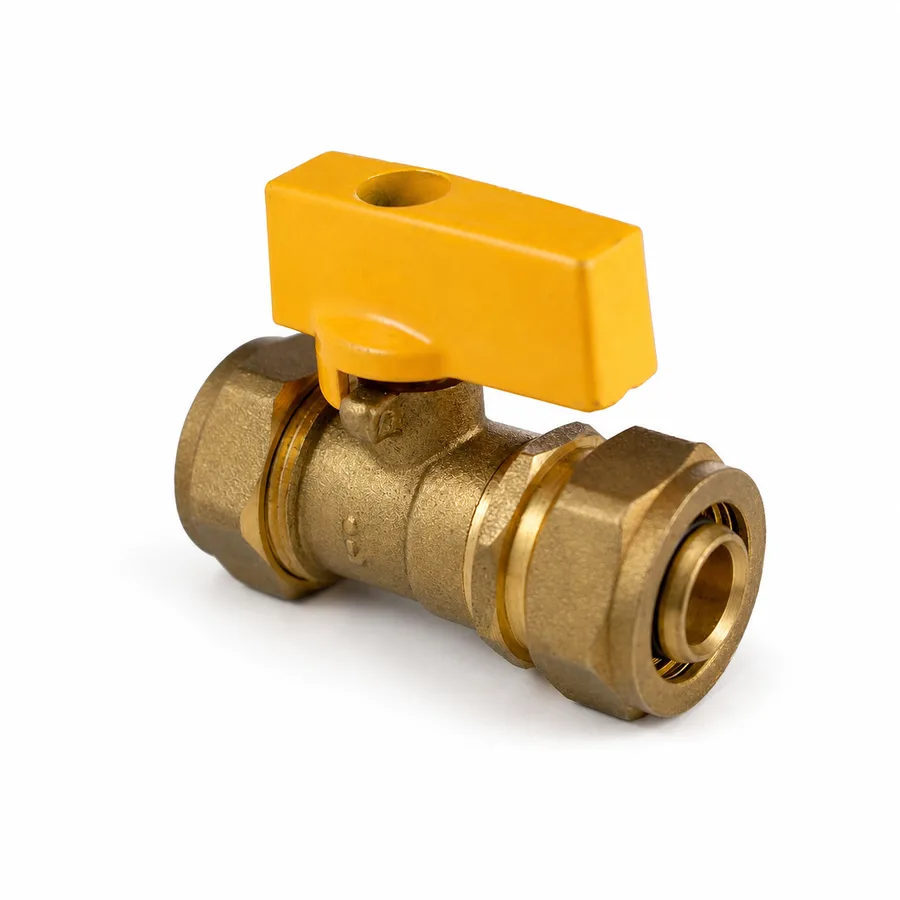
Compression-end ball valve for PE-AL-PE / PEX-AL-PEX multilayer pipe (EN ISO 21003)
TECTUL · Dispatch across Colombia · Exports to Central & South America
Ball valve with a metallic body — brass or bronze — and compression ends designed to take PE-AL-PE / PEX-AL-PEX multilayer pipe directly, with no intermediate fitting, no heat, no cement and no thread on the pipe. The catalog coding (1216, 1418, 1620, 2025) is the standard multilayer one: the first two digits are the nominal inside diameter in millimetres and the last two the outside diameter. The figure that decides the installation and that almost no catalog clarifies: the PN16 rating at 20 °C under EN ISO 21003 belongs to the pipe-plus-fitting assembly, not to the valve on its own — mixing brands or dimensional classes of multilayer pipe voids the published figure. This sheet details the compression joining procedure, what the intermediate aluminium layer contributes, and what must be verified before using it on a domestic gas network.
Important: Before using these data in engineering, design or installation decisions on systems exposed to mechanical, pressure, rupture, fatigue, impact or water-hammer risk, it is essential to read the technical notice and limitation of liability at the end of this sheet.
SKU VT-59190 (PE-AL-PE ball valve) · 5 catalog variants: 1216 (1/2″ standard), 1418 (1/2″ oversize), 1620 (3/4″), 2025 (1″) and 1216 × 1/2″ NPT
1. Technical specifications
TECTUL catalog variants — coding and equivalence
| Code | Commercial name | Nominal inside Ø | Pipe outside Ø | Ends |
|---|---|---|---|---|
| 1216 | 1/2″ standard | 12 mm | 16 mm | compression at both ends |
| 1418 | 1/2″ oversize | 14 mm | 18 mm | compression at both ends |
| 1620 | 3/4″ | 16 mm | 20 mm | compression at both ends |
| 2025 | 1″ | 20 mm | 25 mm | compression at both ends |
| 1216 × 1/2″ NPT | 1/2″ standard with threaded transition | 12 mm | 16 mm | compression at one end, 1/2″ NPT thread at the other |
IMPORTANT
This data sheet is a reference guide to the properties of this product type. The measurements, dimensions and physical or geometric characteristics of the product actually supplied may vary by manufacturer and lot, and may even fall outside the cited standards. If any of these figures is critical to your design or build, it is essential to verify it with one of our advisors against the physical product, so you can be fully certain of what you are buying. · Original data sheet: tectul.com/en/conduccion-de-fluidos/valvulas/ficha-tecnica-valvula-bola-pe-al-pe.html
The four-digit coding is the standard one for multilayer piping systems: the first two digits are the nominal inside diameter in millimetres and the last two the outside diameter. So 1620 connects pipe of 20 mm outside and 16 mm inside diameter. The commercial name in inches is local trade custom, not a standard designation: 1216 and 1418 are both sold as "1/2″" and they are not interchangeable — they are pipes of different outside diameter, 16 and 18 mm.
Materials, construction and standards
| Body | Forged or machined brass or bronze depending on reference — the valve is not plastic: what is plastic is the pipe it receives. The exact alloy is confirmed on quotation. |
| Closure member | Drilled ball with 1/4-turn operation and a 90° mechanical stop, with a butterfly handle or lever depending on reference. |
| Seat and seals | PTFE seats and elastomeric o-rings; at the compression end, o-rings on the inner insert seal against the inner wall of the multilayer pipe. |
| Compression ends | Assembly of compression nut, compression ring and inner insert dimensioned for the multilayer pipe of the corresponding code. It takes the pipe directly, with no intermediate fitting. |
| Pipe received | Multilayer PE-AL-PE / PEX-AL-PEX: inner polyethylene, longitudinally welded intermediate aluminium layer and outer polyethylene (section 4). |
| Nominal pressure | PN16 at 20 °C (16 bar / 232 psi) for water without shock, referred to the pipe-plus-fitting assembly under EN ISO 21003 (section 2). |
| Applicable standards | EN ISO 21003 (multilayer piping systems for hot and cold water installations inside buildings: pipes, fittings and fitness for purpose parts) · ASTM F1281 (PEX-AL-PEX pressure pipe) · ASTM F1974 (metal insert fittings for PE-AL-PE and PEX-AL-PEX composite pipe) · NTC 2505 (installations for combustible gas supply for residential and commercial use), when the intended service is domestic gas. |
The valve has a metallic body and therefore neither the PVC temperature derating nor the PP-R class table applies to it. What limits the assembly is not the valve metal but the multilayer pipe and the compression joint: the weakest link governs, and that link is in the plastic, not in the bronze.
⚠ Important: this technical data sheet is a reference guide to the product's properties; it is not a quality certificate for the product you are buying. Production lots vary from one another and may differ from the values stated here, or even depart from the standards. If your application requires compliance with a standard, always check the quality certificate (mill certificate) of the lot you are buying. If in doubt, ask one of our technical advisors →
2. PN16 belongs to the system, not to the valve alone
PN16 is not the valve's: it belongs to the system
In multilayer piping systems, EN ISO 21003 does not certify loose parts but systems. The pipes part sets requirements for the pipe, the fittings part for the fitting, and a specific fitness for purpose part requires testing the assembled pipe-plus-fitting combination: sustained internal pressure at temperature, thermal cycling, pressure cycling, pull-out resistance of the pipe from the fitting and tightness under bending. The published PN16 at 20 °C figure is the result of testing that specific combination, not of adding two independent ratings.
The practical consequence is blunt and almost nobody writes it down: if the multilayer pipe installed is not the one from the system that was tested, the published figure loses its backing. The geometry of the compression joint depends on three pipe dimensions — outside diameter, wall thickness and inside diameter — and on the position of the aluminium layer. Two pipes both sold as "1/2″" may be 1216 and 1418, with 16 and 18 mm outside diameter: the compression ring of one does not bite the other correctly. And between two pipes of the same code from different manufacturers, the thickness tolerances of the polyethylene layers may differ enough for the inner insert to sit loose or for the ring to over-compress and cut the outer layer.
- Identify the four-digit code of the project's pipe (1216, 1418, 1620, 2025), not the name in inches.
- Confirm the pipe's brand and dimensional class, not just the code: that is what defines the thickness tolerances.
- Verify that valve and pipe belong to the same tested system, or that the valve manufacturer declares compatibility with that pipe. TECTUL confirms that compatibility on quotation.
- If the project already has pipe installed from one brand and the valve is bought from another, document the decision: the published rating is no longer traceable to a fitness-for-purpose test of the assembly.
What this rating is NOT
- It is not a WOG rating nor an ASME class. The brass or bronze body withstands far more than 16 bar; the limit is the compression joint and the plastic pipe, not the metal.
- It is not derated with the PVC table. The 0.88 / 0.75 / 0.62 factors belong to a different polymer and a different regulatory framework; applying them here is a methodological error.
- It is not constant with temperature. As in every thermoplastic system, allowable pressure is combined with service temperature and service life through the system application classes; PN16 is the value at 20 °C.
- It does not automatically cover gas. Water and gas are different services with different regulatory frameworks (section 4).
3. Compression joining step by step
Compression joining: no heat, no cement and no thread on the pipe
The operational advantage of this valve is that it needs none of the three joining technologies that dominate the rest of the catalog: no fusion tool as in PP-R, no solvent cement as in PVC, and no thread cut onto the pipe. The seal is made by mechanical compression of the ring against the multilayer pipe wall, supported from inside by the valve's inner insert. It is a reversible joint: the nut can be loosened, the pipe removed and the joint remade with a new ring.
- Square cut. Cut the pipe perpendicular to its axis with multilayer pipe shears or a wheel cutter. A bevelled cut leaves the ring unevenly supported and is the most common cause of leaks in compression joints.
- End calibration and chamfering. If the cut left the end oval, run the calibrating tool to restore the circular section and lightly chamfer the inside. An oval end does not seat fully in the insert and does not seal; forcing it scrapes the insert o-rings.
- Fit nut and ring onto the pipe, in that order and with the ring correctly oriented (chamfer towards the nut). This is done before inserting the pipe: if forgotten, the pipe has to be cut and the sequence restarted.
- Insert the pipe fully onto the inner insert of the valve, until it bottoms out. A depth mark made beforehand with a marker allows visual confirmation that it did not back off during tightening.
- Tighten the nut with two wrenches: one holding the body or the end hexagon and the other turning the nut. Tighten by hand and then to the number of turns or the torque stated by the system manufacturer. Over-tightening cuts the outer polyethylene layer; under-tightening leaves the ring without bite.
- Tightness test with the network pressurised, checking every joint before closing walls or ceilings.
The errors seen in the field
| Error | Consequence |
|---|---|
| Bevelled cut or oval end left uncalibrated | Uneven support of the ring and o-rings: a leak that appears or disappears with pressure and cannot be corrected by tightening further. |
| Pipe not fully seated against the insert | The insert o-rings sit outside the sealing zone; the pipe may also pull out under pressure and water hammer. |
| Ring reversed or reused from a previous assembly | The ring deforms plastically when tightened: reusing it does not restore the interference. Every dismantled joint needs a new ring. |
| Over-tightened nut | The outer polyethylene layer is cut and the pipe crushed against the insert, restricting the bore. |
| Wrench applied to the lever or body instead of the hexagon | Deformation of the body and the ball housing: the valve never closes properly again. |
4. The aluminium layer, domestic gas and service limits
What the intermediate aluminium layer does
The pipe this valve receives is not plain polyethylene: it is a three-layer composite — inner polyethylene, longitudinally welded aluminium and outer polyethylene — bonded with structural adhesive. That intermediate metallic foil, only tenths of a millimetre thick, contributes two properties no single-layer thermoplastic has:
- Oxygen barrier. Polyethylene is permeable to atmospheric oxygen, which diffuses through the wall and feeds corrosion of the ferrous components in the circuit: boilers, heat exchangers, pumps, radiators. The aluminium layer cuts that diffusion almost completely, which is why multilayer dominates heating and hot water installations over pure polyethylene.
- Shape memory. A pure polyethylene pipe bent by hand tends to spring back straight and collapse the bend radius. Aluminium deforms plastically and holds the bend: the pipe is bent by hand or with a spring and stays where it was put, which eliminates elbows, fittings and potential leak points on a route with many direction changes. The same aluminium also reduces linear thermal expansion compared with unreinforced polyethylene.
The trade-off: aluminium is also the component that demands respecting the minimum bend radius and not cold-bending below it. A tight kink cracks the metallic foil, the oxygen barrier is lost and a fatigue point appears that the outer polyethylene layer hides from view.
Domestic gas service: what must be confirmed first
The catalog lists this valve for water and for domestic gas, but the PN16 water rating is not authorisation for gas. In Colombia, an internal combustible gas network for residential or commercial use is governed by the installation standard in force (NTC 2505 and the applicable technical regulation), which imposes its own requirements on materials, operating pressure, tightness testing and installer competence. Added to that is the rating of the service regulator, which fixes the actual service pressure downstream.
Before specifying this valve on a gas network three things must be confirmed: that the reference and the multilayer pipe are declared by the manufacturer as suitable for the intended gas service; that the installation complies with the internal-network standard in force; and that the operating pressure downstream of the service regulator is within the declared range. TECTUL confirms those three points on quotation, according to the project's use — suitability for gas must not be assumed from the water rating.
When this valve is the right choice and when it is not
It suits networks already executed in multilayer pipe where a shut-off point is needed without introducing an extra joining technology: no fusion tool, no cement and no thread-cutting die has to be brought to site, and a plumber with two wrenches does the job. It also suits embedded installations where a reversible joint is valuable. It does not suit projects whose pipe belongs to another system or an unconfirmed brand (section 2), points requiring a valve certified for a specific service this reference does not declare, or exposed positions with frequent operation: the compression joint tolerates repeated stress transmitted from the lever to the pipe poorly.
5. Frequently asked questions
What do the numbers 1216, 1418, 1620 and 2025 mean?
They are the multilayer piping system coding: the first two digits are the nominal inside diameter in millimetres and the last two the outside diameter. 1620 takes pipe of 20 mm outside and 16 mm inside diameter. Beware of the trade's inch naming: 1216 and 1418 are both sold as "1/2″" and they are not interchangeable, because the pipe is 16 and 18 mm outside diameter respectively.
Can I connect this valve to any multilayer pipe?
Not without confirming it. The PN16 rating at 20 °C under EN ISO 21003 belongs to the tested pipe-plus-fitting assembly, not to the valve on its own. Changing pipe brand or dimensional class changes the thickness tolerances and the compression geometry, and the published figure loses its backing. Exact compatibility with the project pipe is confirmed on quotation.
Do I need a fusion tool or cement to install it?
No. The joint is mechanical compression: square cut, end calibration, nut and ring onto the pipe, full insertion against the insert and tightening of the nut with two wrenches. No heat, no cement and no thread on the pipe. It is also reversible, provided the compression ring is replaced every time it is dismantled.
What is the aluminium layer of the multilayer pipe for?
Two things: it is an oxygen barrier, preventing atmospheric oxygen from diffusing through the wall and corroding the ferrous components of the circuit, and it gives shape memory, so pipe bent by hand stays where it was put and elbows are saved. In exchange it requires respecting the minimum bend radius: a tight kink cracks the foil and the barrier is lost.
Is it suitable for domestic gas?
The catalog lists it for water and domestic gas, but the water rating does not authorise gas service on its own. The internal-network installation standard in force in Colombia (NTC 2505 and the applicable technical regulation) also applies, together with the rating of the service regulator, which fixes the actual downstream pressure. This is confirmed on quotation according to the project's use.
Why does the joint drip even though I keep tightening the nut?
Almost always for one of three reasons, and none is fixed by more tightening: a bevelled cut or an oval end left uncalibrated, a pipe not fully seated against the inner insert, or a ring reused from a previous assembly. The ring deforms plastically the first time it is tightened: every dismantled joint needs a new ring. Continuing to tighten cuts the outer polyethylene layer and makes the leak worse.
6. Application notes
Feasibility
This is the right valve when the network is already built in PE-AL-PE / PEX-AL-PEX multilayer pipe and a shut-off point is needed without introducing fusion or cement. Before buying, identify the four-digit code of the project pipe (1216, 1418, 1620, 2025) and not the inch name: 1216 and 1418 are both sold as "1/2″" and are not interchangeable. Also confirm the pipe brand and dimensional class, because the PN16 rating belongs to the tested assembly. For domestic gas, suitability is not inferred from the water rating: the internal-network installation standard in force and the service regulator rating apply. For critical or safety applications, consult our technical team before specifying.
Installation
Square cut with multilayer pipe shears or a wheel cutter; calibrate and chamfer the end if it came out oval; nut and ring onto the pipe before insertion, with the ring chamfer facing the nut; full insertion against the inner insert, with a depth mark to verify it did not back off; tighten the nut with two wrenches, one holding the end hexagon and the other turning, never levering against the body or the handle. The compression ring is not reused: every dismantled joint needs a new ring. Tightness test before closing walls or ceilings, and respect the pipe minimum bend radius so the aluminium foil is not cracked.
Design
Always specify valve and pipe as a single system: the EN ISO 21003 PN16 at 20 °C comes from testing the assembled joint — sustained pressure, thermal and pressure cycling, pull-out and tightness under bending — not from adding two independent ratings. Do not apply the PVC derating table or the PP-R class framework to this assembly. Remember that the brass or bronze body withstands far more than 16 bar: the weak link is the compression joint and the plastic pipe, and that is where verification must concentrate. At frequently operated or exposed points, provide pipe support close to the valve so that lever effort is not transmitted to the joint.
7. Technical notice and limitation of liability
The pressures and temperatures in this sheet are nominal values published in the standards and sources cited (EN ISO 21003, ASTM F1281, ASTM F1974) or system-manufacturer catalog evidence for the 20 °C reference point. They guide selection; they are not a certificate of conformity for any production lot nor an independent test of the catalog reference.
The published rating corresponds to the pipe-plus-fitting assembly of the tested system. Mixing brands, dimensional classes or multilayer pipe codes other than those declared, or executing the compression outside the manufacturer procedure (bevelled cut, uncalibrated end, reused ring, over-tightening), voids that figure. Certifying a reference requires the manufacturer documentation; TECTUL arranges it upon request.
Use with combustible gas is not inferred from the water rating: the internal-network installation standard in force in Colombia and the service regulator rating apply, and the suitability of the reference must be declared by the manufacturer for that service. These values must not be used as the sole criterion in critical, safety, certified potable-water applications, or wherever failure may compromise people, property or the environment. Before deciding with these data, consult our technical team.
Sources
- EN ISO 21003-1 — Multilayer piping systems for hot and cold water installations inside buildings. Part 1: General (marco normativo del sistema multicapa)
- EN ISO 21003-2 — Multilayer piping systems for hot and cold water installations inside buildings. Part 2: Pipes (requisitos del tubo PE-AL-PE / PEX-AL-PEX)
- EN ISO 21003-3 — Multilayer piping systems for hot and cold water installations inside buildings. Part 3: Fittings (requisitos del accesorio de compresión)
- EN ISO 21003-5 — Multilayer piping systems for hot and cold water installations inside buildings. Part 5: Fitness for purpose of the system (ensayo del conjunto tubo más accesorio: presión sostenida, ciclos térmicos y de presión, arrancamiento y estanqueidad)
- ASTM F1281 — Standard Specification for Crosslinked Polyethylene/Aluminum/Crosslinked Polyethylene (PEX-AL-PEX) Pressure Pipe (base de referencia del tubo multicapa reticulado)
- ASTM F1974 — Standard Specification for Metal Insert Fittings for Polyethylene/Aluminum/Polyethylene and Crosslinked Polyethylene/Aluminum/Crosslinked Polyethylene Composite Pressure Pipe (accesorios con casquillo metálico para tubo compuesto: base de referencia de la unión de compresión)
- NTC 2505 (ICONTEC) — Instalaciones para suministro de gas combustible destinadas a usos residenciales y comerciales (marco de la instalación cuando el uso previsto es gas domiciliario)
- Ficha técnica de fábrica de la referencia del catálogo TECTUL «Válvula de bola PEX-Bronce» — codificación 1216, 1418, 1620 y 2025 y variante con transición roscada NPT (evidencia de catálogo de fabricante, no norma)
This data sheet is the property of TECTUL, part of the Industrias IMR group. Reproduction without attribution is prohibited. Original document and updates: tectul.com/en/conduccion-de-fluidos/valvulas/ficha-tecnica-valvula-bola-pe-al-pe.html.