 TECTULby IMR
PVC-U ball valves — solvent weld, threaded, PCP true union and compact octagonal (ASTM F1970)
TECTUL · Dispatch across Colombia · Exports to Central & South America
Ball valves with a PVC-U body (cell class 12454 per ASTM D1784) for cold water networks, irrigation and light process duty: the technical solvent-weld and threaded line from 1/2″ to 4″, the PCP true-union ball valve in solvent-weld and threaded versions, and the compact octagonal domestic ball valve. The figure no local catalog sheet publishes: a PVC valve has no single pressure. The 235 psi (16.2 bar) from 1/2″ to 2″ and the 150 psi (10.3 bar) from 2-1/2″ to 4″ are values at 23 °C under ASTM F1970, and they fall from the first degree above that temperature down to 52 psi at 60 °C, which is the PVC service ceiling. This sheet publishes the complete derating table, the resulting pressure at each point, and the split between the certified technical line and the domestic octagonal one.
Important: Before using these data in engineering, design or installation decisions on systems exposed to mechanical, pressure, rupture, fatigue, impact or water-hammer risk, it is essential to read the technical notice and limitation of liability at the end of this sheet.
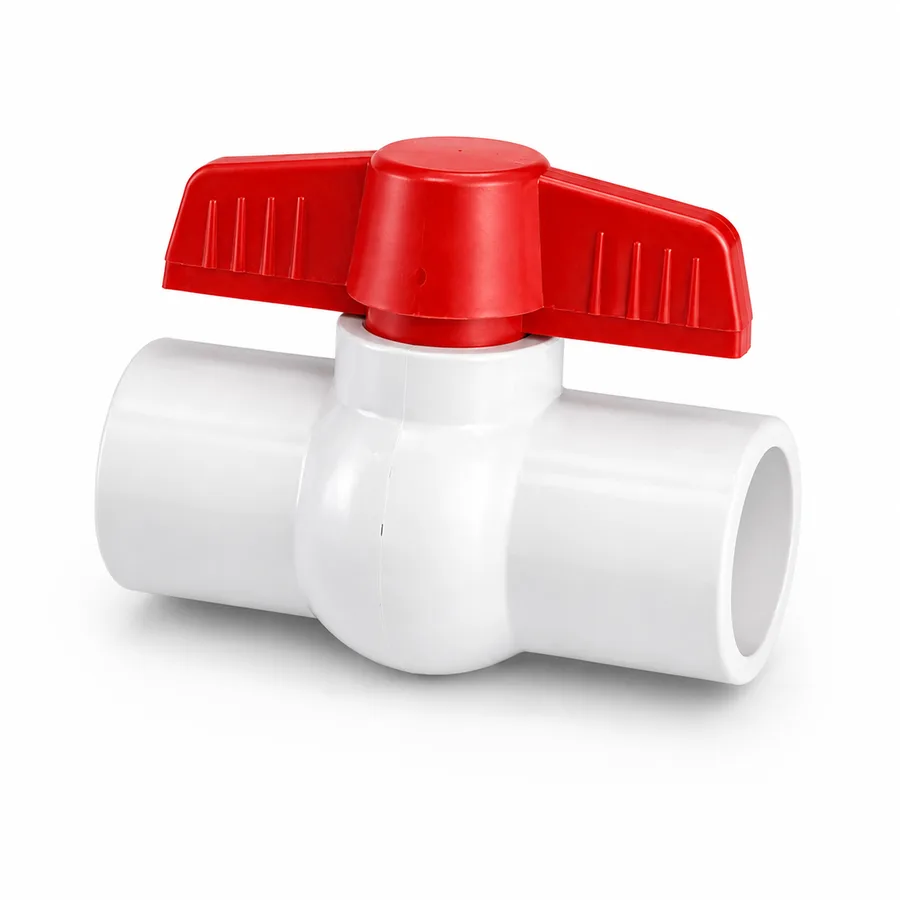
SKU VT-59196 (PVC solvent-weld ball valve) · line of 5 PVC-U references: solvent weld and threaded from 1/2″ to 4″, PCP true union in solvent weld and threaded, and compact octagonal
1. Technical specifications
Working pressure by size — water at 23 °C, non-shock
| Line | Sizes | Pressure @23 °C | Rating system |
|---|---|---|---|
| PVC solvent-weld and threaded ball valve (technical line) | 1/2″, 3/4″, 1″, 1-1/4″, 1-1/2″, 2″ | 235 psi (16.2 bar) | ASTM F1970 · NTC 4404 (ASTM D2467) body |
| PVC solvent-weld and threaded ball valve (technical line) | 2-1/2″, 3″, 4″ | 150 psi (10.3 bar) | ASTM F1970 · NTC 4404 (ASTM D2467) body |
| PCP true-union ball valve, solvent weld and threaded | 1/2″ to 2″ | 235 psi (16.2 bar) | ASTM F1970 · NTC 4404 (ASTM D2467) body |
| Octagonal PVC ball valve (compact domestic line) | 1/2″, 1-1/4″, 2″ | manufacturer rating, no independently published F1970 test | domestic and light duty — see section 3 |
IMPORTANT
This data sheet is a reference guide to the properties of this product type. The measurements, dimensions and physical or geometric characteristics of the product actually supplied may vary by manufacturer and lot, and may even fall outside the cited standards. If any of these figures is critical to your design or build, it is essential to verify it with one of our advisors against the physical product, so you can be fully certain of what you are buying. · Original data sheet: tectul.com/en/conduccion-de-fluidos/valvulas/ficha-tecnica-valvula-bola-pvc-soldar.html
"At 23 °C" is the only correct way to read a plastic rating: it is not a fixed class like metallic WOG nor an ASME class, it is one point on a curve that falls with temperature (section 2). All values are for water without hydraulic shock; water hammer is deducted separately (section 4).
TECTUL catalog references — actual sizes
| Reference | Ends | Catalog sizes |
|---|---|---|
| PVC solvent-weld ball valve (VT-59196) | socket for solvent cement | 1/2″, 3/4″, 1″, 1-1/4″, 1-1/2″, 2″, 2-1/2″, 3″, 4″ |
| PVC threaded ball valve | 60° taper thread for thermoplastics (ASTM F1498) | 1/2″, 3/4″, 1″, 1-1/4″, 1-1/2″, 2″, 2-1/2″, 3″, 4″ |
| PCP true-union ball valve, solvent weld | removable union + socket | 1/2″, 3/4″, 1″, 1-1/4″, 1-1/2″, 2″ |
| PCP true-union ball valve, threaded | removable union + thread | no size variant published in the current catalog |
| Octagonal PVC ball valve (compact domestic) | threaded | 1/2″, 1-1/4″, 2″ |
IMPORTANT
This data sheet is a reference guide to the properties of this product type. The measurements, dimensions and physical or geometric characteristics of the product actually supplied may vary by manufacturer and lot, and may even fall outside the cited standards. If any of these figures is critical to your design or build, it is essential to verify it with one of our advisors against the physical product, so you can be fully certain of what you are buying. · Original data sheet: tectul.com/en/conduccion-de-fluidos/valvulas/ficha-tecnica-valvula-bola-pvc-soldar.html
The gap between the solvent-weld/threaded line and the PCP line is not about pressure — both declare the same rating — but about construction: the PCP carries two removable true unions (section 3).
Materials, construction and standards
| Body | Rigid PVC-U, cell classification compound 12454 per ASTM D1784 — the same compound as the catalog's PVC pressure pipe and fittings. |
| Closure member | Full-port drilled ball in PVC or POM depending on reference, with 1/4-turn operation and a 90° mechanical stop. |
| Seat and seals | PTFE seat; EPDM o-rings for water or FKM depending on chemical compatibility — the exact elastomer per reference is confirmed on quotation. |
| Stem | PVC with blow-out proof design: retained from inside the body, it cannot be ejected by pressure when the handle is removed. |
| Ends | Socket for solvent cement (ASTM D2564 with ASTM F656 primer) or 60° taper thread for thermoplastics (ASTM F1498). The PCP line adds union nuts on both sides of the body. |
| Rating system | ASTM F1970: rating declared and tested by the manufacturer for the complete valve, always referred to 23 °C (73 °F). Pipe and fitting specifications (D1785, D2467) do not cover valves: that is why the valve carries its own number. |
| Maximum service temperature | 60 °C (140 °F) for PVC-U. Above that point the valve does not apply, no matter how far the pressure is reduced. |
| Applicable standards | ASTM F1970 · ASTM D1784 (cell class 12454 compound) · NTC 4404 / ASTM D2467 (dimensional and thread basis of the schedule 80 body) · ASTM F1498 (60° taper thread on thermoplastics) · ASTM D2564 and ASTM F656 (cement and primer) · ASTM D2837 (hydrostatic design basis of the compound). |
IMPORTANT
This data sheet is a reference guide to the properties of this product type. The measurements, dimensions and physical or geometric characteristics of the product actually supplied may vary by manufacturer and lot, and may even fall outside the cited standards. If any of these figures is critical to your design or build, it is essential to verify it with one of our advisors against the physical product, so you can be fully certain of what you are buying. · Original data sheet: tectul.com/en/conduccion-de-fluidos/valvulas/ficha-tecnica-valvula-bola-pvc-soldar.html
⚠ Important: this technical data sheet is a reference guide to the product's properties; it is not a quality certificate for the product you are buying. Production lots vary from one another and may differ from the values stated here, or even depart from the standards. If your application requires compliance with a standard, always check the quality certificate (mill certificate) of the lot you are buying. If in doubt, ask one of our technical advisors →
2. PVC loses pressure with heat: derating and calculation method
The costliest confusion around plastic valves: a catalog that publishes "235 psi" without saying at what temperature says nothing. Unlike metallic WOG (cold, up to 38 °C) or an ASME class (pressure-temperature table per material group), the PVC rating is a continuous curve that falls from the first degree above 23 °C, because the polymer's strength depends directly on how soft it is at that temperature. The hydrostatic design basis (HDB, ASTM D2837) the manufacturer uses to set the rating is measured on that same compound at 23 °C: raising the service temperature is, physically, testing a different material.
Temperature derating — factors on the 23 °C pressure
| °C | °F | Factor | 1/2″–2″ (235 psi base) | 2-1/2″–4″ (150 psi base) |
|---|---|---|---|---|
| 23 °C | 73 °F | 1.00 | 235 psi · 16.2 bar | 150 psi · 10.3 bar |
| 27 °C | 80 °F | 0.88 | 207 psi · 14.3 bar | 132 psi · 9.1 bar |
| 32 °C | 90 °F | 0.75 | 176 psi · 12.1 bar | 113 psi · 7.8 bar |
| 38 °C | 100 °F | 0.62 | 146 psi · 10.1 bar | 93 psi · 6.4 bar |
| 43 °C | 110 °F | 0.51 | 120 psi · 8.3 bar | 77 psi · 5.3 bar |
| 49 °C | 120 °F | 0.40 | 94 psi · 6.5 bar | 60 psi · 4.1 bar |
| 54 °C | 130 °F | 0.31 | 73 psi · 5.0 bar | 47 psi · 3.2 bar |
| 60 °C | 140 °F | 0.22 | 52 psi · 3.6 bar | 33 psi · 2.3 bar |
IMPORTANT
This data sheet is a reference guide to the properties of this product type. The measurements, dimensions and physical or geometric characteristics of the product actually supplied may vary by manufacturer and lot, and may even fall outside the cited standards. If any of these figures is critical to your design or build, it is essential to verify it with one of our advisors against the physical product, so you can be fully certain of what you are buying. · Original data sheet: tectul.com/en/conduccion-de-fluidos/valvulas/ficha-tecnica-valvula-bola-pvc-soldar.html
Factor table published by the standard's manufacturers for PVC (Westlake Pipe & Fittings / LASCO, Spears), consistent with the derating rule used for the catalog's PVC pressure fittings. 60 °C (140 °F) is the PVC-U service ceiling: above that point the valve does not apply even at lower pressure — PP-R socket fusion, CPVC or a metallic body is required. The table applies equally to the PCP line, which declares the same 235 psi base.
Worked example — 2″ PVC ball valve in an irrigation manifold at 38 °C
- Catalog pressure of the 2″ ball valve at 23 °C: 235 psi (16.2 bar).
- Derating factor at 38 °C (100 °F): 0.62.
- Available working pressure: 235 × 0.62 = 146 psi (10.1 bar). The valve lost 89 psi to temperature alone, with nothing else changed.
- That figure is what the line's design pressure is compared against: maximum static pressure plus the water-hammer surge from the 1/4-turn closure (section 4). If the total exceeds 146 psi, the 2″ ball valve does not apply.
- Going up in size solves nothing: the 2-1/2″ to 4″ line starts at 150 psi and at 38 °C ends at 93 psi. The limit is temperature, not size — the correct change is to CPVC, to PP-R socket fusion or to a metallic body.
PVC versus CPVC: the only real reason to pay more
PVC-U (cell class 12454, ASTM D1784) serves up to 60 °C. CPVC (cell class 23447 in the same standard) raises the polymer's deflection temperature and extends service to 93 °C (200 °F) with the same family of thread and joining standards — it is the option when the fluid is domestic hot water or a warm process and moving to metal is undesirable.The alternative that is available is the PP-R socket-fusion line, with 90-95 °C continuous service and a monolithic joint with no thread or sealant.
3. Choosing the line: domestic, technical and PCP true union
The octagonal valve is not the solvent-weld/threaded one: domestic versus technical
The octagonal ball valve (1/2″, 1-1/4″, 2″) shares the same 12454 cell-class PVC-U compound, but it is a compact one-piece low-cost design: short handle, no removable union and no independently published ASTM F1970 test from the manufacturer for the complete valve. It is the right line for plumbing fixtures, domestic manifolds, residential irrigation and shut-off points where a leak is an inconvenience, not a process loss.
It is not the correct specification for a pumping manifold, a technical process network, a chemical dosing system or any point where valve failure compromises production, property or people. Those call for the solvent-weld/threaded ball valve or the PCP valve in this same sheet, which do declare an F1970 rating and let the figure be traced to a manufacturer test. The gap between the two lines is real, but what it delivers is rating traceability and maintainability, not more pressure.
True union: why the PCP comes apart and the solvent-weld valve does not
The PCP line carries union ends on both sides of the body: two coupling nuts with an o-ring that let the complete valve be removed from the line by turning the nuts, without cutting pipe or destroying a solvent-welded joint. With a fixed-body solvent-weld valve, replacement forces cutting the pipe on both sides and rebuilding the run with two new joints; with a threaded one, dismantling the line back to the last free coupling.
Where it pays for itself: manifolds with several valves in series, lines where seat wear from suspended solids or frequent operation is expected, embedded installations with limited access, and sampling or instrument take-off points. The cost of the true union is two extra joints to inspect and a longer face-to-face length: space must be reserved at the design stage, because a PCP valve does not fit in the gap left by a solvent-weld valve of the same size.
How to write it into a specification
Ball valves shall be injection-moulded PVC-U, cell classification compound 12454 per ASTM D1784, with dimensions and threads per NTC 4404 (ASTM D2467 basis) and the manufacturer's own rating under ASTM F1970: 235 psi (16.2 bar) at 23 °C in sizes 1/2″ to 2″ and 150 psi (10.3 bar) from 2-1/2″ to 4″, with declared temperature derating up to the 60 °C (140 °F) service maximum. PTFE seat, EPDM seals (or FKM according to the fluid's chemical compatibility), full-port ball, 1/4-turn handle with mechanical stop and blow-out proof stem. True-union references shall have removable ends with a replaceable o-ring at each coupling.
4. Installation: threads, solvent cement and water hammer
Plastic thread make-up (ASTM F1498)
The 60° taper thread for thermoplastics seals by wedging just like a metallic one, but PVC-U has a far lower modulus of elasticity than steel: over-tightening is the number one cause of plastic thread failure, and on a ball valve the symptom is worse than on a fitting — the body goes out of round and the ball stops sealing in the closed position even though the thread does not drip.
- Tighten hand-tight plus 1 to 2 wrench turns, never "as far as it goes". If it went in barely by hand, the problem is the male thread, not the fitter's strength.
- PTFE tape or a sealant compatible with PVC; do not use compounds with solvents aggressive to PVC.
- In plastic-to-metal transitions the plastic male goes into the metallic female, never the reverse: the metallic female does not yield and the plastic male wedge accommodates itself; reversed, the metallic male splits the plastic female.
- No PVC threads above 43 °C (110 °F): at that temperature the material has already lost half its allowable pressure and the threaded joint is the weakest point of the assembly.
Solvent-cement welding
Socket ends are joined with primer (ASTM F656) and PVC solvent cement (ASTM D2564), following the same procedure as the catalog's pressure pipe: clean dry surface, primer on socket and spigot, cement on both faces, insertion with a quarter turn, holding the assembly while the cement grabs, and respecting cure times before pressurising. The valve adds one precaution of its own: cement with the ball in the open position and keep cement out of the body. Excess cement reaching the PTFE seat hardens it and the valve is left leaking permanently when closed.
Water hammer: why a ball valve is harsher than a gate valve
A ball valve closes in a quarter turn: the port goes from fully open to fully closed in one wrist movement, and most of the effective closure happens in the last few degrees of rotation. A gate or globe valve needs several handwheel turns for the same travel, spreading the deceleration of the water column over seconds instead of tenths of a second. Transient overpressure grows as closing time falls, so the same line generates a larger surge with a ball valve than with a gate valve.
Practical consequences: on long or high-velocity lines, close the ball slowly and deliberately; do not use quarter-turn ball valves as a fast shut-off downstream of a pump without evaluating the transient; and deduct the surge overpressure from the pressure already derated for temperature (section 2), not from the 23 °C figure. PVC is rigid and does not damp the transient the way polyethylene would, so the peak reaches the valve body intact.
5. Frequently asked questions
How many psi does a PVC ball valve take?
235 psi (16.2 bar) at 23 °C in sizes 1/2″ to 2″, and 150 psi (10.3 bar) from 2-1/2″ to 4″ — manufacturer rating under ASTM F1970 over an NTC 4404 (ASTM D2467) body. That figure falls with temperature: 176 psi at 32 °C, 146 psi at 38 °C and only 52 psi at 60 °C. Above 60 °C PVC does not apply at any pressure.
How do I calculate the real pressure for my installation if the water is not at 23 °C?
Look up the service temperature in the section 2 table, take the factor and multiply it by the size's base pressure. Example: 2″ ball valve at 38 °C → 235 × 0.62 = 146 psi. Static pressure plus water-hammer surge is compared against that figure, never against the 235 psi catalog value.
Is the octagonal valve suitable for an industrial network?
It is the compact domestic line: it shares the PVC-U compound but publishes no independent F1970 test and has no removable union. For technical networks, pumping manifolds or any point where failure compromises the process, the solvent-weld/threaded or PCP valve in this sheet is the correct choice.
What is the difference between the solvent-weld/threaded valve and the PCP line?
The working pressure is the same: 235 psi from 1/2″ to 2″. The difference is the joint: the PCP has removable true-union ends on both sides, so the valve leaves the line by turning two nuts, with no pipe cutting. The solvent-weld or threaded valve has a fixed body and is cheaper, for points where removal is not expected.
Can I use a PVC ball valve for hot water?
Not for domestic hot water. PVC-U stops at 60 °C and at that point takes only 22 % of its pressure. For hot water there are two routes: the catalog's PP-R socket-fusion line, with 90-95 °C continuous service and available today, or CPVC up to 93 °C as a special order.
Can a PVC valve be threaded onto a metallic nipple?
Yes, as long as the plastic male goes into the metallic female and make-up is hand-tight plus 1 to 2 wrench turns (section 4). Reversed — metallic male inside a PVC female — the metal acts as a rigid wedge and cracks the plastic body, sometimes weeks after installation.
6. Application notes
Feasibility
The line covers cold water, irrigation and light process duty up to 60 °C (140 °F). Always check size and service temperature against the section 2 table: from 38 °C up the available pressure has already fallen below 65 % of the catalog figure, and at 60 °C only 22 % remains. Continuous domestic hot water calls for the PP-R socket-fusion line or special-order CPVC, never PVC-U. For technical networks use the solvent-weld or threaded line, or the PCP with a declared F1970 rating, not the domestic octagonal one. For critical or safety applications, or wherever failure compromises the process, consult our technical team before specifying.
Installation
ASTM F1498 plastic thread: hand-tight plus 1 to 2 wrench turns, PTFE tape, plastic male always inside a metallic female, and no PVC threads above 43 °C. Solvent-weld ends: ASTM F656 primer and ASTM D2564 cement, with the ball OPEN and no cement reaching the PTFE seat. The PCP valve is removed from the line by turning the union nuts on both sides; the solvent-weld valve forces cutting the pipe. Reserve the PCP longer face-to-face length at the design stage: it does not fit in the gap left by a solvent-weld valve of the same size.
Design
Size with the working pressure ALREADY multiplied by the service-temperature factor (section 2), never with the 23 °C figure. Compare that available pressure against the design pressure of the line: maximum static plus the water-hammer surge from the 1/4-turn closure, which on a ball valve is larger than on a gate or globe valve of the same size because closure happens in tenths of a second. Remember that stepping from 2″ to 2-1/2″ drops the base rating from 235 to 150 psi: going up in size reduces the allowable pressure, it does not raise it. Above 60 °C, change material.
7. Technical notice and limitation of liability
The pressures and temperatures in this sheet are nominal values published in the standards and sources cited (ASTM F1970, ASTM D1784, NTC 4404 / ASTM D2467, ASTM D2837) or standard-manufacturer catalog evidence for the 23 °C (73 °F) reference point, with documented industry-practice derating factors. They guide selection; they are not a certificate of conformity for any production lot nor an independent test of the catalog reference.
The actual behaviour of each lot varies with manufacturing — body injection, PTFE seat and o-ring assembly quality, execution of the solvent-weld or threaded joint in the field — and with the raw material (resin outside its cell class, out-of-spec elastomer). Certifying a reference requires the manufacturer documentation; TECTUL arranges it upon request.
These values must not be used as the sole criterion in critical, safety, certified potable-water applications, or wherever valve failure may compromise people, property or the environment: in such cases the design belongs to the responsible engineer of the project, with the real design temperature, the transients of the line and the weakest element of the system. Before deciding with these data, consult our technical team.
Sources
- ASTM F1970-19 — Standard Specification for Special Engineered Fittings, Appurtenances or Valves for use in Poly(Vinyl Chloride) (PVC) or Chlorinated Poly(Vinyl Chloride) (CPVC) Systems (base del rating declarado de la válvula, no cubierto por las especificaciones de tubo y accesorio)
- ASTM D1784-11 — Standard Classification System and Basis for Specification for Rigid Poly(Vinyl Chloride) (PVC) and Chlorinated Poly(Vinyl Chloride) (CPVC) Compounds (celda de clasificación 12454 para PVC y 23447 para CPVC)
- ASTM D2467 / NTC 4404 — Socket-Type PVC Plastic Pipe Fittings, Schedule 80: base dimensional y de rosca del cuerpo de la válvula; designación citada de forma concordante por fabricantes y distribuidores colombianos del segmento (línea PCP: 234-235 psi a 23 °C)
- ASTM F1498 — Standard Specification for Taper Pipe Threads 60° for Thermoplastic Pipe and Fittings (apriete y transición plástico-metal)
- ASTM D2837 — Standard Test Method for Obtaining Hydrostatic Design Basis for Thermoplastic Pipe Materials (origen del rating a 23 °C y razón física del derating)
- ASTM D2564 y ASTM F656 — Solvent Cements for Poly(Vinyl Chloride) (PVC) Plastic Piping Systems / Primers for Use in Solvent Cement Joints (unión de los extremos socket)
- Spears Manufacturing Company — True Union Ball Valve technical data: 235 psi de 1/2″ a 2″ y 150 psi de 2-1/2″ en adelante a 23 °C (73 °F); temperatura máxima de servicio 60 °C (140 °F) en PVC y 93 °C (200 °F) en CPVC — evidencia de catálogo de fabricante del estándar, no norma
- Westlake Pipe & Fittings / LASCO Fittings — factores de derating por temperatura para PVC (1,00 / 0,88 / 0,75 / 0,62 / 0,51 / 0,40 / 0,31 / 0,22 a 23 / 27 / 32 / 38 / 43 / 49 / 54 / 60 °C), la misma tabla usada en la ficha de accesorios de PVC presión del catálogo TECTUL
This data sheet is the property of TECTUL, part of the Industrias IMR group. Reproduction without attribution is prohibited. Original document and updates: tectul.com/en/conduccion-de-fluidos/valvulas/ficha-tecnica-valvula-bola-pvc-soldar.html.