 TECTULby IMR
Carbon steel gate valve — cast flanged API 600 class 150 and forged compact API 602 class 800
TECTUL · Dispatch across Colombia · Exports to Central & South America
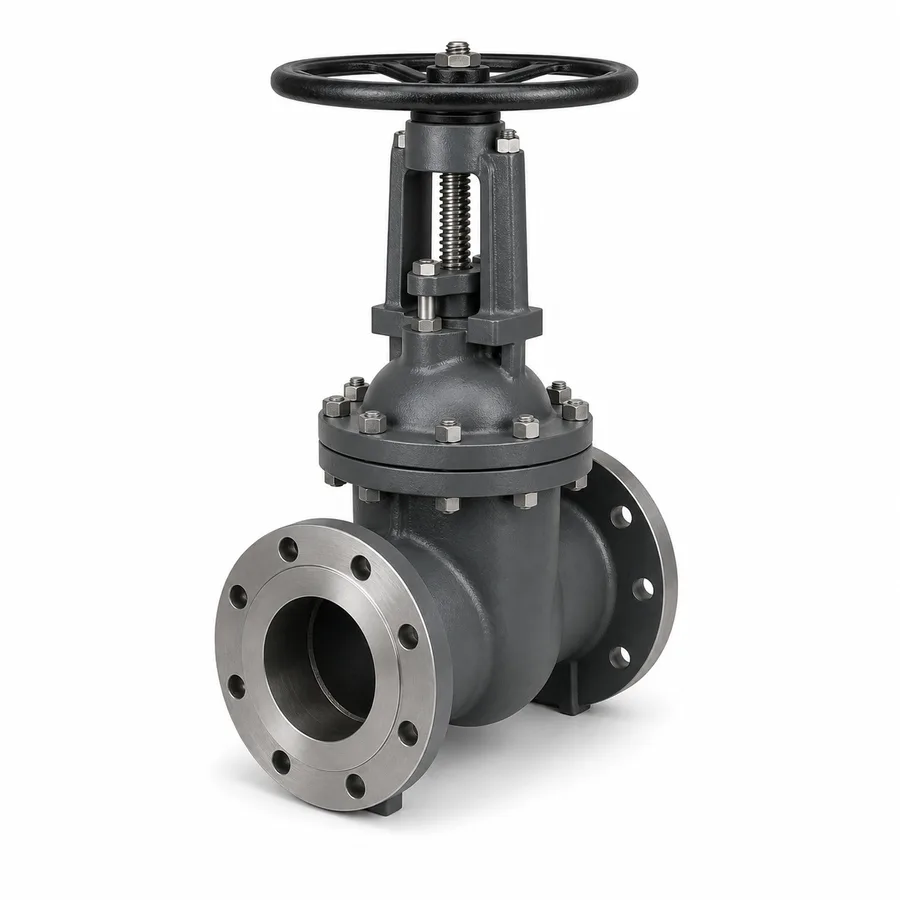
TECTUL's carbon steel gate valve in two constructions that share material but not product standard: the cast flanged version in A216 WCB per API 600 (solid wedge, bolted bonnet, outside-screw-and-yoke stem, class 150 flanged ends per ASME B16.5), and the forged compact version in A105 per API 602 (threaded NPT or socket-weld ends, 1/2″ to 2″, class 800). Both are read under the same ASME B16.34 pressure-temperature framework, just in different class columns. This sheet corrects a naming error in our own catalog: the forged reference we call "800 psi" does not carry an 800 psi rating — it is API 602/B16.34 Class 800, whose cold pressure ceiling is 1,973 psig (136 bar) at 38 °C, almost seven times its commercial name.
Important: Before using these data in engineering, design or installation decisions on systems exposed to mechanical, pressure, rupture, fatigue, impact or water-hammer risk, it is essential to read the technical notice and limitation of liability at the end of this sheet.
SKU VT-valvula-compuerta-acero-al-carbon-bridada · 2 constructions: cast flanged class 150 (2″–12″) and forged compact class 800 (1/2″–2″, catalog alias)
1. Technical specifications
Two constructions, one material
| Construction | Cast flanged: body and bonnet in A216 WCB casting, solid wedge, bolted bonnet, outside-screw-and-yoke (OS&Y) stem. Class 150 flanged ends per ASME B16.5. |
| Forged compact: A105 forged body, solid wedge, threaded or welded bonnet depending on reference, inside or outside stem depending on manufacturer. NPT threaded ends (ASME B1.20.1) or socket-weld (ASME B16.11). | |
| Sizes | Cast flanged: 2″ to 12″ (DN 50–DN 300). Forged compact: 1/2″ to 2″ (DN 15–DN 50), listed in the catalog as Válvula Compuerta Acero Al Carbón 800 Psi. |
| Product standard | Cast: API 600 (Steel Gate Valves for Refinery Service). Forged: API 602 (Compact Steel Gate, Globe and Check Valves for sizes DN 100 and smaller). |
| Pressure-temperature rating | ASME B16.34, material group 1.1 in both cases (A216 WCB and A105 are the same group): class 150 for the flanged version, class 800 for the forged one — see section 2 on why class 800 is not "800 psi". |
| Face-to-face dimensions | Cast flanged: ASME B16.10. Forged compact: its own API 602 dimensional pattern, not under B16.10 because there is no flanged version of class 800 — see section 2. |
| Ends | Flanged: class 150 per ASME B16.5. Forged: tapered NPT thread (ASME B1.20.1) or socket-weld end (ASME B16.11). |
| Tests | Seat and shell per API 598 (Valve Inspection and Testing). |
IMPORTANT
This data sheet is a reference guide to the properties of this product type. The measurements, dimensions and physical or geometric characteristics of the product actually supplied may vary by manufacturer and lot, and may even fall outside the cited standards. If any of these figures is critical to your design or build, it is essential to verify it with one of our advisors against the physical product, so you can be fully certain of what you are buying. · Original data sheet: tectul.com/en/conduccion-de-fluidos/valvulas/ficha-tecnica-valvula-compuerta-acero-al-carbon-bridada.html
Pressure-temperature table — class 150 cast (A216 WCB, B16.34 group 1.1)
| Temperature | Allowable pressure |
|---|---|
| −29 to 38 °C (−20 to 100 °F) | 285 psig (19.6 bar) |
| 93 °C (200 °F) | 260 psig (17.9 bar) |
| 149 °C (300 °F) | 230 psig (15.9 bar) |
| 204 °C (400 °F) | 200 psig (13.8 bar) |
| 260 °C (500 °F) | 170 psig (11.7 bar) |
| 316 °C (600 °F) | 140 psig (9.7 bar) |
| 343 °C (650 °F) | 125 psig (8.6 bar) |
IMPORTANT
This data sheet is a reference guide to the properties of this product type. The measurements, dimensions and physical or geometric characteristics of the product actually supplied may vary by manufacturer and lot, and may even fall outside the cited standards. If any of these figures is critical to your design or build, it is essential to verify it with one of our advisors against the physical product, so you can be fully certain of what you are buying. · Original data sheet: tectul.com/en/conduccion-de-fluidos/valvulas/ficha-tecnica-valvula-compuerta-acero-al-carbon-bridada.html
Pressure-temperature table — class 800 forged (A105, B16.34 group 1.1)
| Temperature | Allowable pressure |
|---|---|
| −29 to 38 °C (−20 to 100 °F) | 1,973 psig (136 bar) |
| 93 °C (200 °F) | 1,800 psig (124 bar) |
| 149 °C (300 °F) | 1,752 psig (121 bar) |
| 204 °C (400 °F) | 1,690 psig (116 bar) |
| 260 °C (500 °F) | 1,597 psig (110 bar) |
| 316 °C (600 °F) | 1,458 psig (101 bar) |
IMPORTANT
This data sheet is a reference guide to the properties of this product type. The measurements, dimensions and physical or geometric characteristics of the product actually supplied may vary by manufacturer and lot, and may even fall outside the cited standards. If any of these figures is critical to your design or build, it is essential to verify it with one of our advisors against the physical product, so you can be fully certain of what you are buying. · Original data sheet: tectul.com/en/conduccion-de-fluidos/valvulas/ficha-tecnica-valvula-compuerta-acero-al-carbon-bridada.html
Class 150: values published directly in Table 2-1.1 of ASME B16.34 for material group 1.1. Class 800: not a direct column of the table — obtained by linear interpolation, 1/3 of class 600 + 2/3 of class 900 of the same group 1.1, a method documented in industry practice around the standard and used by API 602 line manufacturers (see section 2 for the calculation detail). The 38 °C anchor value (1,973 psig) is verified against the figure published by API 602 line manufacturers; the higher-temperature points are the same interpolation applied at each temperature step and should be checked against the manufacturer's full table before a critical design.
Face-to-face dimensions — cast flanged, class 150 (ASME B16.10)
| Size | Face-to-face (RF) |
|---|---|
| 2″ | 178 mm |
| 3″ | 203 mm |
| 4″ | 229 mm |
| 6″ | 267 mm |
| 8″ | 292 mm |
| 10″ | 330 mm |
| 12″ | 356 mm |
IMPORTANT
This data sheet is a reference guide to the properties of this product type. The measurements, dimensions and physical or geometric characteristics of the product actually supplied may vary by manufacturer and lot, and may even fall outside the cited standards. If any of these figures is critical to your design or build, it is essential to verify it with one of our advisors against the physical product, so you can be fully certain of what you are buying. · Original data sheet: tectul.com/en/conduccion-de-fluidos/valvulas/ficha-tecnica-valvula-compuerta-acero-al-carbon-bridada.html
Gate valve pattern with raised face (RF), class 150 flanged ends per ASME B16.5 (bolt circle and stud count set by the same nominal size). The forged compact class 800 has no F2F table in B16.10 because no flanged version of that class exists (section 2); its face-to-face dimension is set by API 602 and the manufacturer of the reference — confirmed on quotation.
⚠ Important: this technical data sheet is a reference guide to the product's properties; it is not a quality certificate for the product you are buying. Heats vary from one another and may differ from the values stated here, or even depart from the standards. If your application requires compliance with a standard, always check the quality certificate (mill certificate) of the lot you are buying. If in doubt, ask one of our technical advisors →
2. The accuracy correction: "800 psi" is actually Class 800
A commercial name that does not match the engineering
The catalog names the forged reference "Válvula Compuerta Acero Al Carbón 800 Psi". That name suggests an 800 psi WOG/CWP rating, in the style of the 600/1000/2000/3000 WOG threaded ball valve line. That is not correct. The reference follows API 602 and its rating is ASME B16.34 Class 800 — a pressure-temperature class, not a WOG number — whose cold ceiling (−29 to 38 °C) is 1,973 psig (136 bar): almost 2.5 times the number in the commercial name.
This sheet corrects the name in the technical content: where the catalog says "800 psi" it should read "Class 800". The correction is not cosmetic — a buyer designing around 800 psi as the real ceiling is leaving more than 1,100 psi of margin the valve actually has on the table, or worse, comparing it against another reference that really is 800 psi WOG and reaching the wrong capacity conclusion.
Why Class 800 does not appear in the standard B16.34 table
ASME B16.34 publishes columns for class 150, 300, 400, 600, 900, 1500, 2500 and some intermediates, but Class 800 is calculated, not read directly, through linear interpolation between Class 600 and Class 900 of the same material group:
- Class 600 at 38 °C: 1,480 psig.
- Class 900 at 38 °C: 2,220 psig.
- Class 800 = 1/3 × Class 600 + 2/3 × Class 900 = 1/3 × 1,480 + 2/3 × 2,220 = 493 + 1,480 = 1,973 psig.
That is the underlying reason why Class 800 has no flanged version: being an interpolated class and not a standard flange class, ASME B16.5 defines no flange pattern for it. That is why Class 800 only exists threaded or socket-weld (API 602), never flanged — and why our cast flanged valve in this same sheet is Class 150, not Class 800: they are two products under different construction standards, not two points on the same pressure ladder.
The steel standards ladder: who governs what
| API 600 | Cast flanged gate valve, solid wedge or OS&Y, bolted bonnet — this sheet's construction in class 150. |
| API 602 | Forged compact gate, globe and check valve, DN 100 and smaller, threaded or socket-weld ends, classes 150 to 1500 — this sheet's construction in class 800. |
| ASME B16.34 | Pressure-temperature rating by class and material group — the common framework both constructions share. |
| ASME B16.10 | Face-to-face dimensions of flanged valves — applies to the cast one, not the forged one. |
| ASME B16.5 | Flanges and flanged ends class 150 to 2500 — applies to the cast one. |
| API 598 | Factory inspection and testing (seat and shell) — applies to both. |
This table is the map that summarizes which standard decides each figure in the sheet: if a valve datum does not fit the correct standard for its construction (for example, looking for F2F in B16.10 for the forged one, or a WOG rating for the flanged one), the error is in the standard consulted, not in the valve.
3. Why API 600 requires an OS&Y stem, trim numbers and graphite packing
Outside-screw-and-yoke stem (OS&Y): mandatory under API 600
API 600 requires the flanged gate valve to have an outside screw and yoke stem: the thread that raises and lowers the wedge stays outside the body, in the yoke visible above the bonnet, instead of being submerged in the process fluid as in an inside-stem design. Two engineering reasons justify it in plant steel valves:
- Visual position indication. The stem protrudes further when the valve is open and retracts when closed: an operator sees the valve's state from a distance, with no extra instrumentation — critical in valve rooms and process lines where confirming "open" or "closed" at a glance prevents wrong maneuvers.
- The thread never touches the fluid. On an inside stem, the actuating thread is exposed to the process fluid — steam, hydrocarbons, chemicals — and it degrades, scales or galls. With OS&Y the thread operates in air, lubricated, protected by the yoke, which extends its life and keeps operating torque stable over the years.
The forged Class 800 compact valve does not always carry OS&Y: in small sizes (1/2″–2″) many manufacturers use a non-rising inside stem to keep the compact design, since API 602 does not mandate OS&Y with the same force as API 600. The stem type of each reference is confirmed on quotation.
API trim numbers: what each one combines
The "trim" is the material combination of the moving wetted parts — seat, wedge/disc and stem — and API 600 identifies them by number, a practice extended to steel valves generally:
| Trim | Seat | Wedge / disc | Stem |
|---|---|---|---|
| Trim 1 | 410 (13Cr), ≥250 HB | F6 (13Cr), 200 HB | 410 (13Cr) |
| Trim 5 | 410 + Stellite overlay (cobalt-chromium alloy), ≥350 HB | F6 + Stellite, ≥350 HB | 410 (13Cr) |
| Trim 8 | 410 + Stellite overlay, ≥350 HB | 410 (13Cr), ≥250 HB | 410 (13Cr) |
| Trim 9 | Monel (nickel-copper alloy) | Monel | Monel |
| Trim 10 | 316 (18Cr-Ni-Mo) | 316 | 316 |
The trim number is not a catalog whim: it sets erosion resistance (Stellite trims, 5 and 8, serve in high-velocity steam and fluids with particles), chemical resistance (Monel for seawater and reducing acids, 316 for moderate chlorides) and the relative hardness between seat and wedge (a hardness difference between the two sealing surfaces is required so they do not gall against each other). The exact trim of each catalog reference is confirmed on quotation.
Graphite packing: why not PTFE in this family
The PTFE-sealed threaded ball valve seals with a polymer that tolerates up to ≈180 °C. The carbon steel gate valve, by contrast, usually works in steam and process lines above that limit, where PTFE degrades. That is why the stem seal in this family is flexible graphite packing, compressed in the packing box by the gland: graphite tolerates temperatures far above PTFE, does not burn, and is the industry reference material for steam and high-temperature steel valves. Its trade-off is that it requires periodic gland re-tightening — the graphite settles with use — and a pitting-free stem surface, because a scored surface opens a leak path that no amount of extra tightening closes.
4. Frequently asked questions
Does the "800 psi" carbon steel gate valve really only take 800 psi?
No — it takes far more. The reference is ASME B16.34/API 602 Class 800, whose real cold ceiling (−29 to 38 °C) is 1,973 psig (136 bar). The commercial name "800 psi" is a legacy simplification that confuses the class number with a WOG rating; this sheet uses the verified figure. The value decreases with temperature (section 1).
What is the pressure of the class 150 flanged gate valve?
285 psig (19.6 bar) at 38 °C, per ASME B16.34 material group 1.1 (A216 WCB), decreasing to 125 psig (8.6 bar) at 343 °C. It is this sheet's cast flanged construction, distinct from the forged Class 800 one.
Why does Class 800 not exist flanged?
Because it is an interpolated class (1/3 of Class 600 + 2/3 of Class 900), not one of the standard flange classes of ASME B16.5. With no flange pattern of its own, it is only manufactured threaded or socket-weld under API 602. If the project needs high-pressure flanged service, the answer is moving up to Class 600 or higher of B16.5, not looking for a "flanged Class 800."
What is the difference between this valve and an 800 WOG ball valve?
The rating system is different: 800 WOG is a manufacturer's cold pressure for a threaded ball valve, not an ASME class (ASME class 800 does not appear directly in B16.34: it is interpolated, see section 2). A Class 800 API 602 gate valve and an 800 WOG ball valve may share the number in their name and have completely different pressure capacities; they cannot be compared by the number alone.
Do I always need an OS&Y stem?
On the API 600 flanged valve, yes — the standard requires it and it is this sheet's reference construction. On the forged compact Class 800 valve, many manufacturers use an inside stem in small sizes to keep the compact design; the stem type of each reference is confirmed on quotation.
What trim should I request for high-velocity steam?
A trim with Stellite-hardfaced surfaces (Trim 5 or 8 from the section 3 table), which resists high-velocity steam erosion better than a plain 410 trim (Trim 1). The exact trim per reference is confirmed on quotation.
5. Application notes
Feasibility
The API 600 class 150 cast flanged valve (285 psig at 38 °C) covers full shut-off in steam, water, oils and compatible hydrocarbons from 2″ to 12″, when free flow and low head loss are needed with the valve fully open. The API 602 forged compact Class 800 valve (1,973 psig at 38 °C, not 800 psi) covers the same shut-off service in the small sizes of instrumentation, sampling and high-pressure drain lines, 1/2″ to 2″, where a threaded or socket-weld end is more practical than a flange. Neither one regulates flow precisely: that is the role of the globe valve in this same family. For critical or safety applications, consult our technical team before specifying.
Installation
Install fully open or fully closed in normal operation — the gate valve is not a throttling device and an intermediate position accelerates seat erosion. Leave clearance above the OS&Y stem yoke for its full opening travel. Align flanges before bolting (flanged) or verify a thread sealant compatible with the fluid (forged threaded). Flush the line before start-up: particles trapped between wedge and seat are the most common cause of leakage on closure in new valves. Re-tighten the graphite gland after the first hours of operation, once the packing settles.
Design
Specify the construction (API 600 flanged or API 602 forged) by the line connection, not by the psi number in the commercial name: check the real point on the section 1 pressure-temperature table against the design temperature, not just the cold figure. For Class 800, use 1,973 psig as the ceiling at 38 °C, not 800 psi. If the project requires high-pressure flanged ends, move up a class within B16.5 (300, 600...) instead of looking for a flanged Class 800, which does not exist. Set the trim by the fluid and service severity (section 3), and the stem type (OS&Y or inside) for the forged compact valve before quoting, since it changes the required installation clearance.
6. Technical notice and limitation of liability
The pressure-temperature ratings in this sheet combine values published directly in ASME B16.34 (class 150, material group 1.1) with Class 800 values obtained by documented linear interpolation (1/3 of Class 600 + 2/3 of Class 900 of the same group), an industry practice method around the standard consistent with what API 602 line manufacturers publish. They are nominal reference values; they are not a certificate of conformity for any production lot nor an independent test of the TECTUL catalog reference.
The "800 psi → Class 800" name correction in section 2 is an engineering clarification of our own catalog, not a certification of the actual manufacturer of each lot: trim, stem type, forged valve face-to-face dimensions and material certificate are confirmed on quotation with factory documentation.
These values must not be used as the sole criterion in critical, safety applications, or wherever valve failure may compromise people, property or the environment: in such cases the design belongs to the project's responsible engineer, under the applicable piping code (ASME B31.1 or B31.3) and with the line's real design temperature. Before deciding with these data, consult our technical team.
Sources
- API Standard 600 — Steel Gate Valves — Flanged and Butt-welding Ends, Bolted Bonnets: cuña sólida, bonete empernado, vástago OS&Y
- API Standard 602 — Compact Steel Gate, Globe, and Check Valves for Sizes DN 100 (NPS 4) and Smaller: construcción forjada, clases de presión 150 a 1500
- ASME B16.34 — Valves — Flanged, Threaded, and Welding End: Tabla 2-1.1, grupo de material 1.1 (A216 WCB / A105); método de interpolación de la Clase 800 (1/3 clase 600 + 2/3 clase 900), consistente con la práctica de fabricantes de la línea API 602
- ASME B16.10 — Face-to-Face and End-to-End Dimensions of Valves: patrón de compuerta clase 150, 2″ a 12″
- ASME B16.5 — Pipe Flanges and Flanged Fittings: bridas clase 150 de los extremos de la construcción fundida
- ASME B1.20.1 — Pipe Threads, General Purpose (Inch): rosca NPT de los extremos de la construcción forjada
- ASME B16.11 — Forged Fittings, Socket-Welding and Threaded: extremo socket-weld de la construcción forjada
- API Standard 598 — Valve Inspection and Test: pruebas de asiento y cuerpo aplicables a ambas construcciones
- ASTM A216/A216M — Standard Specification for Steel Castings, Carbon, Suitable for Fusion Welding, for High-Temperature Service (grado WCB, grupo de material 1.1 de B16.34)
- ASTM A105/A105M — Standard Specification for Carbon Steel Forgings for Piping Applications (grupo de material 1.1 de B16.34, construcción forjada API 602)
This data sheet is the property of TECTUL, part of the Industrias IMR group. Reproduction without attribution is prohibited. Original document and updates: tectul.com/en/conduccion-de-fluidos/valvulas/ficha-tecnica-valvula-compuerta-acero-al-carbon-bridada.html.