 TECTULby IMR
Butterfly valve with an aluminum body for compressed air and pneumatic bulk-solid conveying
TECTUL · Dispatch across Colombia · Exports to Central & South America
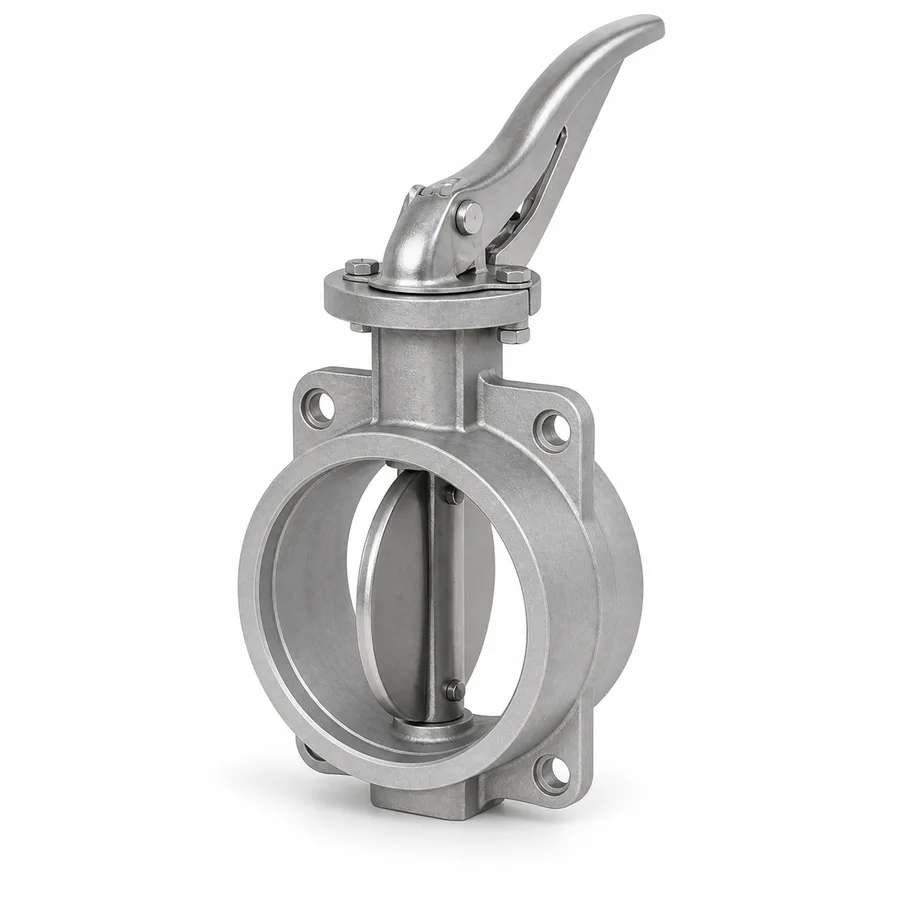
Quarter-turn butterfly valve with an aluminum body, designed for services where weight is the deciding factor: low-pressure compressed air and pneumatic conveying of bulk solids (cement, lime, flours, grains, powdered plastics) through ductwork, mobile silos and tanker discharge. The reason to choose it is not pressure or mechanical strength —ductile iron is superior on both—, but density: aluminum weighs 2.70 g/cm³ against 7.15 g/cm³ for ductile iron, 62 % less at the same geometry, which directly changes the required support structure on mobile equipment, light ductwork and elevated installations. This sheet publishes the calculation behind that weight reduction, and above all its real limits: it carries no published pressure class (it is inherently a low-pressure product because of the material), it wears by abrasion in solids conveying, it is not compatible with certain chemicals or with saline water or galvanic pairs against steel, and its selection against ductile iron depends exclusively on those three factors.
Important: Before using these data in engineering, design or installation decisions on systems exposed to mechanical, pressure, rupture, fatigue, impact or water-hammer risk, it is essential to read the technical notice and limitation of liability at the end of this sheet.
SKU VT-valvula-mariposa-aluminio · aluminum-body butterfly valve, wafer or lug mounting depending on reference, made to order
1. Technical specifications
Materials and construction
| Body | Aluminum alloy, reference density 2.70 g/cm³, natural or anodized finish depending on reference |
| Disc | Aluminum or stainless steel depending on service and expected abrasion level; the lot's exact material is confirmed on quotation |
| Seat | Elastomeric (EPDM or NBR depending on service), validated against the conveyed product; in abrasive solids conveying, subject to accelerated wear (section 3) |
| Shaft | Stainless steel or anodized aluminum depending on reference |
| Mounting | Wafer (between flanges) or lug (threaded lugs) depending on reference — confirm on quotation |
| Operation | Manual notched lever on most sizes; ISO 5211 preparation for an actuator when the reference includes one |
| Reference standards | API 609 (wafer/lug/flanged butterfly type) · MSS SP-67 (general requirements) · ISO 5211 (actuator interface where applicable) |
Density comparison with ductile iron
| Material | Density | Relative weight at equal volume |
|---|---|---|
| Aluminum (this valve's body) | 2.70 g/cm³ | reference (1.00×) |
| Ductile iron (body of sheet FT-TC-VAL-MARIP-HD-001) | 7.15 g/cm³ | 2.65× heavier — aluminum weighs 62 % less |
Reference densities for both materials per metallic-material property literature (ASM Handbook, Vol. 1: Properties and Selection). The calculation (7.15 − 2.70) / 7.15 = 62.2 % is geometric —at equal body shape and volume— and does not include the weight of the disc, shaft or accessories, which may be in a different material depending on the reference. The real weight saving of the complete valve is confirmed on quotation with the factory data.
⚠ Important: this technical data sheet is a reference guide to the product's properties; it is not a quality certificate for the product you are buying. Heats vary from one another and may differ from the values stated here, or even depart from the standards. If your application requires compliance with a standard, always check the quality certificate (mill certificate) of the lot you are buying. If in doubt, ask one of our technical advisors →
2. Why aluminum carries no pressure class: real limits of the material
Ductile iron and carbon steel have standardized pressure-temperature rating tables (ASME B16.34, see ductile iron sheet FT-TC-VAL-MARIP-HD-001 and flanged sheet FT-TC-VAL-MARIP-BRID-001) because they are high-strength structural materials with well-characterized behaviour under pressure. The aluminum in this line has no equivalent table published in the catalog, and that is not an omission: it is a direct consequence of what the product is designed for.
The three real limits that govern this valve
| Low pressure by design | Aluminum has lower mechanical strength than ductile iron or steel at equal wall thickness: reaching a comparable working pressure would require a thicker body, which cancels out the weight advantage that is this valve's whole reason for being. That is why the manufacturer does not publish a pressure class for this line: the product is meant for air and bulk solids at low pressure, not to replace a ductile iron or steel butterfly valve in medium- or high-pressure service. Working pressure per reference is confirmed on quotation. |
| Abrasion in solids conveying | The conveyed product —cement, lime, flours, grains, mineral powders— is abrasive against the elastomeric seat and the disc's sealing surface. Wear appears first on the seat, not on the aluminum body, and its rate depends on abrasiveness and solids concentration in the air stream (detail in section 3). |
| Limited chemical compatibility | Aluminum forms an oxide layer (Al₂O₃) that protects it in dry air and in many neutral environments, but that layer dissolves or pits in the presence of strong alkalis (highly basic solutions), certain acids and concentrated chlorides. It is not suitable by default for aggressive chemicals: each fluid or chemical powder must be validated before specifying. |
| Saline water and galvanic corrosion | In seawater, sea spray or coastal environments, the protective oxide layer loses effectiveness and aluminum pits. Additionally, in direct contact with uninsulated carbon steel in the presence of moisture, a galvanic pair forms where aluminum —the less noble metal— acts as the anode and corrodes preferentially to protect the steel. This risk is eliminated with dielectric insulating gaskets or washers in the mounting, not by ignoring it. |
These four limits are known physical and chemical properties of aluminum as an engineering material (behaviour of the aluminum oxide layer, galvanic series of metals in seawater), not a limitation exclusive to this reference. They define where this valve IS and is NOT the right choice, regardless of manufacturer.
3. Bulk-solids handling service: disc, seat and wear
How the solid wears the valve
In pneumatic conveying, the solid does not flow like a uniform liquid: it travels suspended in the air, and on every opening and closing of the valve, the coarser or harder particles of the product pass rubbing against the disc edge and the seat surface at the point of least opening. That repeated rubbing is the main cause of elastomeric seat wear in this line —long before the aluminum body shows any sign of deterioration—.
Factors that accelerate wear
| Product abrasiveness | Cements and mineral powders with angular, hard particles wear faster than flours or grains with softer, rounder particles |
| Solids concentration in the air | The higher the solid load per volume of conveyed air, the higher the impact frequency on the seat and the disc |
| Conveying velocity | Dilute-phase pneumatic conveying lines (high velocity, low concentration) generate more impact per particle than dense-phase ones (low velocity, high concentration), although each system has its own balance |
| Cycle frequency | Valves that open and close many times per shift accumulate more rubbing cycles than one that stays open or closed for long periods |
Practical service recommendations
- Schedule periodic seat inspection, not only of the disc or the body: the seat is the component that fails first in this service, and its replacement is the line's most frequent maintenance intervention.
- Validate the seat against the real product before specifying: a standard seat can last weeks in a service that needed a reinforced compound or a different geometry.
- In food conveying, verify that the seat and disc meet the sanitary grade the plant requires; this sheet does not cover dedicated sanitary design —see the catalog's sanitary stainless butterfly valve sheet for that case—.
- For automated operation, confirm the required torque and the actuator mounting platform with the manufacturer, since breakaway torque in solids service can be higher than in clean air due to the product's added friction on the disc.
4. Mounting on ductwork and hoppers: making the most of the light weight
Where the light weight changes the mounting decision
The 62 % weight reduction against ductile iron (section 1) is not an abstract figure: it translates into lighter supports and mounting structure, which is decisive in three typical scenarios for this valve:
- Tankers and mobile equipment. Tanker trucks, mobile hoppers and pneumatic discharge equipment where every extra kilogram in the valve adds to the dead weight carried and cuts into payload.
- Thin-sheet ductwork and hoppers. Dust collector, silo and discharge structures where the enclosure is not designed to bear the weight of a ductile iron valve without extra reinforcement.
- Elevated or hard-to-access mountings. Valves installed high up on silos or on roof lines, where handling and lifting a lighter part reduces installation risk and cost.
Mounting recommendations
- Centre the body between flanges of the correct pattern and check the face-to-face length before tightening, same as any wafer or lug butterfly valve (ductile iron sheet, section 3).
- Check that the disc rotates without touching the piping or ductwork through the full 90° travel.
- Tighten the bolts in a cross-pattern sequence to avoid deforming the elastomeric seat, with the same criterion as the ductile iron sheet (section 3), even though final torque is lower due to the body material.
- On thin-sheet ductwork, verify flange parallelism before mounting: a misalignment that on ductile iron would only cause a leak can deform a thinner-walled aluminum body.
- Electrically insulate direct contact with uncoated carbon steel when the environment is humid, to avoid the galvanic pair described in section 2.
Common purchasing errors: using this valve for pressurized water or chemical services it was not designed for; ignoring the conveyed product's abrasiveness when sizing the seat; and mounting it without checking flange parallelism on thin-sheet ductwork, which deforms the light body more easily than a ductile iron one.
5. Frequently asked questions
Why choose an aluminum-body butterfly valve instead of ductile iron?
For weight: aluminum has a density of 2.70 g/cm³ against 7.15 g/cm³ for ductile iron, 62 % less at the same geometry. On tankers, mobile silos and thin-sheet ductwork that reduction changes the required support structure and eases mounting on structures that cannot bear an iron valve's weight.
What pressure does this valve withstand?
The manufacturer does not publish a pressure class for this lot: aluminum has lower mechanical strength than ductile iron or steel, and this line is meant for low-pressure air and bulk solids, not to replace a ductile iron butterfly valve in medium- or high-pressure service. The exact value per reference is confirmed on quotation.
Is it suitable for seawater or a coastal environment?
Not without precautions: in saline water the aluminum's protective oxide layer loses effectiveness and the material pits. In direct contact with uninsulated carbon steel and moisture, a galvanic pair also forms where the aluminum corrodes to protect the steel. Dielectric insulation in the mounting is required in coastal or humid environments.
How long does the seat last in cement or abrasive solids conveying?
It depends on the product's abrasiveness, solids concentration and cycle frequency: there is no universal figure. What is constant is that the seat —not the aluminum body— is the component that fails first in this service, which is why scheduled periodic inspection is recommended (section 3).
Can I use it on a pressurized water line?
That is not the service it is designed for: its pressure limit is low by the nature of the material (section 2), and for pressurized water the concentric ductile iron butterfly valve (sheet FT-TC-VAL-MARIP-HD-001) or the flanged one (FT-TC-VAL-MARIP-BRID-001) is the right choice, depending on the required size and class.
6. Application notes
Feasibility
The reference covers low-pressure compressed air and pneumatic conveying of non-corrosive bulk solids —cement, lime, flours, grains, powdered plastics— on mountings where weight is the deciding factor: mobile equipment, thin-sheet ductwork and elevated installations. It is not the choice when the service requires medium or high pressure (ductile iron or steel is the right choice, sheets FT-TC-VAL-MARIP-HD-001 and FT-TC-VAL-MARIP-BRID-001), when the fluid is saline water or a coastal environment with no dielectric insulation available, or when the conveyed product is strongly alkaline or acidic without validated compatibility. Always check the product's real abrasiveness against the seat's expected service life before specifying. For critical or safety applications, consult our technical team before specifying.
Installation
Centre the body between flanges of the correct pattern and check the face-to-face length before tightening; verify that the disc rotates without touching the duct through the full 90° travel; tighten the bolts in a cross-pattern sequence to avoid deforming the seat or the thin-walled body. Verify flange parallelism on thin-sheet ductwork, where a misalignment deforms aluminum more easily than ductile iron. Electrically insulate contact with uncoated carbon steel in humid or coastal environments. In solids service, schedule the first seat inspection earlier than the standard interval for a clean-service valve, to calibrate the real service life for the conveyed product.
Design
Specify this valve only when weight is the deciding factor: on pressure, mechanical strength and service life against abrasion, ductile iron is superior under equal conditions. Define the real abrasiveness of the conveyed product and its concentration in the air stream before fixing the seat compound, and plan the inspection and replacement interval as part of the operating cost, not as an unexpected event. If the mounting will be in a coastal or humid environment with steel structure, include dielectric insulation in the specification from the design stage. Account for the saved weight in the structural calculation of the duct or the mobile equipment, which is this reference's real benefit.
7. Technical notice and limitation of liability
The materials and standards in this sheet combine API 609 and MSS SP-67 (butterfly valve type and general requirements), ISO 5211 (actuator interface where applicable) and physical property data for aluminum and ductile iron from materials engineering literature (density, behaviour of the aluminum oxide layer), with the data TECTUL publishes on the product page (declared material). They do not constitute a certificate of conformity for any production lot.
The manufacturer does not publish a working pressure class for this line: this is a consequence of the intended use (low-pressure air and bulk solids), not an omitted datum. The real pressure of each reference, the exact seat compound and its chemical compatibility with the real conveyed product, and the operating torque when automated, are confirmed on quotation with the manufacturer's data sheet.
These values must not be used as the sole criterion in critical, safety, certified food-grade applications, or wherever valve failure may compromise people, property or the environment: in such cases the design belongs to the responsible engineer of the project, with the real design pressure and validated chemical compatibility. Before deciding with these data, consult our technical team.
Sources
- API 609 — Butterfly Valves: Double-Flanged, Lug- and Wafer-Type: alcance general del tipo mariposa aplicado a esta referencia
- MSS SP-67 — Butterfly Valves: requisitos generales de diseño y prueba de válvulas de mariposa
- ISO 5211 — Industrial valves — Part-turn actuator attachments: interfaz de montaje de actuador cuando la referencia lo incluye
- ASM Handbook, Volume 1: Properties and Selection — Irons, Steels, and High-Performance Alloys (densidad del hierro dúctil, 7,1–7,3 g/cm³)
- Propiedades físicas de aleaciones de aluminio de uso general (densidad ≈2,70 g/cm³) — literatura de ingeniería de materiales metálicos
- Comportamiento de la capa de óxido de aluminio (Al₂O₃) en agua salina y ambientes con cloruros — fundamento de la corrosión por picadura del aluminio en agua de mar
- Serie galvánica de metales en agua de mar — fundamento de la corrosión galvánica en contacto directo aluminio-acero al carbón sin aislar
- Ficha de producto TECTUL (tectul.com): Válvula Mariposa Cuerpo Aluminio — fuente de material declarado y servicio típico
- Ficha técnica FT-TC-VAL-MARIP-HD-001 (mariposa hierro dúctil, catálogo TECTUL) — densidad de referencia del hierro dúctil usada en la comparación de esta ficha
This data sheet is the property of TECTUL, part of the Industrias IMR group. Reproduction without attribution is prohibited. Original document and updates: tectul.com/en/conduccion-de-fluidos/valvulas/ficha-tecnica-valvula-mariposa-aluminio.html.