 TECTULby IMR
Sanitary butterfly valve in 304/316L stainless steel — clamp or weld ends
TECTUL · Dispatch across Colombia · Exports to Central & South America
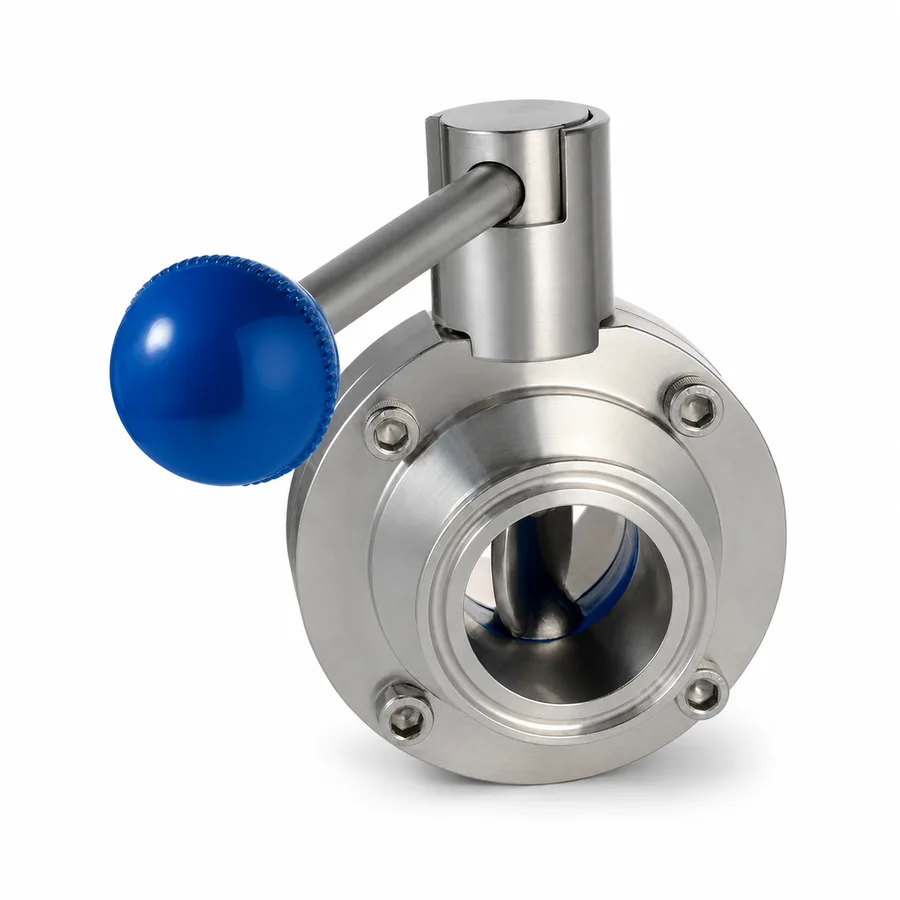
Sanitary quarter-turn butterfly valve in 304 or 316L stainless steel, offered in the TECTUL catalog with clamp ends (per ISO 2852 or DIN 32676, the quick-disconnect tri-clamp system) or weld ends to the line. In sanitary design, the deciding factor is not only the steel grade: it is the surface finish (Ra roughness in microns) of the product-contact surfaces, because a rough surface retains microbial residue that no cleaning cycle removes completely. This sheet publishes the finish levels typical of the sanitary industry, the compatibility of the elastomeric seats —EPDM, silicone or FKM— with clean-in-place (CIP) cycles and steam sterilization (SIP), the multi-position handle with detent for fixing partial openings, and the drainability and dead-leg-free criteria that distinguish a sanitary mounting from a generic industrial one.
Important: Before using these data in engineering, design or installation decisions on systems exposed to mechanical, pressure, rupture, fatigue, impact or water-hammer risk, it is essential to read the technical notice and limitation of liability at the end of this sheet.
SKU VT-87076 (sanitary stainless clamp butterfly valve) · 6 published sizes · weld-end alias in the same sanitary design family
1. Technical specifications
Materials and construction
| Body and disc | Austenitic stainless steel 304 or 316L (low carbon, C ≤0.03 %) depending on reference; 316L is preferred when the process requires better chloride resistance and lower risk of intergranular sensitization after welding |
| Shaft | Stainless steel, with an elastomeric shaft seal that prevents product ingress to the outside |
| Seat | Sanitary elastomeric: EPDM, silicone or FKM depending on temperature and cleaning cycle (section 3) |
| Operating handle | Multi-position with a detent that fixes intermediate opening angles for flow regulation, not just on/off |
| Ends — clamp reference | Ferrules per ISO 2852 or DIN 32676, for quick coupling with a tri-clamp band and an interchangeable sanitary gasket |
| Ends — weld reference | Plain ends prepared for butt welding to the line's sanitary piping, no removable clamp |
| Reference standards | API 609 (butterfly type) · MSS SP-67 (general requirements) · ISO 2852 / DIN 32676 (clamp ends) · ASME BPE / 3-A Sanitary Standards sanitary finish practice |
Sanitary butterfly valve references in the TECTUL catalog
| Reference | End type | Catalog sizes |
|---|---|---|
| Sanitary stainless butterfly valve | Clamp (tri-clamp), removable | 1″ · 1-1/2″ · 2″ · 2-1/2″ · 3″ · 4″ |
| Sanitary weld butterfly valve | Weld, permanent connection | Per reference; confirm exact size on quotation |
IMPORTANT
This data sheet is a reference guide to the properties of this product type. The measurements, dimensions and physical or geometric characteristics of the product actually supplied may vary by manufacturer and lot, and may even fall outside the cited standards. If any of these figures is critical to your design or build, it is essential to verify it with one of our advisors against the physical product, so you can be fully certain of what you are buying. · Original data sheet: tectul.com/en/conduccion-de-fluidos/valvulas/ficha-tecnica-valvula-mariposa-inoxidable-sanitaria.html
The clamp system itself —ferrule geometry, band and gasket— belongs to the catalog's sanitary piping (see the corresponding sanitary piping/fittings sheet): this sheet only covers the end-designation row as applied to the butterfly valve. Exact size per reference and handle thread type: confirmed on quotation.
⚠ Important: this technical data sheet is a reference guide to the product's properties; it is not a quality certificate for the product you are buying. Heats vary from one another and may differ from the values stated here, or even depart from the standards. If your application requires compliance with a standard, always check the quality certificate (mill certificate) of the lot you are buying. If in doubt, ask one of our technical advisors →
2. Surface finish, not pressure, is the datum that governs hygiene
On a sanitary valve the specification criterion is not a pressure class: it is the compatibility of the clamp system (tube size per ISO 2852 or DIN 32676, section 4) and, above all, the surface finish of the product-contact faces. Two valves identical in steel grade (304 or 316L) can have very different hygienic performance depending on their interior roughness: a rough surface retains product residue and bacterial biofilm in the metal's microscopic valleys, and no CIP cleaning protocol completely removes what gets trapped there.
Finish levels typical of the sanitary industry
| Level | Ra roughness | Typical application |
|---|---|---|
| Standard mechanical (factory polish) | Ra ≤0.8 µm (32 µin) | Standard-grade food and beverage contact; the most common level in catalog sanitary valves |
| Bioprocess | Ra ≤0.5 µm | Medium-demand pharmaceutical and biotech processes, where residual microbial growth must be minimized beyond the food-industry standard |
| Critical bioprocess | Ra ≤0.4 µm (15 µin) or better, usually with electropolishing | Vaccines, monoclonal antibodies and high-purity processes where any residual surface is unacceptable |
Reference levels consistent with the surface finish designations of ASME BPE (Bioprocessing Equipment) and 3-A Sanitary Standards practice (dairy and food industry) for product-contact surfaces; both normative bodies define finish designation tables, but the exact numeric values per designation are taken from documented industry practice, not a single clause cited here. The exact certified finish of each reference in this sheet is confirmed on quotation.
Why this matters more than the steel grade alone
316L resists chloride pitting better than 304, but neither grade is sanitary by itself if the interior finish is left rough from the factory: a 316L body with a coarse finish retains as much residue as a 304 one with the same finish. Correct sanitary specification always fixes both data points —steel grade and Ra finish— not just one.
3. Sanitary seats and CIP/SIP cleaning compatibility
The cleaning cycles the seat must withstand
| CIP (Clean-in-Place) | Circulation of washing solutions —typically caustic then acidic— at usual temperatures of 70 to 85 °C, without dismantling the equipment. This is the routine cycle between production batches. |
| SIP (Sterilize-in-Place) | Sterilization with saturated steam, in a usual range of 121 to 134 °C, for processes requiring microbial load elimination beyond what CIP achieves. Not every elastomeric seat tolerates this cycle repeatedly. |
Sanitary elastomers and their tolerance range
| EPDM | Covers most CIP cycles well; under repeated SIP exposure at the upper end of the steam range, its service life shortens more than silicone's or FKM's. Good resistance to caustic solutions, the usual base of CIP washing. |
| Silicone | Tolerates steam sterilization temperature more stably than EPDM under repeated cycles, with good low-temperature flexibility; lower mechanical resistance to friction wear than EPDM or FKM. |
| FKM (fluoroelastomer, e.g. Viton) | Good chemical resistance across a wide range of cleaning agents and to sterilization temperature, with better wear resistance than silicone; higher cost than EPDM or silicone. |
The elastomer choice depends on the plant's real cleaning protocol (temperature, SIP cycle frequency, washing chemical agent) and compatibility with the process product, not only peak temperature. The compound's exact grade and its sanitary compliance certificate (FDA 21 CFR 177.2600 or equivalent, depending on the project's market) are confirmed on quotation.
Multi-position handle with detent
This line's handle incorporates a detent that fixes intermediate opening positions, not just the fully open or fully closed extremes. This allows the same valve to be used for shut-off and for basic flow regulation in a filling or transfer process, without needing a dedicated control valve, provided the application does not require a precise flow curve.
4. Drainability, no dead legs and the clamp system
What distinguishes a sanitary mounting from an industrial one
- Drainability: the valve must be mounted so the line drains by gravity to a low point after every wash, with no pockets where cleaning liquid or product remains trapped. On a butterfly valve, this depends on the body orientation and on the shaft and handle not creating a low bend where liquid accumulates.
- No dead legs: any piping run or fitting with no active flow during cleaning is a potential dead leg. The butterfly valve's short-body design —compared with longer face-to-face valves— helps minimize that risk, but the final criterion depends on the whole line assembly, not the valve alone.
- Smooth, crevice-free surfaces: joints, welds and the seat itself must have no steps or crevices where residue accumulates; on the weld reference, interior weld quality (full penetration, no porosity, with a subsequent polished finish) is as critical as the body's factory finish.
- Easy disassembly for inspection: the clamp reference allows the line to be opened in minutes for visual inspection or seat replacement, something the weld reference does not offer without cutting the piping.
The clamp system: only the designation row
The ferrule geometry, band and gasket of the clamp system —ISO 2852 or DIN 32676— is a specification of TECTUL's catalog sanitary piping and fittings, not of this valve in particular: this sheet's clamp butterfly valve simply adopts that end designation to couple with that piping. When quoting, specify the sanitary pipe's nominal size (not the valve's bore diameter, which may differ) and the exact series —A or B— if the project uses DIN 32676, since both series share the ferrule geometry but differ in the associated tube-diameter convention.
Clamp or weld: when to use each
Clamp when the process requires frequent disassembly for manual cleaning, inspection or line reconfiguration. Weld when the connection must be permanent and crevice-free —the stricter hygiene criterion—, typical of fixed process runs where disassembly is not a routine operation.
5. Frequently asked questions
What surface finish should a sanitary valve have?
Ra ≤0.8 µm (32 µin) is the usual standard mechanical level for food and beverage contact; Ra ≤0.5 µm for medium-demand bioprocess, and Ra ≤0.4 µm or better, with electropolishing, for critical processes such as vaccines or monoclonal antibodies. The exact certified finish of each reference is confirmed on quotation.
Is 316L enough on its own to make a valve sanitary?
Not by itself: the steel grade (304 or 316L) addresses corrosion resistance, but the interior surface finish is what determines whether the valve retains microbial residue. A 316L valve with a coarse factory finish is no more hygienic than a 304 one with the same finish.
Which seat withstands steam sterilization (SIP) better?
Silicone and FKM tolerate repeated SIP cycles in the 121 to 134 °C range better than EPDM, whose service life shortens faster under that exposure. EPDM remains a good choice when the cycle is CIP only, without frequent steam sterilization.
What is the difference between ISO 2852 and DIN 32676?
Both define the sanitary clamp system's ferrule geometry, but DIN 32676 offers two series —A (inch-based diameter convention) and B (metric equivalent, compatible with ISO 2852)—. Always specify the exact series used by the project's piping when quoting.
Clamp or weld for my process?
Clamp if you need frequent disassembly for manual cleaning, inspection or reconfiguration. Weld if the connection must be permanent and crevice-free, the stricter hygiene criterion, on fixed runs where disassembly is not routine.
6. Application notes
Feasibility
The line covers standard-demand food, beverage and pharmaceutical processes (Ra ≤0.8 µm) in 1″ to 4″, with clamp ends for frequent-disassembly service or welded ends for a permanent connection. For medium- or critical-demand bioprocess, the standard finish may not be enough: verify the reference's real Ra level against the process requirement before specifying (section 2). It is not the choice for high industrial pressure or abrasive services —the ductile iron or steel butterfly valves in this series are the right choice for those—. For critical or safety applications, consult our technical team before specifying.
Installation
Orient the body so the line drains by gravity after cleaning, with no pockets where liquid accumulates at the shaft or handle. Verify that the clamp ferrule and gasket match the size and series —DIN 32676 A or B, or ISO 2852— of the project's sanitary piping before mounting. On the weld reference, require full-penetration interior welding, free of porosity, with a subsequent polished finish equivalent to the body's level. Avoid runs with no active flow during the CIP cycle (dead legs) in the line design around the valve.
Design
Always specify steel grade (304 or 316L) and Ra finish as two independent data points: neither substitutes for the other in the hygiene criterion. Define the plant's real cleaning cycle (CIP, SIP or both, with temperatures and frequency) before fixing the seat elastomer. If the system uses clamp, specify the exact series and the sanitary pipe's nominal diameter, not the valve's bore diameter. Evaluate clamp versus weld based on the process's real disassembly frequency, not as a generic preference.
7. Technical notice and limitation of liability
The materials and practices in this sheet combine API 609 and MSS SP-67 (butterfly valve type and general requirements), ISO 2852 and DIN 32676 (clamp end geometry), and the surface finish designations of ASME BPE and 3-A Sanitary Standards practice, with the data TECTUL publishes on each product page (sizes). They do not constitute a certificate of conformity for any production lot nor an independent test of the catalog reference.
The surface finish (Ra) levels cited in section 2 are reference levels from documented sanitary practice, not a literal quote of a single normative clause: the real certified finish of each reference, the exact seat elastomer grade and its sanitary compliance certificate (FDA 21 CFR 177.2600 or equivalent depending on the market) are confirmed on quotation with the manufacturer's data sheet.
These values must not be used as the sole criterion in pharmaceutical, biotech or food processes subject to regulatory validation (FDA, INVIMA or another applicable authority): in such cases hygiene qualification of the equipment belongs to the project's quality or validation engineer, with the protocols and certificates required by the competent authority. Before deciding with these data, consult our technical team.
Sources
- API 609 — Butterfly Valves: Double-Flanged, Lug- and Wafer-Type: alcance general del tipo mariposa
- MSS SP-67 — Butterfly Valves: requisitos generales de diseño y prueba
- ISO 2852 — Stainless steel valves for the food industry: geometría de ferrula clamp
- DIN 32676 — Aseptic and hygienic couplings: series A y B de ferrula clamp
- ASME BPE — Bioprocessing Equipment: designaciones de acabado superficial (Ra) para superficies de contacto con producto
- 3-A Sanitary Standards — práctica de diseño higiénico de válvulas y equipos de contacto alimentario (drenabilidad, ausencia de zonas muertas)
- FDA 21 CFR 177.2600 — Rubber articles intended for repeated use: marco de aptitud de compuestos elastoméricos en contacto con alimentos
- Fichas de producto TECTUL (tectul.com): Válvula Mariposa Inoxidable Sanitaria y Válvula Mariposa Inoxidable Sanitaria Soldar — fuente de material declarado y tipo de extremo
This data sheet is the property of TECTUL, part of the Industrias IMR group. Reproduction without attribution is prohibited. Original document and updates: tectul.com/en/conduccion-de-fluidos/valvulas/ficha-tecnica-valvula-mariposa-inoxidable-sanitaria.html.