 TECTULby IMR
2/2 solenoid valves in the TECTUL catalog — bronze and carbon steel, stainless steel and steam bronze, direct-acting or diaphragm servo-assisted
TECTUL · Dispatch across Colombia · Exports to Central & South America
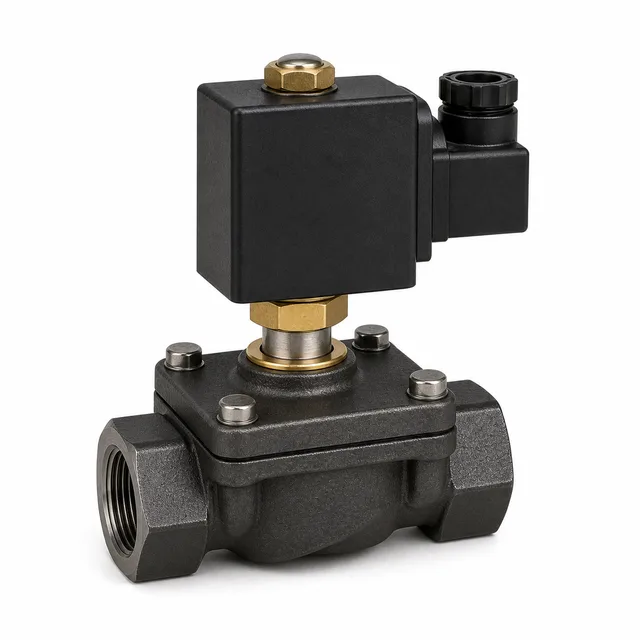
The three 2/2 solenoid valves in the TECTUL catalog: Generic Bronze Solenoid (bronze and carbon steel body, 1/4″ to 1″, 110/220 V), Stainless Solenoid (stainless steel body, 1″, declared working pressure 0.15-0.85 MPa) and Steam Solenoid Series 2L (bronze body, piston-pilot operated, minimum opening pressure 0.5 to 15 kgf/cm²). The number one cause of returns in this family is not a factory defect: it is confusing a direct-acting solenoid (the magnetic field moves the plunger with no need for line pressure) with a diaphragm or piston servo-assisted one, which needs a minimum differential pressure to open. This sheet publishes that distinction with the real figures for each reference, how to correctly specify a solenoid valve (Cv, orifice, elastomer by fluid, coil, 100% ED duty cycle), why a water solenoid is unfit for steam, water hammer from fast closure in a long line, and the NC versus NO criterion.
Important: Before using these data in engineering, design or installation decisions on systems exposed to mechanical, pressure, rupture, fatigue, impact or water-hammer risk, it is essential to read the technical notice and limitation of liability at the end of this sheet.
SKU VT-59224 (Generic Bronze Solenoid) · line of 3 2/2 solenoid valve references in the TECTUL catalog, from 1/4″ to 2″
1. Technical specifications
References, mechanism and construction
| Reference | Body | Mechanism | Sizes | Voltages |
|---|---|---|---|---|
| Generic Bronze Solenoid (liquid-gas) | Bronze and carbon steel | Direct acting: the coil's magnetic field directly moves the plunger/piston that opens or closes the port | 1/4″ · 3/8″ · 1/2″ · 3/4″ · 1″ | 110 V · 220 V |
| Stainless Solenoid | 304/316 stainless steel | 2-way, 2-position, normally closed (NC), as declared by the manufacturer | 1″ | 110 V · 220 V |
| Steam Solenoid (Series 2L) | Bronze | Servo-assisted, piston-pilot operated (mechanism declared "multiplex"), 2/2 normally closed | 1/2″ · 3/4″ · 1″ · 1-1/2″ · 2″ | 220 V |
IMPORTANT
This data sheet is a reference guide to the properties of this product type. The measurements, dimensions and physical or geometric characteristics of the product actually supplied may vary by manufacturer and lot, and may even fall outside the cited standards. If any of these figures is critical to your design or build, it is essential to verify it with one of our advisors against the physical product, so you can be fully certain of what you are buying. · Original data sheet: tectul.com/en/conduccion-de-fluidos/valvulas/ficha-tecnica-valvula-solenoide-bronce-acero-al-carbon.html
The "direct acting" or "servo-assisted" construction of each reference is taken from the manufacturer's description on its product page (direct plunger on the Generic Bronze; piston pilot expressly declared on the Steam one). The Stainless one is declared 2/2 NC without specifying the exact internal mechanism; its working pressure range, which does not start at zero (section 2), is consistent with a servo-assisted design.
Reference framework and supply conditions
| Valve type | 2/2 solenoid valve, direct acting or diaphragm/piston servo-assisted depending on reference |
| Cv reading framework | ISO 6358 (flow testing of pneumatic components) is used in the industry as a method reference for expressing Cv/Kv of control valves this size; it is not a certification of the TECTUL product |
| Pressure rating system | Working differential pressure by fluid (minimum and maximum ΔP), not a single psi value — see the pressure table below and section 2 |
| Coil class | Not declared per reference on the commercial sheet; the industry's usual pattern is class F (155 °C) or class H (180 °C) — confirmed on quotation |
| IP protection rating | Not declared on the commercial sheet for any of the three references; confirmed on quotation |
| Ends | NPT thread |
Pressure, fluids and temperature declared per reference
| Reference | Minimum opening pressure / minimum ΔP | Maximum working pressure | Declared fluids | Declared temperature |
|---|---|---|---|---|
| Generic Bronze | Not declared by the manufacturer; confirmed on quotation | Not declared; confirmed on quotation | Water, oils and non-corrosive liquids | Not declared |
| Stainless | 1.5 bar (0.15 MPa · 21.8 psi) — lower end of the declared working range | 8.5 bar (0.85 MPa · 123 psi) | Water, air, light oil and non-corrosive gases | -5 °C to 80 °C |
| Steam (Series 2L) | 0.5 kgf/cm² ≈ 0.49 bar (7.1 psi) — minimum opening pressure expressly declared by the manufacturer | 15 kgf/cm² ≈ 14.7 bar (213 psi) | Steam and heavy oil; not suitable for fluids with viscosity above 20 cSt, liquids that solidify at low temperature, or corrosive substances | Not declared; the manufacturer refers to the pressure range |
IMPORTANT
This data sheet is a reference guide to the properties of this product type. The measurements, dimensions and physical or geometric characteristics of the product actually supplied may vary by manufacturer and lot, and may even fall outside the cited standards. If any of these figures is critical to your design or build, it is essential to verify it with one of our advisors against the physical product, so you can be fully certain of what you are buying. · Original data sheet: tectul.com/en/conduccion-de-fluidos/valvulas/ficha-tecnica-valvula-solenoide-bronce-acero-al-carbon.html
The pressure, fluid and temperature values are data published by the manufacturer on each product page, not an independent TECTUL test. Where the manufacturer does not declare a datum, the cell states so explicitly rather than assuming another reference's value. The steam reference's kgf/cm² is converted using 1 kgf/cm² = 0.9807 bar = 14.22 psi.
⚠ Important: this technical data sheet is a reference guide to the product's properties; it is not a quality certificate for the product you are buying. Heats vary from one another and may differ from the values stated here, or even depart from the standards. If your application requires compliance with a standard, always check the quality certificate (mill certificate) of the lot you are buying. If in doubt, ask one of our technical advisors →
2. Why it does not open (or close): direct acting versus servo-assisted
The number one cause of returning a solenoid valve that "does not work" is not a factory defect: it is having installed the wrong actuation type for the actual installation.
Direct acting: zero minimum ΔP
In a direct-acting solenoid, the coil alone, with its own magnetic force, moves the plunger that opens the port — it needs no line pressure to operate. That is why it can open at zero differential pressure, even under partial vacuum: it is the type suited to gravity feed, low-head tanks or lines where inlet pressure can drop to almost nothing. The trade-off is that, for large orifices, the required magnetic force grows a great deal, so direct action is typically reserved for small to medium sizes and orifices.
Diaphragm or piston servo-assisted: needs pressure to open
In a servo-assisted solenoid (diaphragm or piston-pilot type), the coil does not move the main closure member directly: it opens a small pilot orifice, and it is the line pressure itself, unbalanced through that pilot, that lifts the diaphragm or main piston and opens the large port. That mechanism allows much larger orifices with a small coil — and it is the construction of this catalog's Stainless Solenoid and Steam Solenoid — but it requires a minimum differential pressure between inlet and outlet for the line pressure to do its part of the work. Below that minimum, the diaphragm or piston does not fully lift: the coil may hum (energised) while the valve still fails to open, or it opens only partially and drips when closed.
- Stainless Solenoid: 1.5 bar (21.8 psi) minimum — installing it on a line with less than that differential pressure (for example, gravity-fed from a low tank) is the most likely cause of it "not opening".
- Steam Solenoid: 0.5 kgf/cm² ≈ 0.49 bar (7.1 psi) minimum — a lower minimum than the Stainless one, but real: below that steam or heavy-oil line pressure, the reference is not guaranteed to open per its own sheet.
- The Generic Bronze Solenoid, direct acting per its description, should not have this problem — it is the choice when the installation cannot guarantee a minimum differential pressure, for example gravity or tank feed.
The field selection criterion is simple: if the installation does not guarantee a permanent minimum differential pressure, direct acting is needed, not servo-assisted, no matter how appealing the large orifice of the servo-assisted option looks. It is the criterion that prevents the most returns in this family.
3. How a solenoid valve is really specified
A diameter and a voltage do not specify a solenoid valve. The seven data points below do, and none can be omitted without leaving an engineering gap.
Function, orifice and Cv/Kv
- Function: 2/2 normally closed (NC) or normally open (NO) — see the fail-safe criterion in section 4.
- Orifice diameter: the actual internal port, which does not always match the connection thread; on servo-assisted valves a larger orifice requires more minimum differential pressure to lift the diaphragm, not less.
- Cv (or Kv in metric): the flow coefficient — the water flow rate in gallons per minute (or m³/h with Kv) passing through the fully open valve with a 1 psi (or 1 bar) drop. It is the datum that truly predicts the actual installation flow rate; the thread's nominal diameter does not. None of the three references in this catalog publishes its Cv: it is confirmed on quotation with the actual manufacturer.
Minimum and maximum ΔP by fluid, not a generic psi
The correct pressure rating for a solenoid valve is not a single psi number: it is a pair of values, minimum and maximum, declared per fluid (water, air, oil, steam), because the fluid's viscosity and density change the force line pressure can exert on the diaphragm or piston pilot. This sheet already declared those pairs for the Stainless one (1.5-8.5 bar) and the Steam one (0.49-14.7 bar) in section 1; for the Generic Bronze one, the manufacturer does not publish the pair and it is confirmed on quotation.
Elastomer and its temperature
| Typical industry elastomer | Reference temperature range | Usual service |
|---|---|---|
| NBR (nitrile) | Approximately -10 °C to 80 °C | Water, air and light mineral oils — the most common general-purpose elastomer |
| FKM / Viton | Approximately -10 °C to 150-200 °C depending on grade | Higher-temperature oils and fuels, aggressive fluids |
| PTFE | Approximately -30 °C to 180-200 °C | Steam and high-temperature or chemically aggressive fluids |
IMPORTANT
This data sheet is a reference guide to the properties of this product type. The measurements, dimensions and physical or geometric characteristics of the product actually supplied may vary by manufacturer and lot, and may even fall outside the cited standards. If any of these figures is critical to your design or build, it is essential to verify it with one of our advisors against the physical product, so you can be fully certain of what you are buying. · Original data sheet: tectul.com/en/conduccion-de-fluidos/valvulas/ficha-tecnica-valvula-solenoide-bronce-acero-al-carbon.html
This table is a general industry elastomer reference, not the actual elastomer data sheet of each TECTUL reference. The temperature range declared by the manufacturer for the Stainless one, -5 °C to 80 °C, is compatible with an NBR-type elastomer; the Steam one declares neither elastomer nor service temperature, and being a steam service its actual elastomer is confirmed on quotation (section 4).
Coil: voltage, power, insulation class and duty cycle
Voltage (110 V, 220 V) is only half the datum: the coil power in watts and its insulation class (usual pattern class F at 155 °C or class H at 180 °C) determine how much it heats up in continuous service. 100% ED duty cycle (continuous duty) means the coil can remain energised indefinitely at its rated voltage without overheating by design: the housing being hot to the touch under those conditions is normal, not a fault. The IP rating of the electrical enclosure defines its resistance to dust and water from the installation environment (outdoor, weather, washdown) and none of the three references declares it on its commercial sheet.
4. Steam, water hammer and the NC versus NO criterion
Why a water solenoid dies in steam
A solenoid specified for water or air almost always carries an NBR-type elastomer, with a temperature ceiling on the order of 80 °C (section 3). Saturated steam, even at moderate pressures, comfortably exceeds that temperature — at 7 bar, saturated steam is above 165 °C —, so the NBR degrades, loses elasticity and ends up failing within weeks where it would have lasted years in water. In addition, the condensate that forms inside a poorly drained steam line hits the seat with high-velocity droplets and carries scale particles, wear a clean fluid like treated water does not produce. That is why this catalog's Steam Solenoid is a distinct reference, in bronze, piston-pilot operated — and not a Generic Bronze Solenoid put to work with steam.
The Steam Solenoid's manufacturer does not declare the elastomer or the service temperature on its commercial sheet: for steam, the expected elastomer on engineering grounds is PTFE or an equivalent high-temperature elastomer, consistent with the section 3 table, but this is confirmed on quotation and is not published as a certified datum in this sheet.
Water hammer from fast closure on a long line
A solenoid valve closes in fractions of a second — it is part of its usefulness —, but that same fast closure, on a long line with a considerable liquid column, stops the flow abruptly and generates an over-pressure wave: water hammer. The longer the line and the higher the fluid velocity, the more severe the wave. Two practical mitigations: install a cushioned check valve downstream (from the catalog's special check valve line) to absorb the return, or specify, when the manufacturer offers it, a slow-closing solenoid (with a pilot circuit that delays closure, analogous to this catalog's hydraulic pilot control valves) instead of forcing an instantaneous closure on a line that cannot tolerate it.
NC versus NO: the fail-safe criterion
The choice between normally closed (NC) and normally open (NO) is not one of electrical convenience, it is one of what must happen if power is cut:
- Normally closed (NC): with no power, the valve is closed; it is energised to let the fluid through. It is the default choice when a power cut must stop flow — most safety, dosing and process control applications.
- Normally open (NO): with no power, the valve is open; it is energised to close the port. It is used when a power cut must allow flow to continue — for example, emergency cooling lines that must not run dry if the controller's power fails.
All three references in this catalog are declared normally closed (NC); an NO configuration is confirmed on quotation as a special order if the manufacturer offers it for that reference.
5. Frequently asked questions
Why doesn't my solenoid valve open if the coil hums?
Almost always insufficient differential pressure on a servo-assisted valve. The Stainless Solenoid needs a minimum 1.5 bar (21.8 psi) and the Steam one a minimum 0.49 bar (7.1 psi) between inlet and outlet for line pressure to lift the diaphragm or piston pilot; the energised coil hums, but without that minimum differential the port does not fully open (section 2). The Generic Bronze Solenoid, direct acting, does not depend on that differential.
What does Cv mean on a solenoid valve?
It is the flow coefficient: the water flow rate, in gallons per minute, passing through the fully open valve with a 1 psi pressure drop. It predicts the installation's actual flow rate better than the thread's nominal diameter. None of the three references in this catalog publishes it; it is confirmed on quotation with the actual manufacturer (section 3).
Why does a water solenoid get damaged if I use it in steam?
Because of the elastomer and the condensate. The typical seal of a water solenoid is NBR, with a temperature ceiling of about 80 °C; saturated steam comfortably exceeds that temperature and degrades the elastomer within weeks. Condensate in a steam line also hits the seat with high-velocity droplets. That is why the specific steam reference exists, in bronze and with a piston pilot (section 4).
Should I choose NC or NO?
It depends on what must happen if power is cut. Normally closed (NC) if a power cut must stop the flow — the most common case. Normally open (NO) if a power cut must let the fluid through, for example on an emergency cooling line. All three references in this catalog are NC; an NO version is confirmed on quotation (section 4).
Is it normal for the coil to feel hot to the touch?
Yes, if the coil is designed for 100% ED duty cycle (continuous duty): it can stay energised indefinitely at its rated voltage without overheating by design, and a high temperature to the touch under those conditions is expected, not a fault (section 3).
How do I avoid water hammer when the solenoid closes?
By installing a cushioned check valve downstream to absorb the return, or by specifying a slow-closing solenoid when the manufacturer offers one, instead of forcing an instantaneous closure on a long line that cannot tolerate it (section 4).
6. Application notes
Feasibility
The line covers 2/2 NC automatic control of water, air, light oils and non-corrosive gases (Generic Bronze and Stainless, within 1.5-8.5 bar on the Stainless one) and steam and heavy oil up to 14.7 bar (Steam Solenoid), always within each reference's declared minimum differential. It is not the choice when the installation cannot guarantee a servo-assisted valve's minimum differential (use the direct-acting Generic Bronze, or confirm with the manufacturer whether a direct-acting version exists in the required size), nor for viscous (>20 cSt), corrosive or cold-solidifying fluids on the steam reference. For critical, safety or continuous-process applications, consult our technical team before specifying.
Installation
Check the installation's actual differential pressure against the declared minimum before installing a servo-assisted reference; install in the indicated flow direction; on the steam reference, mount horizontally as recommended by the manufacturer and install a Y-strainer upstream to extend service life. Confirm the available voltage against the coil's before energising. On long lines, evaluate the need for a cushioned check valve downstream or a slow-closing version to mitigate water hammer (section 4). Perform periodic maintenance of the coil, electrical connections and internal cleaning to avoid blockage or leaks.
Design
Always specify the seven data points in section 3 (NC/NO function, orifice, Cv, minimum-maximum ΔP by fluid, elastomer and its temperature, coil voltage and power, IP) and not just diameter and voltage. Check the installation's available differential pressure against the minimum of the chosen servo-assisted reference; if it cannot be guaranteed, specify direct acting. For steam, demand the actual elastomer and its temperature from the manufacturer before accepting the generic water reference. Include water hammer mitigation in the drawing if the line is long and closure is fast.
7. Technical notice and limitation of liability
The pressure values in this sheet — 1.5-8.5 bar on the Stainless Solenoid and 0.49-14.7 bar on the Steam Solenoid — are data the manufacturer publishes on each product page, not an independent TECTUL test nor a certification under a specific valve standard. Where the manufacturer does not declare a datum — pressure of the Generic Bronze, Cv of all three references, exact elastomer, coil class, IP rating —, the sheet states so explicitly rather than assuming a generic value: it is confirmed on quotation.
The elastomer tables (NBR/FKM/PTFE) and Cv/Kv in section 3, and the water hammer mitigation criterion in section 4, are general solenoid valve engineering reference, consistent across multiple manufacturers, not the certified data sheet of an actual reference in this catalog. The direct-acting versus servo-assisted mechanism of each reference is taken from the manufacturer's description on its product page.
These values must not be used as the sole criterion in critical, safety, boiler or process applications where valve failure may compromise people, property or the environment: in such cases NC/NO function selection, design differential pressure and elastomer belong to the project's responsible engineer, verified against the actual manufacturer's certified data sheet. Before deciding with these data, consult our technical team.
Sources
- ISO 6358 — Pneumatic fluid power: components using compressible fluids, determination of flow-rate characteristics: marco de método de referencia para expresar Cv/Kv de válvulas de control de este tamaño
- Bürkert — "Direct-acting vs pilot solenoid valves" (nota técnica de fabricante): principio de funcionamiento y presión diferencial mínima de cada tipo de accionamiento
- Valves Online — "Solenoid Valves: Minimum Differential Explained" y "Servo-assisted Solenoid Valves": rango típico de presión diferencial mínima de válvulas servopilotadas por diafragma
- STC Valve / Naylamp — especificaciones de la serie genérica 2/2 acción directa tipo 2W (cuerpo latón/inox, Cv 0,23-48, NBR/Viton, 0-7 kgf/cm², bobina clase F/H, duty cycle 100 % ED): evidencia de catálogo de fabricante genérico del tipo, no del producto TECTUL
- Tameson / Electricsolenoidvalves.com — guías de material de sello para válvulas solenoide: rangos de temperatura de referencia de NBR, FKM/Viton y PTFE
- IEC 60085 — Electrical insulation: clasificación térmica de bobinas, clase F (155 °C) y clase H (180 °C), patrón habitual de la industria de electroválvulas
- Cla-Val / Cougar USA — notas técnicas de golpe de ariete y válvulas anticipadoras/amortiguadas: mitigación de sobrepresión por cierre rápido en línea larga
- Fichas de producto TECTUL (tectul.com): Solenoide Bronce Genérica, Solenoide Inoxidable y Solenoide para Vapor Serie 2L — fuente de presión de trabajo, fluidos, temperatura, diámetros y voltajes, agosto 2026
This data sheet is the property of TECTUL, part of the Industrias IMR group. Reproduction without attribution is prohibited. Original document and updates: tectul.com/en/conduccion-de-fluidos/valvulas/ficha-tecnica-valvula-solenoide-bronce-acero-al-carbon.html.