
Flexible fiberglass fabric duct for high temperature — with and without aluminum core
TECTUL · Dispatch across Colombia · Exports to Central & South America
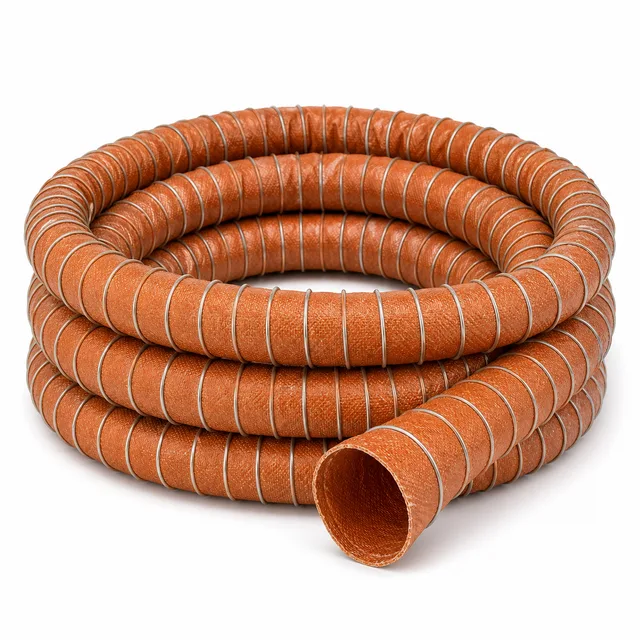
IMPORTANT: reference data — may differ from the physical product; verify with an advisor before buying.
SKU VT-142151 (fiberglass duct) · sibling VT-142138 (aluminum core) · 2 references, 33 diameter variants · sold by 10 m roll
1. Technical specifications
General specifications
| Product | Flexible duct for ventilation, hot gas extraction and air conveyance in high-temperature environments, offered in two constructions: fiberglass fabric (VT-142151) and aluminum core with fiberglass coating (VT-142138) |
| Temperature range | VT-142151: -70 °C to 260 °C (-94 °F to 500 °F) · VT-142138: up to 150 °C (302 °F), the only value the manufacturer publishes |
| Working pressure/vacuum | Not a pressure pipe: it operates under the draft (positive or negative) generated by a fan or extractor. The manufacturer publishes no maximum working pressure or vacuum — confirmed on quotation |
| Construction | VT-142151: fiberglass fabric over a steel wire helix, with no continuous metal core, and an outer fiberglass coating of low thermal conductivity. VT-142138: an aluminum core that holds the duct's shape, with an outer fiberglass coating for thermal insulation |
| Presentation | 10 m rolls on both references, no partial cuts |
| Intended use | Ventilation systems, hot gas extraction and air conveyance in high-temperature environments; VT-142138 is also aimed at air conditioning/heating and extraction of corrosive gases and vapors |
IMPORTANT
This technical data sheet is a reference guide to the properties of this product type; it is not a quality certificate for the product you are buying. The measurements, dimensions and physical or geometric characteristics of the product supplied may vary by manufacturer, heat and lot, and may even fall outside the cited standards. If any of these figures is critical to your design or build, verify it with one of our advisors against the physical product or the lot's mill certificate, so you can be fully certain of what you are buying. · Original data sheet: tectul.com/en/conduccion-de-fluidos/mangueras/ficha-tecnica-ducto-de-fibra-de-vidrio-para-alta-temperatura.html
Dimensional table — VT-142151 (fiberglass fabric)
| Nominal diameter (in) | Internal diameter (mm) | Internal diameter (in) |
|---|---|---|
| 2″ | 51 | 2.0 |
| 3″ | 76 | 3.0 |
| 4″ | 102 | 4.0 |
| 5″ | 127 | 5.0 |
| 6″ | 152 | 6.0 |
| 7″ | 178 | 7.0 |
| 8″ | 203 | 8.0 |
| 9″ | 228 | 9.0 |
| 10″ | 254 | 10.0 |
| 11″ | 279 | 11.0 |
| 12″ | 305 | 12.0 |
| 13″ | 329 | 13.0 |
| 14″ | 356 | 14.0 |
| 15″ | 381 | 15.0 |
| 16″ | 406 | 16.0 |
| 18″ | 457 | 18.0 |
| 19″ | 482 | 19.0 |
| 20″ | 508 | 20.0 |
| 21″ | 533 | 21.0 |
| 22″ | 550 | 21.7 |
| 23″ | 584 | 23.0 |
| 24″ | 609 | 24.0 |
IMPORTANT: reference data — may differ from the physical product; verify with an advisor before buying.
Dimensional table — VT-142138 (aluminum core with fiberglass)
| Nominal diameter (in) | Internal diameter (mm) | Internal diameter (in) |
|---|---|---|
| 2″ | 51 | 2.0 |
| 2-1/2″ | 63 | 2.5 |
| 3″ | 76 | 3.0 |
| 4″ | 102 | 4.0 |
| 5″ | 127 | 5.0 |
| 6″ | 152 | 6.0 |
| 8″ | 203 | 8.0 |
| 10″ | 254 | 10.0 |
| 12″ | 305 | 12.0 |
| 14″ | 356 | 14.0 |
| 16″ | 406 | 16.0 |
IMPORTANT: reference data — may differ from the physical product; verify with an advisor before buying.
Dimensions are nominal catalog values, for reference only, subject to the normal manufacturing tolerance of woven flexible ducts; the exact diameter per lot is confirmed on quotation.
2. Why this sibling withstands less temperature than plain fiberglass, and how to choose among the 5 TECTUL ducts
El dato que rompe la intuición
Se podría suponer que añadir un núcleo de aluminio a un ducto de fibra de vidrio mejora su resistencia térmica, porque el aluminio también tolera el calor. La ficha del fabricante muestra lo contrario: VT-142151 (solo tela de fibra de vidrio) llega a 260 °C (500 °F) mientras que VT-142138 (núcleo de aluminio con fibra de vidrio) declara un único valor de 150 °C (302 °F), casi 110 °C menos. La razón no es el aluminio en sí —que funde muy por encima de 260 °C— sino la construcción completa del ducto: el núcleo de VT-142138 existe para mantener la forma del tubo (rigidez direccional), y esa función normalmente se logra con un ensamble de espiral metálica más adhesivos o materiales de unión que limitan el techo térmico real del conjunto muy por debajo del punto de fusión del aluminio. La tela de fibra de vidrio de VT-142151, en cambio, no lleva ese ensamble adicional y por eso alcanza el techo térmico propio de la fibra de vidrio.
Esta ficha declara los dos valores exactamente como los publica el fabricante: un rango (-70 °C a 260 °C) para VT-142151 y un único límite superior (150 °C) para VT-142138, sin límite inferior declarado. No asuma que la hermana comparte el mismo piso de -70 °C: ese dato se confirma al cotizar.
Tabla comparativa de los 5 ductos de la familia TECTUL
| Referencia | Rango de temperatura | Diámetros | Presentación | Uso típico |
|---|---|---|---|---|
| Ducto flexible genérico (PVC) | -20 °C a 80 °C (-4 °F a 176 °F) | 4″–50″ (100–1270 mm) | Rollo de 10 m | Climatización y extracción de aire a temperatura ambiente |
| Poliéster para alta temperatura | -20 °C a 120 °C (-4 °F a 248 °F) | 2″–24″ (51–609 mm) | Rollo de 10 m | Extracción de humos y aire caliente moderado |
| TPR (manguera-ducto) | -40 °C a 150 °C (-40 °F a 302 °F) | 1″–12″ (25–305 mm) | Rollo de 15 m (10 m en 10″–12″) | Ventilación industrial y gases calientes, incluida intemperie fría |
| Fibra de vidrio con núcleo de aluminio (VT-142138, esta ficha) | Hasta 150 °C (302 °F) | 2″–16″ (51–406 mm) | Rollo de 10 m | Ventilación/extracción en entornos de alta temperatura moderada que exigen forma propia |
| Fibra de vidrio (VT-142151, esta ficha) | -70 °C a 260 °C (-94 °F a 500 °F) | 2″–24″ (51–609 mm) | Rollo de 10 m | Extracción de gases calientes y aire de alta temperatura sostenida |
| Silicona | -70 °C a 260 °C (-94 °F a 500 °F) | 1″–12″ (26–305 mm) | Rollo de 4 m | Escape de motores, hornos industriales, exposición a UV/ozono |
IMPORTANT: reference data — may differ from the physical product; verify with an advisor before buying.
Cómo leer esta tabla
- Si la temperatura real de servicio no supera 120 °C, el poliéster o el ducto genérico cubren la necesidad a menor costo.
- Entre 120 °C y 150 °C hay tres alternativas: TPR, silicona o esta hermana de núcleo de aluminio; la elección depende de si se necesita forma propia del ducto (aluminio), flexibilidad de tramo corto reforzada con acero (TPR) o resistencia a UV/ozono (silicona).
- Por encima de 150 °C y hasta 260 °C, solo la tela de fibra de vidrio (VT-142151) o la silicona cumplen, según este catálogo.
- Ninguna de las cinco referencias de esta familia es tubería de presión: todas trabajan por el tiro de un ventilador o extractor.
Construcción, en la práctica
La tela de fibra de vidrio de VT-142151 se arma típicamente sobre una espiral de alambre de acero que le da la forma corrugada y la resistencia al aplastamiento, con la fibra de vidrio como capa exterior de baja conductividad térmica que conserva la temperatura del aire conducido. Este patrón de construcción —espiral metálica interior + tela técnica exterior— es el mismo que describe UL 181 para ductos y conectores de aire flexibles fabricados en planta.
3. Installation: worm-gear clamp, sleeve overlap and minimum bend radius
Connection to the collar or spigot
Slide the duct onto the metal collar (spigot) of the box, diffuser or fan with an overlap of 50 to 100 mm (2″ to 4″) and secure it with a worm-gear clamp 25 to 38 mm (1″ to 1.5″) wide, positioned directly over the collar, never over the free corrugated section of the duct. Over that joint, apply at least two full wraps of foil tape compatible with flexible ducts to seal the overlap and prevent air leakage at the seam.
Minimum bend radius
Do not bend the duct below one times its nominal diameter: a smaller radius chokes the inner cross-section, reduces actual airflow and accelerates material fatigue at the bend point. On direct connections to diffusers, grilles or where the run is exposed, use a radius of at least two times the nominal diameter to avoid losing effective section. Avoid sharp-angle folds (creases) and support the curved section so no weight rests on the duct itself.
Support and routing
Support the duct at reasonable intervals with clamps or wide straps that do not cut the fabric or insulation —never with wire or thin cord—, and prevent the weight of the duct itself or of accessories from hanging off a single joint. Extend the duct to its working length without compressing or overstretching it beyond its natural slack: compression reduces the flow cross-section and overstretching thins the wall at the point of maximum extension.
These are general flexible air duct installation practices (not specific to a TECTUL lot), documented in installation guides conforming to UL 181 and NFPA 90A; the manufacturer's manual for each reference may add its own requirements.
4. Frequently asked questions
Why does the aluminum-core duct withstand less temperature than the plain fiberglass one?
Because the core exists to give the duct its own shape, and that added assembly (metal helix plus joining materials) limits the assembly's real thermal ceiling to 150 °C (302 °F), while the fiberglass fabric without that assembly reaches 260 °C (500 °F). It is not a matter of aluminum's melting point, but of the complete construction.
Do these ducts withstand pressure from an industrial fan?
They are not rated as pressure pipe: they operate under the draft —positive or negative— generated by the fan or extractor, typically low values compared to a pressure piping system. The manufacturer publishes no maximum working pressure or vacuum for either reference; that figure is confirmed on quotation according to the system's actual operating point.
What is the maximum diameter available in each reference?
VT-142151 (fiberglass) reaches 24″ (609 mm); VT-142138 (aluminum core) reaches 16″ (406 mm). Both start at 2″ (51 mm) and are sold in 10 m rolls.
Can I use the aluminum-core one to extract corrosive gases?
Its catalog application includes extraction of corrosive gases and vapors in addition to ventilation, air conditioning and heating at high temperature. Exact chemical compatibility with the specific process gas or vapor is confirmed on quotation, because the manufacturer publishes no chemical resistance table by substance.
How tightly can I bend the duct without damaging it?
Not less than one times its nominal diameter in general, and at least two times the diameter on direct connections to diffusers or grilles. A smaller radius chokes the inner cross-section and accelerates material fatigue at the bend point.
5. Application notes
Feasibility
Use VT-142151 (fiberglass fabric) when the real service temperature may approach 260 °C (500 °F) or drop to -70 °C (-94 °F): hot gas extraction, sustained high-temperature process air. Use VT-142138 (aluminum core with fiberglass) when, in addition to moderate heat (up to 150 °C/302 °F), the duct needs to hold its own shape without collapsing, or when the application includes extraction of corrosive gases and vapors. Neither is pressure pipe: do not specify them where the system develops significant positive pressure without first confirming with the manufacturer.
Installation
Secure with a worm-gear clamp over the metal collar, with a 50–100 mm overlap and foil tape sealing. Respect a minimum bend radius of one times the diameter (two times on connections to diffusers or grilles). Do not let the run's weight hang off a single joint or compress the duct below its nominal section.
Design
Do not assume the aluminum-core reference shares the -70 °C to 260 °C range of the plain fiberglass fabric: its manufacturer data sheet only declares an upper limit of 150 °C, with no published thermal floor. For design temperatures above 150 °C, specify VT-142151 or this family's silicone reference. Neither reference in this group is rated as pressure pipe; if the system requires a declared working pressure or vacuum, request it from the manufacturer before specifying.
6. Technical notice and limitation of liability
The pressures, dimensions, weights and other characteristics in this sheet are theoretical calculation values obtained from nominal properties published in the standards cited (ASME B36.10-2022, ASME B31.3-2024, ASTM A106/A106M-19a, ASTM A53/A53M-24, API Spec 5L 46th ed.). They guide selection; they are not a certificate of conformity for any given lot.
The actual behavior of each lot varies with manufacturing — wall tolerance (up to −12.5%), out-of-roundness, residual stresses — and with the raw material — chemical composition within the ranges the standard allows, heat-to-heat differences. To certify a lot, the tests defined by its product standard are required: tensile test, flattening test and hydrostatic test, documented in the manufacturer's mill test certificate (MTC), which TECTUL supplies upon request; testing of the lot in an independent laboratory can also be arranged.
These values must not be used as the sole criterion in critical or safety applications, or wherever failure of the line may compromise people, property or the environment: in such cases the design belongs to the project's responsible engineer under the applicable code (ASME B31.3, B31.1 or the one governing the installation), with the design temperature, corrosion allowance and load cases of the actual service. Before deciding with these data, consult our technical team.
Sources
- Ficha técnica de fabricante «Ducto de fibra de vidrio» (TECTUL SAS, fichas-rescate/ft-ducto-de-fibra-de-vidrio.pdf): rango de temperatura -70 °C a 260 °C (-94 °F a 500 °F), tabla dimensional NPS 2″–24″
- Ficha técnica de fabricante «Ducto de aluminio con fibra de vidrio» (TECTUL SAS, fichas-rescate/ft-ducto-aluminio-con-fibra-de-vidrio.pdf): rango de temperatura 150 °C (302 °F), tabla dimensional NPS 2″–16″
- UL 181, Standard for Factory-Made Air Ducts and Air Connectors, Ed. 11-2013 (reafirmado 2021) — clasificación y construcción de ductos y conectores de aire flexibles fabricados en planta
- NFPA 90A, Standard for the Installation of Air-Conditioning and Ventilating Systems, edición 2024 — requisitos de instalación de ductos y conectores flexibles
This data sheet is the property of TECTUL, part of the Industrias IMR group. Reproduction without attribution is prohibited. Original document and updates: tectul.com/en/conduccion-de-fluidos/mangueras/ficha-tecnica-ducto-de-fibra-de-vidrio-para-alta-temperatura.