 TECTULby IMR
Threaded carbon steel ball valves — 1000 and 3000 WOG (CWP), not an ASME Class
TECTUL · Dispatch across Colombia · Exports to Central & South America
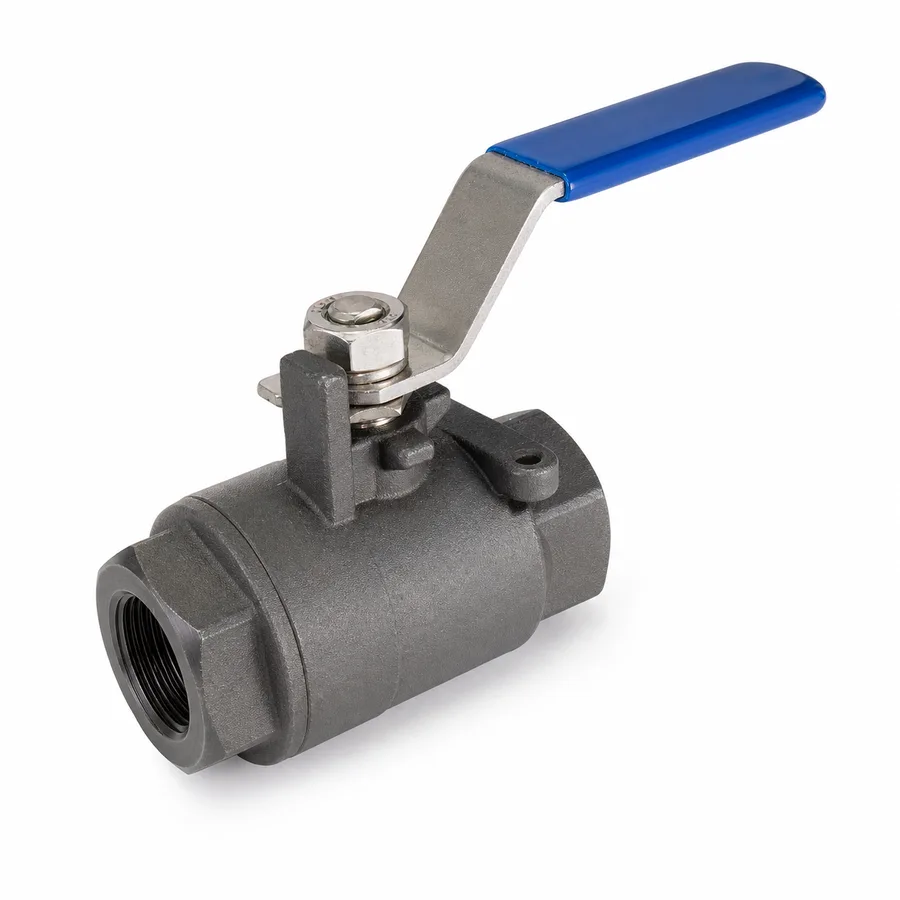
NPT threaded ball valves with a carbon steel body —cast ASTM A216 grade WCB or forged ASTM A105 depending on the reference—, stainless steel ball and reinforced PTFE seat. The backbone of this sheet is a naming correction: the "Class 3000" currently published on the product page does NOT exist in ASME B16.34, whose tabulated classes are 150, 300, 400, 600, 900, 1500, 2500 and 4500. The 3000 is the valve's cold WOG/CWP rating (206.8 bar at ≤38 °C) and the correct reading is "3000 WOG (CWP), MSS SP-110". The same applies to the 1000 psi sibling reference (68.9 bar). The sheet also covers the reinforced wall of the 3000, the four-bolt bolted body.
Important: Before using these data in engineering, design or installation decisions on systems exposed to mechanical, pressure, rupture, fatigue, impact or water-hammer risk, it is essential to read the technical notice and limitation of liability at the end of this sheet.
SKU VT-59180 (carbon steel ball valve 3000 psi) · 3 carbon steel references, 1/4″–4″ · sold by the unit
1. Technical specifications
Materials by component
| Component | Material | Designation | Remark |
|---|---|---|---|
| Body and cap | Cast or forged carbon steel, depending on the reference | ASTM A216 grade WCB (cast) or ASTM A105 (forged) | WCB is cast carbon steel suitable for fusion welding and high-temperature service; A105 is the forged equivalent. The exact designation per reference is confirmed on quotation |
| Ball | Stainless steel | Austenitic grade — confirmed on quotation | Stainless is chosen even though the body is carbon steel: the ball is the sealing surface and cannot be allowed to rust |
| Stem | Carbon or stainless steel, depending on the reference | Confirmed on quotation | Blowout-proof assembly from inside the body |
| Seat and seals | Reinforced PTFE (RPTFE) | PTFE compound with 15–25 % glass fiber | Sets the real thermal limit: −45 °C to +232 °C, far below what the steel body withstands |
| Body bolting | Steel | Confirmed on quotation | Present only on the four-bolt construction |
TECTUL catalog references in carbon steel
| Reference | Correct rating reading | Construction | Catalog diameters |
|---|---|---|---|
| Carbon steel ball valve 3000 psi (VT-59180) | 3000 WOG (CWP) · 206.8 bar at ≤38 °C | Two threaded pieces, reinforced wall | 1/4″ · 3/8″ · 1/2″ · 3/4″ · 1″ · 1-1/4″ · 1-1/2″ · 2″ (8 variants) |
| Carbon steel ball valve 1000 psi | 1000 WOG (CWP) · 68.9 bar at ≤38 °C | Two threaded pieces | 1/4″ · 3/8″ · 1/2″ · 3/4″ · 1″ · 1-1/4″ · 1-1/2″ · 2″ · 3″ · 4″ (10 variants) |
| Carbon steel four-bolt ball valve | Confirmed on quotation | Body bolted with 4 bolts, maintainable in line | 1/4″ · 3/8″ · 1/2″ · 3/4″ · 1″ · 1-1/4″ · 1-1/2″ · 2″ · 2-1/2″ · 3″ · 4″ (11 variants) |
IMPORTANT
This data sheet is a reference guide to the properties of this product type. The measurements, dimensions and physical or geometric characteristics of the product actually supplied may vary by manufacturer and lot, and may even fall outside the cited standards. If any of these figures is critical to your design or build, it is essential to verify it with one of our advisors against the physical product, so you can be fully certain of what you are buying. · Original data sheet: tectul.com/en/conduccion-de-fluidos/valvulas/ficha-tecnica-valvula-bola-acero-al-carbon-3000-psi.html
The four-bolt reference does not declare a rating on its product page: its WOG/CWP is confirmed on quotation with the real supplier and must not be assumed equal to the other two.
Comparison of the two references with a declared rating
| Item | 1000 psi reference | 3000 psi reference |
|---|---|---|
| Cold WOG/CWP rating (≤38 °C) | 1000 psi | 3000 psi |
| Equivalent in bar | 68.9 bar | 206.8 bar |
| Equivalent in kg/cm² | 70.3 kg/cm² | 210.9 kg/cm² |
| Catalog naming to be corrected | "Class 1000" → 1000 WOG (CWP) | "Class 3000" → 3000 WOG (CWP) |
| Catalog range | 1/4″–4″ | 1/4″–2″ |
| Construction feature | Two threaded pieces, standard wall | Two threaded pieces, reinforced wall |
IMPORTANT
This data sheet is a reference guide to the properties of this product type. The measurements, dimensions and physical or geometric characteristics of the product actually supplied may vary by manufacturer and lot, and may even fall outside the cited standards. If any of these figures is critical to your design or build, it is essential to verify it with one of our advisors against the physical product, so you can be fully certain of what you are buying. · Original data sheet: tectul.com/en/conduccion-de-fluidos/valvulas/ficha-tecnica-valvula-bola-acero-al-carbon-3000-psi.html
General specifications
| Product | Threaded carbon steel ball valves for on-off shutoff service, in two-piece construction (1000 and 3000 WOG) and four-bolt bolted body |
| Material | Carbon steel body ASTM A216 WCB (cast) or ASTM A105 (forged) depending on the reference · stainless steel ball · carbon or stainless steel stem · RPTFE seat and seals |
| Ends | Female NPT thread per ASME B1.20.1 |
| Rating | Manufacturer WOG/CWP at ≤38 °C: 1000 WOG (68.9 bar) and 3000 WOG (206.8 bar) — not an ASME B16.34 Class, see section 2 |
| Commercial range | 1/4″–4″ by reference; 3 active references and 29 diameter variants in TECTUL's carbon steel catalog |
| Sale | By the unit, per reference and diameter — |
| Applicable standards | MSS SP-110-2010 (ball valves threaded, socket-welding, solder joint, grooved and flared ends) · ASME B1.20.1-2013 (R2018) (NPT thread) · ASTM A216 (cast WCB body) · ASTM A105 (forged body) · ASTM A351 (stainless ball, when cast). Contrast standard cited in section 2: ASME B16.34 |
IMPORTANT
This data sheet is a reference guide to the properties of this product type. The measurements, dimensions and physical or geometric characteristics of the product actually supplied may vary by manufacturer and lot, and may even fall outside the cited standards. If any of these figures is critical to your design or build, it is essential to verify it with one of our advisors against the physical product, so you can be fully certain of what you are buying. · Original data sheet: tectul.com/en/conduccion-de-fluidos/valvulas/ficha-tecnica-valvula-bola-acero-al-carbon-3000-psi.html
⚠ Important: this technical data sheet is a reference guide to the product's properties; it is not a quality certificate for the product you are buying. Heats vary from one another and may differ from the values stated here, or even depart from the standards. If your application requires compliance with a standard, always check the quality certificate (mill certificate) of the lot you are buying. If in doubt, ask one of our technical advisors →
2. Naming correction: "Class 3000" is not an ASME class
The error, in one line
The current product page for valvula-bola-acero-al-carbon-3000-psi reads "Standard: Class 3000" today. Class 3000 does not exist in ASME B16.34, which is the valve class standard. The "3000" on this valve is its cold WOG/CWP rating —the maximum pressure with water, oil or non-flammable gas at ≤38 °C— and not a flange class. The correct reading is "3000 WOG (CWP), MSS SP-110". The same correction applies to the sibling reference: 1000 WOG (CWP), not "Class 1000".
What ASME B16.34 classes are, and which ones exist
An ASME Class is not a pressure figure: it is the entry point to a full pressure-temperature table by material group, with a different allowable value at each thermal step, plus the minimum wall thickness and testing requirements the standard imposes on the body. The classes tabulated in ASME B16.34 are:
| Class | 150 | 300 | 400 | 600 | 900 | 1500 | 2500 | 4500 |
|---|---|---|---|---|---|---|---|---|
| Cold allowable pressure, material group 1.1 (A105 / A216 WCB), −29 to 38 °C | 285 psi | 740 psi | 990 psi | 1480 psi | 2220 psi | 3705 psi | 6170 psi | Per standard |
| Equivalent in bar | 19.6 | 51.0 | 68.3 | 102.1 | 153.1 | 255.5 | 425.4 | Per standard |
IMPORTANT
This data sheet is a reference guide to the properties of this product type. The measurements, dimensions and physical or geometric characteristics of the product actually supplied may vary by manufacturer and lot, and may even fall outside the cited standards. If any of these figures is critical to your design or build, it is essential to verify it with one of our advisors against the physical product, so you can be fully certain of what you are buying. · Original data sheet: tectul.com/en/conduccion-de-fluidos/valvulas/ficha-tecnica-valvula-bola-acero-al-carbon-3000-psi.html
None of those classes is "3000". The "Class 800" that circulates on forged carbon steel valves is not a tabulated B16.34 class either: it is a commercial industry designation, common in forged valve practice (API 602), obtained by interpolation between 600 and 900. The group 1.1 values correspond to A105/A216 WCB carbon steel, which is exactly the body material of these valves.
Where the confusion comes from: Class 3000 does exist, but for fittings
Nobody invented the number 3000: it belongs to ASME B16.11, the standard for forged socket-welding and threaded fittings, whose classes are 2000, 3000, 6000 and 9000. A Class 3000 forged elbow, tee or coupling is a perfectly valid and frequent designation on the very line where this valve is installed. What is not valid is transferring that designation to a ball valve body, because valves are not classified on the B16.11 scale but on the B16.34 one — or, as in this threaded family, by the manufacturer's WOG/CWP rating under MSS SP-110.
- Starting figure: 3000 WOG (CWP) = 3000 psi = 206.8 bar, with water, oil or non-flammable gas, at ≤38 °C.
- Position in the B16.34 table, group 1.1 (A105/A216 WCB) cold: Class 900 allows 2220 psi and Class 1500 allows 3705 psi. The 3000 psi falls between the two.
- Position calculation: (3000 − 2220) / (3705 − 2220) = 780 / 1485 = 0.53 — that is, slightly past halfway across the step from Class 900 to Class 1500.
- Conclusion you CAN draw: cold, this valve sustains a pressure higher than a Class 900 and lower than a Class 1500 of the same material.
- Conclusion you CANNOT draw: that the valve "is Class 1500" or "is Class 900". A class implies meeting the minimum wall thickness, the full P-T table at every temperature and the testing B16.34 requires, and this valve declares none of those requirements: it declares a single cold figure.
- Practical consequence: if the project specification calls for "Class 900 minimum per ASME B16.34", this valve does not comply merely by saying 3000. You must quote a valve that declares the class, not the WOG.
Why this matters at temperature
The difference is not semantic. An ASME Class brings its own tabulated derating: the same group 1.1 body allowing 2220 psi cold in Class 900 drops in a tabulated way as temperature rises. A WOG rating, in contrast, is a single point: above 38 °C there is no table, you must request the curve from the manufacturer. That is why a 3000 WOG valve cannot replace a class-declared valve on a line with a high design temperature — not because it withstands less cold, but because it does not carry the information the designer needs.
And above all that, the seat governs
| Seat | Typical catalog thermal range |
|---|---|
| Virgin PTFE | Approx. −20 °C to +180 °C (valve industry seat selection guides) |
| RPTFE (15–25 % glass fiber) | −45 °C to +232 °C (−50 °F to 450 °F) |
IMPORTANT
This data sheet is a reference guide to the properties of this product type. The measurements, dimensions and physical or geometric characteristics of the product actually supplied may vary by manufacturer and lot, and may even fall outside the cited standards. If any of these figures is critical to your design or build, it is essential to verify it with one of our advisors against the physical product, so you can be fully certain of what you are buying. · Original data sheet: tectul.com/en/conduccion-de-fluidos/valvulas/ficha-tecnica-valvula-bola-acero-al-carbon-3000-psi.html
The WCB carbon steel body retains pressure capacity well above 232 °C, but the RPTFE seat does not. In practice, this valve's thermal ceiling is set by the seat polymer, not by the steel — and that ceiling is the same as the 600 WOG bronze line's. Going from 1000 to 3000 WOG buys pressure, not temperature.
3. Construction: reinforced wall, bolted body and installation
Why the 3000 carries a reinforced wall
The two threaded references are both two-piece and share the same body material, but not the same thickness. The pressure a cylindrical body can contain grows with wall thickness relative to inner radius: to triple the cold rating from 1000 to 3000 psi with the same carbon steel, the wall, the threaded mouth and the cap flange must all be thickened in comparable proportion. That explains three things visible in the catalog at once:
- Material and machining: the 3000 psi reference carries considerably more metal and machining per unit than the 1000 psi one.
- Range: the 3000 psi reaches 2″ while the 1000 psi reaches 4″. The wall thickness needed to sustain 206.8 bar grows with diameter and the valve stops being reasonable in size and weight; at that point the market moves to another construction.
- Weight and operating torque: at equal nominal diameter, the 3000 psi is appreciably heavier and demands more force at the handle.
The exact wall thickness of each reference is not published in the catalog and is confirmed on quotation: MSS SP-110 does not impose the tabulated minimum thickness that ASME B16.34 does impose on class-rated valves.
What the four-bolt bolted body changes
The two-piece threaded body is the simplest and cheapest construction, but reaching the ball and seat requires removing the valve from the line or installing unions upstream and downstream. The four-bolt version solves that: the cap joins the body with four through bolts and comes off without touching the pipe, so seat and ball are changed in line. That is its argument, not pressure.
| Construction | Advantage | Catalog range |
|---|---|---|
| Two threaded pieces | More compact, cheaper, fewer potential leak paths | 1/4″–4″ (1000 psi) · 1/4″–2″ (3000 psi) |
| Four-bolt | Seat and ball maintenance in line, without cutting or unthreading pipe | 1/4″–4″ |
The four-bolt reference declares no rating on its product page; do not assume it shares the 1000 or 3000 WOG of the other two. Its WOG/CWP is confirmed on quotation.
A stainless ball in a carbon steel body
It may look like a materials inconsistency, but it is not: the body is the structural element containing the pressure, and for that carbon steel is economical and sufficient, whereas the ball is the sealing surface, turning against the PTFE seat on every operation and exposed to the fluid even with the valve closed. A carbon steel ball would rust-pit and score the seat in the first idle period with moisture inside the line. That is why the ball is always stainless in this family, and the stem usually is too.
Installation and body protection
Seal the NPT thread with PTFE tape or a fluid-compatible sealant; always hold the valve by the hex of the end being threaded, never by the handle. On the four-bolt reference, respect the bolting torque and cross-tightening sequence when closing the body again after maintenance: uneven tightening deforms the seat and causes body leakage. Operate the valve fully open or fully closed — MSS SP-110 covers on-off service valves and at 206.8 bar partial opening erodes the RPTFE seat very quickly. Unlike bronze and stainless, the carbon steel body corrodes on the outside: outdoors, in marine environments or in damp rooms, check that the external coating is intact and restore it after any mechanical intervention.
4. Frequently asked questions
Does "Class 3000" on a ball valve mean 3,000 psi of ASME class?
No. Class 3000 does not exist in ASME B16.34: the tabulated classes are 150, 300, 400, 600, 900, 1500, 2500 and 4500. The "3000" appearing on the product page today is the cold WOG/CWP rating (≤38 °C) of a valve under MSS SP-110, not a flange class. The correct reading is "3000 WOG (CWP)". Class 3000 does exist, but in ASME B16.11, the forged fittings standard (classes 2000, 3000, 6000 and 9000) — that is where the confusion comes from.
So which ASME Class does a 3000 WOG valve equal?
None. Cold, its 3000 psi (206.8 bar) falls between Class 900 (2220 psi) and Class 1500 (3705 psi) of material group 1.1, which is that of A105/A216 WCB carbon steel. But a class is not just a pressure figure: it implies meeting the minimum wall thickness, the full pressure-temperature table and the testing B16.34 requires. If your specification calls for a declared class, you must quote a valve that declares it.
How much pressure does the 1000 psi carbon steel ball valve withstand?
1000 WOG (CWP): 1000 psi, 68.9 bar, 70.3 kg/cm², with water, oil or non-flammable gas, cold (up to 38 °C). It is not "Class 1000" — that designation does not exist either. Above 38 °C you must come down the reference manufacturer's pressure-temperature curve, because MSS SP-110 publishes no common derating table.
Why does the 3000 psi cost five times more and only reach 2″?
Because it carries a reinforced wall. Tripling the cold rating with the same carbon steel requires thickening the wall, the threaded mouth and the cap flange: that means more metal, more machining and more weight per unit. And since the required thickness grows with diameter, above 2″ the valve stops being reasonable in size and weight, so the catalog stops there while the 1000 psi continues to 4″.
Is a carbon steel ball valve suitable for steam at 200 °C?
The carbon steel body does reach it, but the RPTFE seat is at the edge of its range (up to ≈232 °C) and in real steam, with thermal cycling and condensate carryover, PTFE creeps and loses its seal. For continuous process steam another valve family or a different seat (PEEK, metal-to-metal) is specified. Besides, the allowable pressure at 200 °C is no longer the cold WOG figure: you must request the reference's P-T curve from the manufacturer.
What is the four-bolt version for, if the two-piece is cheaper?
To avoid cutting pipe. On the two-piece threaded body, changing seat and ball forces you to remove the valve from the line or to have unions nearby. The four-bolt opens in place and its internals are changed without touching the assembly. On a welded, embedded or hard-to-reach line, that difference is recovered on the first intervention. That said: its rating is not declared in the catalog and is confirmed on quotation.
5. Application notes
Feasibility
Carbon steel is the threaded ball valve solution when working pressure exceeds what bronze (600 WOG) and the standard stainless line (1000 WOG) provide, and the fluid does not demand corrosion resistance in the body: hydraulics, high-pressure compressed air, oil, non-corrosive process lines. It is not specified for potable water in permanent contact, sanitary food service or chloride-bearing fluids, where the body corrodes: there selection moves to the CF8M stainless line. The body also corrodes externally outdoors or in damp environments, so the external coating is part of the specification. The four-bolt reference declares no rating and requires confirmation before being specified.
Installation
Seal the NPT thread with PTFE tape or a fluid-compatible sealant and always hold the valve by the hex of the end being threaded, never by the handle. Operate the valve fully open or fully closed: MSS SP-110 covers on-off service valves, and at 206.8 bar partial opening erodes the RPTFE seat very quickly. On the four-bolt reference, respect the bolting torque and cross-tightening sequence when closing the body again after maintenance; uneven tightening deforms the seat and causes body leakage. Check that the body's external coating is intact and restore it after any mechanical intervention: unlike bronze and stainless, this body corrodes on the outside.
Design
Do not specify these valves as if they had an ASME class. The 1000 and the 3000 are the manufacturer's cold WOG/CWP ratings under MSS SP-110: a single point at ≤38 °C, with no derating table, no tabulated minimum wall thickness and none of the testing regime ASME B16.34 imposes on a class-rated valve. If the project specification calls for a declared class, this family does not comply merely by showing a high number. For design temperatures above 38 °C, request the reference's full pressure-temperature curve from the real manufacturer before specifying it, and remember that above 232 °C the limiting factor is the RPTFE seat, not the steel. Final selection of rating, material and end type is the responsibility of the line designer per the project code (ASME B31.3, B31.1, the applicable NTC or other) and its current edition.
6. Technical notice and limitation of liability
The ratings in this sheet are WOG/CWP values published in manufacturer catalogs declaring conformance to MSS SP-110-2010, or catalog thermal ranges for PTFE/RPTFE seats from the valve industry; they guide selection and are not a certificate of conformance for any lot. The per-class pressure values cited in section 2 (285, 740, 990, 1480, 2220, 3705 and 6170 psi) are those of ASME B16.34/B16.5 material group 1.1 cold and are included solely as a contrast reference: these valves declare no ASME class and cannot replace a class-declared valve.
Certifying a lot requires the manufacturer's MTC per the body's ASTM specification (A216 grade WCB if cast, A105 if forged) and legible valve marking on the body. Updating the product page for "carbon steel ball valve 3000 psi" —which today reads "Standard: Class 3000"— to "3000 WOG (CWP), MSS SP-110" is still pending, as is that of its 1000 psi sibling. Final selection of rating, material and end type is the responsibility of the line designer per the project code (ASME B31.3, B31.1 or other) and its current edition.
Sources
- MSS SP-110-2010 (incluye fe de erratas del 23-ago-2010) — Ball Valves Threaded, Socket-Welding, Solder Joint, Grooved and Flared Ends (alcance NPS 1/4″–4″; acero al carbón entre los materiales cubiertos; exige una sección de Pressure-Temperature Ratings por válvula pero no publica una tabla de derating común a toda la norma)
- ASME B16.34-2020 — Valves — Flanged, Threaded, and Welding End (clases tabuladas 150, 300, 400, 600, 900, 1500, 2500 y 4500; tabla presión-temperatura por grupo de material y requisitos de espesor mínimo de pared — norma que demuestra que la «Clase 3000» no existe para válvulas)
- ASME B16.5-2020 — Pipe Flanges and Flanged Fittings: NPS 1/2 Through NPS 24 Metric/Inch (valores de presión admisible del grupo de materiales 1.1 —A105 / A216 WCB— a −29/38 °C: 285, 740, 990, 1480, 2220, 3705 y 6170 psi para las Clases 150 a 2500)
- ASME B16.11-2021 — Forged Fittings, Socket-Welding and Threaded (clases 2000, 3000, 6000 y 9000 de accesorios forjados — origen documentado de la confusión con la designación «Clase 3000»)
- ASME B1.20.1-2013 (R2018) — Pipe Threads, General Purpose, Inch (rosca NPT de los extremos)
- ASTM A216/A216M — Standard Specification for Steel Castings, Carbon, Suitable for Fusion Welding, for High-Temperature Service (grado WCB, cuerpo de acero al carbón fundido)
- ASTM A105/A105M — Standard Specification for Carbon Steel Forgings for Piping Applications (cuerpo de acero al carbón forjado, alternativa de fabricación según la referencia)
- ASTM A351/A351M — Standard Specification for Castings, Austenitic, Austenitic-Ferritic (Duplex), for Pressure-Containing Parts (bola de acero inoxidable, cuando es de fundición)
- API 602 — Gate, Globe, and Check Valves for Sizes DN 100 and Smaller for the Petroleum and Natural Gas Industries (práctica de válvulas forjadas donde circula la designación comercial «Clase 800», no tabulada en ASME B16.34)
- NIBCO INC. — Two-Piece Carbon Steel Ball Valve T-580-CS-R-25, ficha técnica de producto (cdn.mscdirect.com, consultada 04-ago-2026): cuerpo de acero al carbón, bola inoxidable, asiento y sello RPTFE, vástago de acero al carbón, puerto convencional (reducido), peso 2,570 lb en 1″
- LINS Valve — Ball Valve Seat Material Guide: PTFE vs RPTFE vs PEEK vs Metal (rango térmico de catálogo del asiento RPTFE con 15–25 % de fibra de vidrio: −50 °F a 450 °F / −45 °C a 232 °C)
This data sheet is the property of TECTUL, part of the Industrias IMR group. Reproduction without attribution is prohibited. Original document and updates: tectul.com/en/conduccion-de-fluidos/valvulas/ficha-tecnica-valvula-bola-acero-al-carbon-3000-psi.html.