 TECTULby IMR
PP-R type 3 socket-fusion valves — ball, true union, brass adapters, globe and wye check (NTC 4897-3 / DVS 2207-11)
TECTUL · Dispatch across Colombia · Exports to Central & South America
Complete valve line for random copolymer polypropylene (PP-R type 3) socket-fusion networks per NTC 4897-3:2017 and DIN 8077-8078: blue-handle ball valve for cold fluid, red-handle ball valve for hot fluid, removable true-union ball valve for hot fluid, the three adapters with a threaded brass insert (male, female and coupling), globe valve and wye check valve. Sizes from 20 to 50 mm. PN16 rating at 20 °C. What decides the installation is not the rating but the procedure: the joint is made by socket fusion with a heating tool at 260 ± 10 °C under DVS 2207-11, and the valve adds a rule no commercial sheet publishes — never fuse with the ball in the closed position, because heat deforms the PTFE seat against the ball. PP-R is also the alternative available today in the catalog for 90 to 95 °C continuous hot water, where PVC stops at 60 °C.
Important: Before using these data in engineering, design or installation decisions on systems exposed to mechanical, pressure, rupture, fatigue, impact or water-hammer risk, it is essential to read the technical notice and limitation of liability at the end of this sheet.
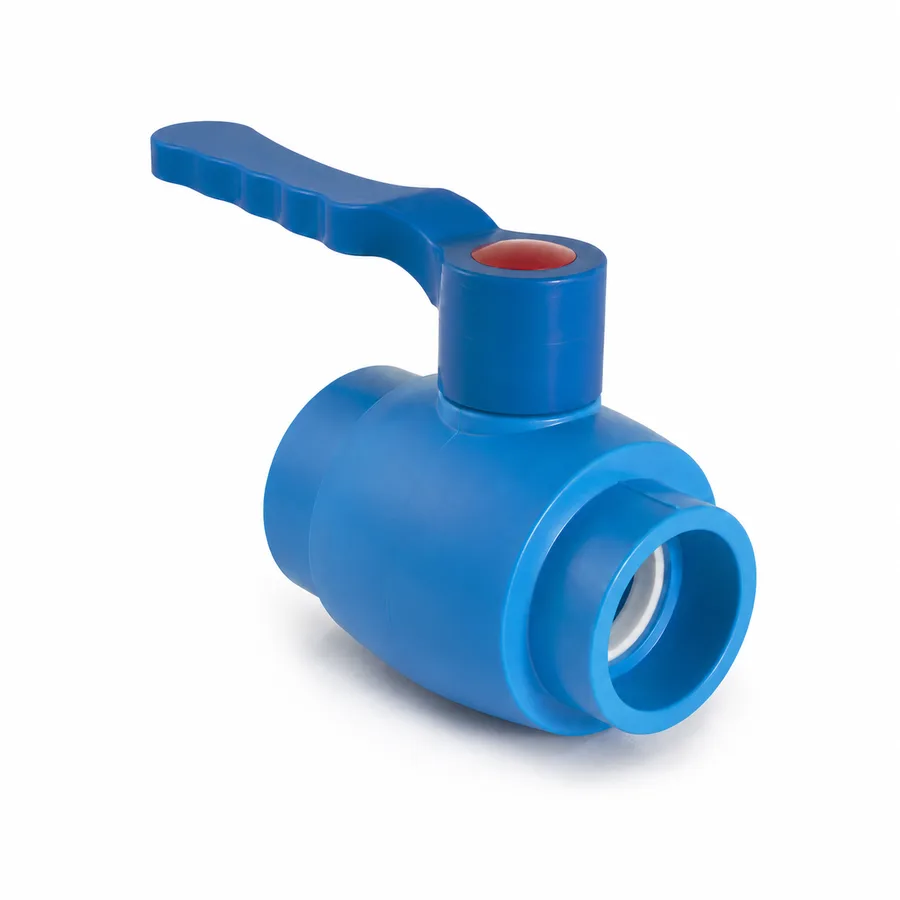
SKU VT-59191 (PP-R fusion ball valve, blue handle, cold fluid) · line of 8 PP-R socket-fusion references: cold ball, hot ball, true union, three brass-insert adapters, globe and wye check · sizes from 20 to 50 mm
1. Technical specifications
Line rating — water at 20 °C, non-shock
| Material | Random copolymer polypropylene, PP-R type 3, per NTC 4897-3:2017 (ICONTEC) and DIN 8077 / DIN 8078 — the same material as the catalog's socket-fusion pipe and fittings. |
| Nominal pressure | PN16 at 20 °C: 16 bar (232 psi) for water without hydraulic shock. Allowable pressure falls with service temperature according to the system standard's application classes; the published rating is always the 20 °C one. |
| Service temperature | Up to 90-95 °C continuous in the hot-fluid references (red handle and true union), with higher short-duration peaks allowed according to the application class. The handle colour code is service signage, not a different pressure class (section 2). |
| Closure member | Nickel-plated brass or PP ball depending on reference, with 1/4-turn operation and a 90° mechanical stop. The globe valve has a disc and rising stem; the wye check, a swing disc in an inclined body. |
| Seat and seals | PTFE seat and EPDM o-rings. The PTFE seat is the heat-sensitive component during fusion: hence the rule of fusing with the lever open (section 3). |
| Ends | Female socket for socket fusion. On the three adapter references one end carries a threaded brass insert (male, female or coupling) encapsulated during factory moulding. |
| Joining | Socket fusion with a heating tool at 260 ± 10 °C, with heating, joining and cooling times per size according to DVS 2207-11. |
| Applicable standards | NTC 4897-3:2017 (plastic piping systems for hot and cold water, polypropylene, fittings) · DIN 8077 and DIN 8078 (dimensions and general quality requirements for PP pipe) · DVS 2207-11 (socket fusion of polypropylene pipes and fittings) · NTC 4897-1 (general requirements and system application classes). |
Unlike PVC, this line is NOT read with the PVC derating factor table: PP-R has its own framework of application classes combining temperature, pressure and design service life. What it does share with PVC is the principle: the catalog number is a value at a reference temperature, not a constant.
TECTUL catalog references — actual sizes
| Reference | Service | Catalog sizes |
|---|---|---|
| PP-R fusion ball valve, blue handle (VT-59191) | cold fluid | 20, 25, 32, 40 and 50 mm (green or blue body) |
| PP-R fusion ball valve, red handle | hot fluid | 20, 25, 32, 40 and 50 mm |
| PP-R fusion true-union ball valve | hot fluid, removable joint | 20, 25 and 32 mm |
| Ball valve with male-thread adapter, PP-R fusion / brass | transition to male thread | 20, 25 and 32 mm |
| Ball valve with adapter, PP-R fusion / brass (coupling) | coupling transition | 20, 25 and 32 mm |
| Ball valve with female-thread adapter, PP-R fusion / brass | transition to female thread | 1/2″, 3/4″ and 1″ |
| PP-R fusion globe valve | regulation and shut-off | blue and green references; no size variant published in the current catalog |
| PP-R wye check valve | non-return in an inclined body | 20 mm, in blue and green |
IMPORTANT
This data sheet is a reference guide to the properties of this product type. The measurements, dimensions and physical or geometric characteristics of the product actually supplied may vary by manufacturer and lot, and may even fall outside the cited standards. If any of these figures is critical to your design or build, it is essential to verify it with one of our advisors against the physical product, so you can be fully certain of what you are buying. · Original data sheet: tectul.com/en/conduccion-de-fluidos/valvulas/ficha-tecnica-valvula-bola-polipropileno-fusion-manija-azul.html
The three brass-insert adapters cost an order of magnitude more than the plain ball valve because they include the encapsulated metallic part and its assembly: that is the trade-off of having the threaded transition made in the factory and not in the field (section 4).
⚠ Important: this technical data sheet is a reference guide to the product's properties; it is not a quality certificate for the product you are buying. Production lots vary from one another and may differ from the values stated here, or even depart from the standards. If your application requires compliance with a standard, always check the quality certificate (mill certificate) of the lot you are buying. If in doubt, ask one of our technical advisors →
2. PN16, colour code and service temperature
What PN16 means and what it does not
PN16 is the nominal pressure in bar at the 20 °C reference temperature: 16 bar, equivalent to 232 psi, for water without hydraulic shock. It is not a wall-thickness class like steel schedule, nor an ASME class, and it is not a constant for the life of the installation: in PP-R systems the allowable pressure is combined with service temperature and design service life through the application classes of the system standard (NTC 4897-1). A domestic hot water network at 70 °C for 50 years does not work at the same 16 bar as a cold water network at 20 °C, even though the fitting is identical.
This is the point that separates PP-R from the PVC covered in the PVC ball valve sheet: PP-R is not derated with the PVC factor table. They are different polymers, with different hydrostatic design bases and different regulatory frameworks. Applying the PVC 0.88 / 0.75 / 0.62 factors to a PP-R valve is a methodological error, not a conservative approximation.
The handle colour code
| Handle colour | Intended service | Catalog references |
|---|---|---|
| Blue | Cold fluid: cold domestic water, irrigation, tank feed and ambient-temperature process lines | PP-R fusion ball valve, blue handle (VT-59191), 20 to 50 mm |
| Red | Hot fluid: domestic hot water and warm circuits, up to 90-95 °C continuous | PP-R fusion ball valve, red handle, 20 to 50 mm; true-union ball valve, 25 mm |
The handle colour is intended-service signage, not a different pressure class: both references are PN16 at 20 °C. What changes is the internal construction foreseen for the thermal cycle — the hot-fluid reference is designed for repeated expansion and contraction of seat and body. A fitter who installs a blue handle on the hot water branch does not get an immediate failure: he gets a valve outside its intended service, which ages sooner and which no inspector can identify afterwards without dismantling it. The catalog also offers green and blue bodies on several references, which matches the network colour and does not change the rating.
Why PP-R is the catalog's answer for hot water
PVC-U stops at 60 °C, and at that point it takes only 22 % of its catalog pressure: it is not a domestic hot water material however low the network pressure may be. CPVC reaches 93 °C. The PP-R line in this sheet covers 90-95 °C continuous by a different route: a monolithic fused joint, with no thread, no sealant and no elastomeric gasket along the pipe run, which is exactly where hot water networks built with cold water materials fail. That is the technical reason to pay for the PP-R line and learn its fusion procedure: it is not more pressure, it is sustained temperature with a joint that has no leak paths by design.
3. Socket fusion at 260 ± 10 °C and the valve-specific rule
Socket fusion: the procedure
The eight references in this sheet are joined exactly like the catalog's PP-R fitting: heating tool at 260 ± 10 °C with the male-female die pair for the size, per DVS 2207-11. The sequence is square cut, marking the insertion depth on the pipe, simultaneous heating of pipe and socket for the tabulated time for the size, removal and immediate joining without rotation, and cooling without moving the assembly for the stated time. The complete times per size, from 20 to 110 mm, are in the catalog's PP-R socket-fusion fittings data sheet and are not repeated here.
The valve-specific rule: never fuse with the ball closed
This is the difference between fusing a fitting and fusing a valve, and the main reason for this sheet. The valve seat is PTFE and is compressed against the ball. When the ball is closed, it presents its solid face against both seats, and the heat travelling through the body from the fusion die reaches a loaded seat: PTFE flows under that combination of heat and compression and keeps a permanent imprint. The valve comes out of the fusion apparently sound and fails at the first closure, with a leak no tightening can correct because the defect is inside the body.
- Before bringing the heating tool close, put the lever in the OPEN position (port aligned with the pipe axis). The ball then presents its bore to the seats and is unloaded.
- Fuse both ends with the normal procedure at 260 ± 10 °C and the times for the size.
- Let the joint cool for the full DVS table time without operating the valve: operating it hot drags the still-soft seat.
- Only with the joint cold, verify closure: 90° rotation to the mechanical stop, with no hard spots, and hydrostatic test of the network with the valve closed to confirm that it seals.
The three typical fusion errors
| Error | Cause | How it shows up |
|---|---|---|
| Cold fusion | Tool below 250 °C, short heating time, or a die fouled with carbonised residue that insulates | The material did not melt through the full depth: the joint survives installation and fails weeks later, at the first thermal or pressure cycle. It is the most dangerous failure because it passes the initial test. |
| Overheating | Tool above 270 °C or heating time exceeded | Excessive bead invading the bore, section reduction and, on a valve, seat deformation even with the lever open. Degraded PP loses properties irreversibly. |
| Misalignment | Joining with rotation, out-of-square cut, or the part moved before cooling | Uneven fusion thickness around the perimeter: full weld on one side and marginal contact opposite. Localised failure under bending or expansion stress. |
A square cut with PP shears or a wheel cutter, cleaning of the pipe end and the die, and respecting the marked insertion depth eliminate most of these three errors. A die with carbonised residue is cleaned hot with a non-metallic fibre cloth: scraping it with metal ruins the non-stick coating and the next fitting sticks.
4. Brass inserts, make-up and removable joints
The brass insert comes from the factory, it is not threaded in the field
Three references in this sheet carry a threaded brass insert: the male thread, the female thread and the coupling. The metallic thread is encapsulated inside the PP-R moulding at the factory, with an anchoring geometry (knurling, sunk hexagon or grooves) that prevents it from turning or pulling out under make-up torque. It is the only correct way to have a thread in a socket-fusion network.
A thread is never cut onto PP-R in the field, nor is a metallic nipple threaded directly against a polypropylene body. There are three reasons, and they are cumulative:
- PP-R is a soft thermoplastic with elastic memory: a thread cut onto it loses interference through thermal cycles and ends up dripping, even if it seals on installation day.
- Cutting a thread removes wall thickness at the point of highest stress concentration, exactly where the expansion cycle of a hot water network concentrates fatigue.
- A metallic taper thread acts as a rigid wedge against a material that creeps cold: the make-up torque a fitter considers normal cracks the body, sometimes weeks later.
That is why the threaded transition of a PP-R network is bought, not made. The cost premium of these three references over the plain ball valve is the cost of the encapsulated brass part and its assembly process; it is also why the catalog lists them as separate references and not as an add-on fitting.
How to tighten the insert thread
Normal metallic thread practice applies to the brass insert — PTFE tape or a compatible sealant, and tightening with a wrench against the metallic hexagon of the insert itself, never levering against the PP-R body. Holding the valve by the plastic body while tightening a nipple transmits the full torque to the encapsulation and can pull the insert out of its seat, which is the characteristic failure of these parts when badly installed.
True union in the PP-R line
The true-union hot-fluid ball valve reference brings in the same concept as the PCP line in PVC: coupling nuts that let the valve be removed without destroying the fused joints. In a socket-fusion network this matters more than in a PVC one, because a fused joint cannot be "taken apart": replacing a fixed-body valve forces cutting pipe on both sides and remaking two fusions inside a wall or ceiling that is already closed. Wherever maintenance is anticipated — equipment inlets, water heaters, sectional shut-off points — the true-union valve pays for itself.
5. Frequently asked questions
At what temperature is a PP-R valve fused?
With the heating tool at 260 ± 10 °C, per DVS 2207-11, and the heating, joining and cooling times for the size. The difference from a fitting is that the valve is fused with the lever OPEN: with the ball closed, heat deforms the PTFE seat compressed against the ball and the valve is left leaking permanently when closed.
How many bar does a polypropylene socket-fusion ball valve take?
PN16 at 20 °C, that is 16 bar (232 psi) for water without shock. That value is at the reference temperature: in a hot water network the allowable pressure is determined by the system's application class, which combines service temperature, pressure and design service life. The PVC derating factors do not apply — different polymer, different regulatory framework.
What is the difference between the blue handle and the red handle?
The colour signals the intended service: blue for cold fluid and red for hot fluid, up to 90-95 °C continuous. Both are PN16 at 20 °C; what changes is the internal construction foreseen for repeated thermal cycling. Installing the blue one on a hot water branch does not burst the network on day one, but it leaves a valve outside its service, ageing sooner.
Can I thread the PP-R valve directly onto a metallic nipple?
Not onto the polypropylene. That is what the three references with a factory-encapsulated brass insert are for (male thread, female thread and coupling). Threading against the PP-R body, or cutting a thread onto it in the field, ends in a leak from material relaxation or a crack from make-up torque. When tightening the insert, apply the wrench against the metallic hexagon, never against the plastic body.
Is PP-R suitable for domestic hot water when PVC is not?
Yes, and that is why this line exists in the catalog. PVC-U stops at 60 °C, where it takes only 22 % of its pressure. PP-R covers 90-95 °C continuous with a monolithic fused joint: no thread, no sealant and no elastomeric gasket along the pipe run, which is where hot water networks built with cold water material fail.
How do I know a fusion was done correctly?
By the displaced material bead, uniform around the whole perimeter and not invading the bore, and by an insertion depth matching the mark made before heating. A joint with an excessive bead indicates overheating; one with no visible bead, cold fusion — the most dangerous, because it passes the commissioning test and fails weeks later.
6. Application notes
Feasibility
The line covers cold water and domestic hot water networks up to 90-95 °C continuous, with a PN16 rating at 20 °C, in sizes from 20 to 50 mm. It is the alternative available today in the catalog when temperature rules out PVC-U, which stops at 60 °C. Select the reference by service, not by size alone: blue handle for cold fluid, red handle or true union for hot fluid. In domestic hot water networks, the allowable pressure is determined by the system application class, not by the 16 bar on the label. For critical or safety applications, or wherever failure compromises the process, consult our technical team before specifying.
Installation
Socket fusion with the heating tool at 260 ± 10 °C per DVS 2207-11, with the heating, joining and cooling times for the size. Valve-specific rule: lever OPEN throughout the fusion, and do not operate it until the joint has fully cooled; with the ball closed, heat deforms the PTFE seat and the closure leak is irreversible. Avoid the three typical errors: cold fusion (low tool temperature or short time), overheating (bead invading the bore) and misalignment (joining with rotation or moving the part while hot). The threaded transition is made only with the factory brass-insert references, tightening with a wrench against the metallic hexagon and never against the PP-R body.
Design
Do not apply the PVC derating factor table to this line: PP-R has its own application-class framework, combining service temperature, pressure and design service life. Size the hot water network with that class, not with the nominal 16 bar. Allow for thermal expansion of the polypropylene with expansion loops, direction changes or sliding points: a rigidly anchored socket-fusion network transmits expansion stress to the joints and to the valve bodies. At points where maintenance is anticipated — equipment inlets, water heaters, sectional shut-offs — specify the removable true-union ball valve, because a fused joint cannot be taken apart and replacement forces cutting pipe and remaking two fusions.
7. Technical notice and limitation of liability
The pressures and temperatures in this sheet are nominal values published in the standards and sources cited (NTC 4897-3:2017, DIN 8077 and DIN 8078, DVS 2207-11) or system-manufacturer catalog evidence for the 20 °C reference point. They guide selection; they are not a certificate of conformity for any production lot nor an independent test of the catalog reference.
The actual behaviour of each lot varies with manufacturing — body injection, brass insert encapsulation, PTFE seat and o-ring assembly quality — and, above all, with the execution of the fusion in the field: actual tool temperature, die cleanliness, timing and alignment. A badly fused joint invalidates every figure in this sheet. Certifying a reference requires the manufacturer documentation; TECTUL arranges it upon request.
These values must not be used as the sole criterion in critical, safety, certified potable-water applications, or wherever valve failure may compromise people, property or the environment: in such cases the design belongs to the responsible engineer of the project, with the real design temperature, the system application class and the required service life. Before deciding with these data, consult our technical team.
Sources
- NTC 4897-3:2017 (ICONTEC) — Sistemas de tuberías plásticas para instalaciones de agua caliente y fría. Polipropileno (PP). Parte 3: accesorios (base normativa colombiana de la línea PP-R tipo 3)
- NTC 4897-1 (ICONTEC) — Sistemas de tuberías plásticas para instalaciones de agua caliente y fría. Polipropileno (PP). Parte 1: generalidades y clases de aplicación (marco de temperatura, presión y vida útil de diseño)
- DVS 2207-11 — Schweißen von thermoplastischen Kunststoffen: Heizelementschweißen von Rohren, Rohrleitungsteilen und Tafeln aus PP (termofusión por manguito: temperatura de plancha 260 ± 10 °C y tiempos por diámetro)
- DIN 8077 — Polypropylene (PP) pipes: dimensions (base dimensional del sistema de termofusión)
- DIN 8078 — Polypropylene (PP) pipes: general quality requirements and testing (requisitos generales de calidad del material PP-R tipo 3)
- ISO 15874-3 — Plastics piping systems for hot and cold water installations — Polypropylene (PP) — Part 3: Fittings (norma internacional de la que deriva la serie NTC 4897)
- Ficha técnica de accesorios de termofusión PP-R del catálogo TECTUL (FT-TC-ACC-PPR-001) — tabla completa de tiempos de calentamiento, unión y enfriamiento por diámetro de 20 a 110 mm, no repetida en esta ficha
- Fichas técnicas de fábrica de las referencias del catálogo TECTUL de la línea de termofusión (válvula de bola agua fría y agua caliente, universal, adaptadores con inserto de latón, globo y cheque yee) — evidencia de catálogo de fabricante, no norma
This data sheet is the property of TECTUL, part of the Industrias IMR group. Reproduction without attribution is prohibited. Original document and updates: tectul.com/en/conduccion-de-fluidos/valvulas/ficha-tecnica-valvula-bola-polipropileno-fusion-manija-azul.html.