 TECTULby IMR
Large-diameter PVC swing check valve — 4″ and 6″, elastomeric seat (ASTM F1970)
TECTUL · Dispatch across Colombia · Exports to Central & South America
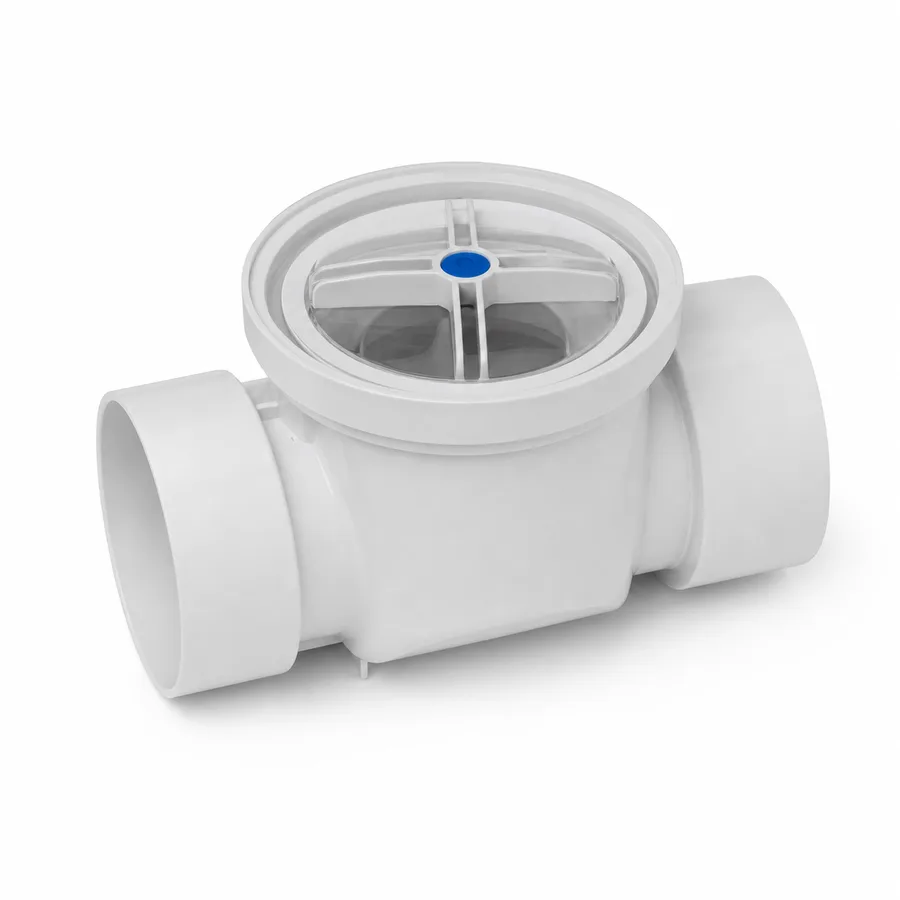
Large-diameter non-return valve with an injection-moulded PVC-U body, a PVC or POM swing disc and an elastomeric seat (EPDM or NBR depending on fluid), in 4″ and 6″. Working pressure of 150 psi (10.3 bar) at 23 °C under ASTM F1970. The figure the local catalog does not publish and that decides the installation: those 150 psi are a value at 23 °C and they fall with temperature down to 33 psi at 60 °C, the service ceiling of the PVC body — and that ceiling governs even when the seat elastomer tolerates more. This sheet publishes the full derating table applied to the 150 psi base, the logic of the elastomeric seal versus metal-to-metal, flow direction and mounting position, and an honest comparison with the metallic check valve of the same size in weight, corrosion, cost and water-hammer resistance.
Important: Before using these data in engineering, design or installation decisions on systems exposed to mechanical, pressure, rupture, fatigue, impact or water-hammer risk, it is essential to read the technical notice and limitation of liability at the end of this sheet.
SKU VT-178885 (PVC swing check valve) · 2 catalog variants: 4″ and 6″
1. Technical specifications
Working pressure and TECTUL catalog references
| Reference | Size | Pressure @23 °C | Rating system |
|---|---|---|---|
| PVC swing check valve (VT-178885) | 4″ | 150 psi (10.3 bar) | ASTM F1970 · cell class 12454 PVC-U body |
| PVC swing check valve (VT-178885) | 6″ | 150 psi (10.3 bar) | ASTM F1970 · cell class 12454 PVC-U body |
IMPORTANT
This data sheet is a reference guide to the properties of this product type. The measurements, dimensions and physical or geometric characteristics of the product actually supplied may vary by manufacturer and lot, and may even fall outside the cited standards. If any of these figures is critical to your design or build, it is essential to verify it with one of our advisors against the physical product, so you can be fully certain of what you are buying. · Original data sheet: tectul.com/en/conduccion-de-fluidos/valvulas/ficha-tecnica-valvula-cheque-antirretorno-en-pvc.html
"At 23 °C" is the only correct way to read a plastic rating: it is not a fixed class like metallic WOG nor an ASME class, it is one point on a curve that falls with temperature (section 2). Value for water without hydraulic shock; water-hammer surge is deducted separately (section 4).
Materials, construction and standards
| Body | Injection-moulded rigid PVC-U, cell classification compound 12454 per ASTM D1784 — the same compound as the catalog's PVC pressure pipe and fittings. |
| Closure member | Swing disc pivoting on a pin, in PVC or POM depending on reference. The disc opens under forward flow pressure and closes by gravity and reverse pressure. |
| Seat | Elastomeric: EPDM for water and aqueous solutions, or NBR depending on the fluid. The exact elastomer per reference is confirmed on quotation (section 3). |
| Ends | Flanged or wafer-between-flanges configuration depending on reference — the exact configuration of the catalog reference is confirmed on quotation. |
| Rating system | ASTM F1970: rating declared and tested by the manufacturer for the complete valve, always referred to 23 °C (73 °F). Pipe and fitting specifications do not cover valves: that is why the valve carries its own number. |
| Maximum service temperature | 60 °C (140 °F), set by the PVC-U body. The EPDM seat tolerates more, but the lower of the two limits governs (section 3). |
| Flow direction | Unidirectional, marked with an arrow on the body. Installing against the arrow leaves the line without non-return protection and with a permanent head loss (section 4). |
| Applicable standards | ASTM F1970 (valve rating) · ASTM D1784 (compound, cell class 12454) · ASME B16.5 class 150 (mating flanges of the installation) · ASTM D2564 and ASTM F656 (cement and primer, where the connection to the run is solvent welded). |
IMPORTANT
This data sheet is a reference guide to the properties of this product type. The measurements, dimensions and physical or geometric characteristics of the product actually supplied may vary by manufacturer and lot, and may even fall outside the cited standards. If any of these figures is critical to your design or build, it is essential to verify it with one of our advisors against the physical product, so you can be fully certain of what you are buying. · Original data sheet: tectul.com/en/conduccion-de-fluidos/valvulas/ficha-tecnica-valvula-cheque-antirretorno-en-pvc.html
⚠ Important: this technical data sheet is a reference guide to the product's properties; it is not a quality certificate for the product you are buying. Production lots vary from one another and may differ from the values stated here, or even depart from the standards. If your application requires compliance with a standard, always check the quality certificate (mill certificate) of the lot you are buying. If in doubt, ask one of our technical advisors →
2. Temperature derating on the 150 psi base
A PVC check valve that publishes "150 psi" without saying at what temperature says nothing. Unlike metallic WOG (cold, up to 38 °C) or an ASME class, the PVC rating is a continuous curve that falls from the first degree above 23 °C, because the polymer's strength depends directly on how soft it is. The hydrostatic design basis (HDB, ASTM D2837) the manufacturer uses to set the rating is measured on that same compound at 23 °C: raising the service temperature is, physically, testing a different material.
Temperature derating applied to the 150 psi base
| °C | °F | Factor | Available pressure (psi) | Available pressure (bar) |
|---|---|---|---|---|
| 23 °C | 73 °F | 1.00 | 150 psi | 10.3 bar |
| 27 °C | 80 °F | 0.88 | 132 psi | 9.1 bar |
| 32 °C | 90 °F | 0.75 | 113 psi | 7.8 bar |
| 38 °C | 100 °F | 0.62 | 93 psi | 6.4 bar |
| 43 °C | 110 °F | 0.51 | 77 psi | 5.3 bar |
| 49 °C | 120 °F | 0.40 | 60 psi | 4.1 bar |
| 54 °C | 130 °F | 0.31 | 47 psi | 3.2 bar |
| 60 °C | 140 °F | 0.22 | 33 psi | 2.3 bar |
IMPORTANT
This data sheet is a reference guide to the properties of this product type. The measurements, dimensions and physical or geometric characteristics of the product actually supplied may vary by manufacturer and lot, and may even fall outside the cited standards. If any of these figures is critical to your design or build, it is essential to verify it with one of our advisors against the physical product, so you can be fully certain of what you are buying. · Original data sheet: tectul.com/en/conduccion-de-fluidos/valvulas/ficha-tecnica-valvula-cheque-antirretorno-en-pvc.html
Factor table published by the standard's manufacturers for PVC (Westlake Pipe & Fittings / LASCO, Spears), consistent with the derating rule used for the catalog's PVC pressure fittings. 60 °C (140 °F) is the PVC-U service ceiling: above that point the valve does not apply even at lower pressure — a metallic body is required. Watch the large diameter: on a 6″ check valve, 33 psi of allowable pressure at 60 °C is less than the water column of a 24-metre elevated tank exerts.
Worked example — 6″ check valve on an irrigation pump discharge at 32 °C
- Catalog pressure at 23 °C: 150 psi (10.3 bar).
- Derating factor at 32 °C (90 °F): 0.75.
- Available working pressure: 150 × 0.75 = 113 psi (7.8 bar). 37 psi lost to temperature alone.
- That figure is compared against the design pressure: the pump shut-off discharge pressure plus the surge on disc closure, not the normal operating pressure. On a check valve, the critical event is precisely the closure.
- If the total exceeds 113 psi, the PVC reference does not apply at that point: a metallic-body check valve of the same size is required (section 4), not a larger PVC size — the limit is temperature, not diameter.
Why a check valve is more sensitive to derating than a shut-off valve
A ball or gate valve spends most of its time in a stable position, open or closed, and its body sees the line pressure. A check valve, by contrast, is the component that takes the transient event head on: every time the pump stops, the water column reverses, the disc closes and all the kinetic energy of that column converts into a pressure peak on the disc and the body. That peak occurs at the worst possible moment and, if the water is warm, it occurs on a body that has already lost a third of its capacity. That is why derating a PVC check valve is not a catalog formality: it is the margin that separates a normal closure from a cracked body.
3. The elastomeric seat: advantage, limit and ageing
Why an elastomeric seat seals better at low differential pressure
A metal-to-metal seat needs appreciable contact force to close the last gap between disc and body: tightness depends on the surface finish of two rigid parts and on the load pressing them together. On a check valve that load is supplied by reverse fluid pressure, so when the reverse differential pressure is small — end of a pump stop, low column, nearly balanced line — metal-to-metal keeps dripping. The elastomeric seat solves exactly that case: the elastomer deforms under very low loads and conforms to irregularities on the disc surface, so it seals tight at minimum differential pressure. That is why water pumping lines with frequent stops and irrigation suction lines prefer a soft seat.
What that seat costs
- It limits the fluid. EPDM works well with water, aqueous solutions and dilute acids and bases, but it swells and is ruined by hydrocarbons, mineral oils and greases. NBR is the opposite: excellent with hydrocarbons and oils, poor with ozone, steam and many oxidisers. There is no universal elastomer, and the correct seat is chosen by fluid.
- It ages. Ozone, ultraviolet radiation, sustained temperature and permanent compression degrade the elastomer: it hardens, loses elastic recovery and the valve starts to drip in reverse with nothing else having changed. A check valve exposed to weather ages its seat far sooner than a buried or sheltered one.
- It is a consumable. Unlike the body, the seat has a finite life and must be treated as a periodic replacement item in the maintenance plan.
The thermal limit comes from the body, not the elastomer
A frequent specification error: EPDM tolerates service temperatures well above the 60 °C of PVC-U, and from there people jump to assuming the assembly tolerates them. The lower of the two limits governs, and that is the body. A PVC check valve with an EPDM seat on a 70 °C line does not fail at the seat: it fails through deformation and loss of strength of the plastic body, with the aggravating factor that the intact seat gives no advance warning. Above 60 °C the reference does not apply and a metallic body is required.
The same weakest-link logic applies to chemical compatibility: if the fluid attacks the elastomer but not the PVC, the elastomer governs. Always specify by the more limited of the two components, in temperature and in compatibility.
4. Installation, flow direction and comparison with the metallic check valve
Flow direction and mounting position
The check valve is unidirectional and carries a flow-direction arrow marked on the body. Installing it reversed is not an error the hydrostatic test detects: the valve simply stays closed against service flow or permanently open, depending on the design, and the line is left without non-return protection. Before tightening the first stud, the arrow must be checked against the actual flow direction, not against the drawing.
| Installation aspect | Rule |
|---|---|
| Pin axis position | The swing disc relies on gravity to close: the pin axis must be horizontal and above the disc, with the valve in a horizontal run, or in a vertical run with upward flow. Never vertical with downward flow: the disc would hang open. |
| Straight run upstream | Leave a straight run before the valve, with no elbow or reducer immediately against it: turbulent flow makes the disc flutter, wearing out the pin and the seat prematurely. |
| Support and stresses | The PVC body does not carry pipe weight or bending stress. At 4″ and 6″ the filled assembly is heavy enough to require its own support on both sides and alignment without forcing the flanges. |
| Flanges and studs | Class 150 mating flanges per ASME B16.5. Cross-pattern tightening in stages, to the torque stated by the manufacturer — over-tightening deforms the PVC flange and cracks the hub, which is the characteristic failure of plastic flanged connections. |
| Accessibility | The elastomeric seat is a consumable: leave space and means to remove the valve without dismantling half the line, and provide a removable joint on one side. |
PVC check valve versus metallic check valve of the same size
| Criterion | PVC check valve (this sheet) | Metallic check valve of the same size |
|---|---|---|
| Weight | Far lower: at 4″ and 6″ the difference decides whether two people can install it or lifting equipment is needed, and it reduces support requirements. | High: requires its own structural support and, at 6″, frequently mechanical means for installation. |
| Corrosion | Immune to electrochemical corrosion: its decisive advantage in chemically dosed water, brackish water, fertigation systems and saline discharges. | Susceptible depending on alloy: bronze and iron corrode in those services; stainless resists, but at a much higher cost. |
| Cost | Lower in most sizes for cold water service at moderate pressure. | Higher, especially in stainless; justified when temperature, pressure or surge demand it. |
| Water-hammer resistance | Its weak point. PVC is rigid and brittle: it does not yield plastically under a pressure peak, it cracks. And the rating is already reduced by temperature (section 2). | Clearly superior: metal absorbs the transient by elastic deformation and has far more margin over the nominal pressure. |
| Temperature | Hard ceiling of 60 °C, with only 22 % of the pressure at that point. | Much higher, with its own material pressure-temperature table. |
Honest summary of the choice: the PVC check valve wins in cold water with chemicals or salinity, where metal corrodes, and in installations where weight matters. The metallic check valve wins where water hammer is severe, temperature exceeds 60 °C or design pressure is high. When both criteria compete — aggressive water and severe surge at once — the answer is usually a metallic check valve in a resistant alloy plus transient control, not PVC.
5. Frequently asked questions
How much pressure does a PVC check valve take?
150 psi (10.3 bar) at 23 °C, manufacturer rating under ASTM F1970 over a cell class 12454 PVC-U body. That figure falls with temperature: 113 psi at 32 °C, 93 psi at 38 °C and only 33 psi at 60 °C. Above 60 °C PVC does not apply at any pressure and a metallic body is required.
In what position is a swing check valve installed?
In a horizontal run with the pin axis horizontal and above the disc, or in a vertical run with upward flow. Never vertical with downward flow, because the disc relies on gravity to close and would hang open. Always check the body arrow against the actual flow direction before tightening the first stud.
Why is the seat rubber and not metallic?
Because the elastomer deforms under very low loads and seals tight at minimum differential pressure, which is exactly the condition at the end of a pump stop, when a metal-to-metal seat keeps dripping. The trade-off of that advantage is that the elastomer limits the fluid (EPDM does not suit hydrocarbons, NBR does not suit ozone) and ages with ozone, ultraviolet radiation and temperature: it is a consumable.
If EPDM tolerates more than 60 °C, can I raise the temperature?
No. The lower of the two limits governs, and that is the PVC-U body at 60 °C. A PVC check valve on a 70 °C line does not fail at the seat but through deformation and loss of strength of the plastic body, with no advance warning because the seat remains intact.
PVC or metallic for my pump discharge?
PVC if the water is cold, carries chemicals or salt and water hammer is controlled: it does not corrode and weighs far less, which at 4″ and 6″ decides the installation. Metallic if water hammer is severe, temperature exceeds 60 °C or design pressure is high: metal absorbs the transient by elastic deformation, PVC cracks because it is rigid and brittle.
How often is the seat replaced?
There is no universal interval: it depends on the fluid, exposure to ozone and ultraviolet radiation, sustained temperature and the number of closing cycles. The practical criterion is to treat it as a consumable and inspect it when reverse dripping appears with nothing else having changed. Leave the space and a removable joint in the design so the valve can be taken out without dismantling half the line.
6. Application notes
Feasibility
The reference covers cold water and aqueous solution service up to 60 °C (140 °F), in 4″ and 6″. Always check the service temperature against the section 2 table: at 38 °C the available pressure has already dropped to 93 psi and at 60 °C it stands at 33 psi, which on a 6″ size is little margin against an elevated tank column. Choose the elastomer by fluid: EPDM does not suit hydrocarbons or oils, and NBR does not suit ozone. Wherever water hammer is severe, temperature exceeds 60 °C or design pressure is high, a metallic-body check valve is required. For critical or safety applications, consult our technical team before specifying.
Installation
Check the flow-direction arrow against the actual flow before tightening the first stud: installed backwards, the check valve does not protect and the hydrostatic test does not reveal it. The disc closes by gravity, so the pin axis goes horizontal and above the disc in a horizontal run, or the valve goes vertical with upward flow — never vertical with downward flow. Leave a straight run upstream so the disc does not flutter, support the pipe on both sides without loading the PVC body, and tighten the class 150 flanges in a cross pattern and in stages: over-tightening cracks the plastic flange hub. Provide space and a removable joint to replace the seat, which is a consumable.
Design
Size with the working pressure ALREADY multiplied by the service-temperature factor (section 2), never with the 150 psi at 23 °C. On a check valve, the relevant design pressure is not normal operation but the pump shut-off discharge pressure plus the surge on disc closure: the check valve takes the transient head on every time the pump stops. PVC is rigid and brittle, does not absorb that peak by elastic deformation, and at elevated temperature receives it with a third less capacity. Remember too that the thermal limit is set by the weakest element: the PVC-U body at 60 °C, even if the seat elastomer tolerates more.
7. Technical notice and limitation of liability
The pressures and temperatures in this sheet are nominal values published in the standards and sources cited (ASTM F1970, ASTM D1784, ASTM D2837, ASME B16.5) or standard-manufacturer catalog evidence for the 23 °C (73 °F) reference point, with documented industry-practice derating factors. They guide selection; they are not a certificate of conformity for any production lot nor an independent test of the catalog reference.
The actual behaviour of each lot varies with manufacturing — body injection, quality of the elastomeric seat and the disc pin, execution of the flanged connection in the field — and with the raw material (resin outside its cell class, out-of-spec elastomer or one aged in storage). Certifying a reference requires the manufacturer documentation; TECTUL arranges it upon request.
These values must not be used as the sole criterion in critical, safety, certified potable-water applications, or wherever valve failure may compromise people, property or the environment: in such cases the design belongs to the responsible engineer of the project, with the real design temperature, the pump-stop transient analysis and the weakest element of the system. Before deciding with these data, consult our technical team.
Sources
- ASTM F1970-19 — Standard Specification for Special Engineered Fittings, Appurtenances or Valves for use in Poly(Vinyl Chloride) (PVC) or Chlorinated Poly(Vinyl Chloride) (CPVC) Systems (base del rating declarado de la válvula, no cubierto por las especificaciones de tubo y accesorio)
- ASTM D1784-11 — Standard Classification System and Basis for Specification for Rigid Poly(Vinyl Chloride) (PVC) and Chlorinated Poly(Vinyl Chloride) (CPVC) Compounds (celda de clasificación 12454 del cuerpo)
- ASTM D2837 — Standard Test Method for Obtaining Hydrostatic Design Basis for Thermoplastic Pipe Materials (origen del rating a 23 °C y razón física del derating)
- ASME B16.5 — Pipe Flanges and Flanged Fittings, NPS 1/2 through NPS 24: clase 150, base de las bridas de acople del montaje de 4″ y 6″
- ASTM D2564 y ASTM F656 — Solvent Cements for Poly(Vinyl Chloride) (PVC) Plastic Piping Systems / Primers for Use in Solvent Cement Joints (acople al tramo cuando la conexión es soldada)
- Spears Manufacturing Company — Swing Check Valve technical data: 150 psi a 23 °C (73 °F) en la línea de gran diámetro y temperatura máxima de servicio 60 °C (140 °F) en PVC — evidencia de catálogo de fabricante del estándar, no norma
- Westlake Pipe & Fittings / LASCO Fittings — factores de derating por temperatura para PVC (1,00 / 0,88 / 0,75 / 0,62 / 0,51 / 0,40 / 0,31 / 0,22 a 23 / 27 / 32 / 38 / 43 / 49 / 54 / 60 °C), la misma tabla usada en la ficha de accesorios de PVC presión del catálogo TECTUL
- Crane Co. — Flow of Fluids Through Valves, Fittings and Pipe (Technical Paper No. 410): comportamiento hidráulico y criterio de montaje de la válvula de retención de clapeta oscilante
This data sheet is the property of TECTUL, part of the Industrias IMR group. Reproduction without attribution is prohibited. Original document and updates: tectul.com/en/conduccion-de-fluidos/valvulas/ficha-tecnica-valvula-cheque-antirretorno-en-pvc.html.