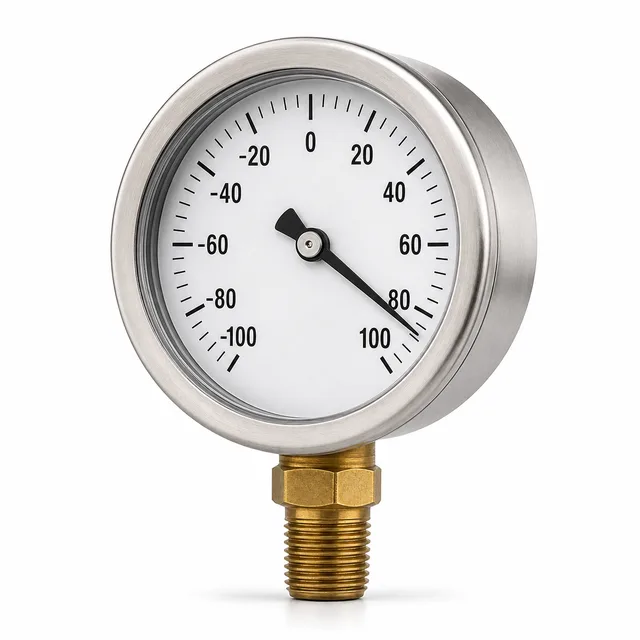
Stainless Steel Vacuum Gauge and Compound Gauge is a product in the instrumentation family for fluid conduction in stainless steel, ASME B40.100-2022. 4 sizes published with per-variant price and availability. Price from $ 29.600 COP before VAT.
| SKU | Size | Unit price (from) | Availability | Qty | |
|---|---|---|---|---|---|
| VT-SER-VAC-01 | Manovacuómetro · 2,5" · vertical (inferior) 1/4" NPT (bronce) · seco | $ 29.600 * | Made to order | ||
| VT-SER-VAC-02 | Manovacuómetro glicerinado · 2,5" · vertical (inferior) 1/4" NPT | Request a quote | Made to order | ||
| VT-SER-VAC-03 | Vacuómetro · 2,5" · vertical (inferior) 1/4" NPT (bronce) · seco | $ 29.600 * | Made to order | ||
| VT-SER-VAC-04 | Vacuómetro glicerinado · 2,5" · vertical (inferior) 1/4" NPT | Request a quote | Made to order |
Prices per size, per unit, before VAT. Confirmed in the quote together with shipping. Sizes marked with * show the base reference price.
| Family | Instrumentation |
| Material | Acero inoxidable |
| Standard | ASME B40.100-2022 |
| Connection | Other |
| Sales unit | Se vende por Unidades (Unid.) |
| Availability | Made to order |
A vacuum gauge measures pressure below atmospheric (vacuum); a compound gauge combines the vacuum and positive-pressure scales on a single dial, useful on pumps, suction systems and line tests where the process alternates between both states. Series with 2.5" stainless steel case, bottom (lower) 1/4" NPT brass connection, dry type; the glycerin-filled version is quoted on request.
| Instrument | Dial | Connection | Damping | Price |
|---|---|---|---|---|
| Vacuum gauge | 2.5" (63.5 mm) | bottom (lower) 1/4" NPT | dry | COP $29,600 — made to order |
| Compound gauge | 2.5" (63.5 mm) | bottom (lower) 1/4" NPT | dry | COP $29,600 — made to order |
| Glycerin-filled vacuum gauge | 2.5" (63.5 mm) | bottom (lower) 1/4" NPT | glycerin | quote |
| Glycerin-filled compound gauge | 2.5" (63.5 mm) | bottom (lower) 1/4" NPT | glycerin | quote |
Before using these data in engineering decisions — design, installation or systems with mechanical risk of pressure, rupture, fatigue, impact or water hammer — you must read the Technical notice and limitation of liability at the end of this page.
The pressure range of each variant is defined at quotation based on your operating point; the source data sheets do not publish a per-variant range. The most requested range ladder in the Colombian market is 15, 30, 60, 100, 160, 200 and 300 psi (1.0 to 20.7 bar).
ASME B40.100-2022 (Pressure Gauges and Gauge Attachments) also covers vacuum and compound-scale indicators.
Educational guide: what a compound gauge is and how to use it.
The vacuum gauge only measures vacuum (pressure below atmospheric), while the compound gauge has a combined scale: vacuum and positive pressure on the same dial. If your process alternates suction and discharge, the compound gauge avoids installing two instruments.
Yes: the vacuum gauge is the control instrument for vacuum pumps and suction systems, and the compound gauge is the option when the connection point also sees positive pressure at start-up or shutdown.
On request: both glycerin-filled variants (2.5" vacuum gauge and compound gauge) are quoted via WhatsApp stating quantity and required range.
Before using these data in engineering decisions — design, installation or systems with mechanical risk of pressure, rupture, fatigue, impact or water hammer — you must read the Technical notice and limitation of liability at the end of this page.
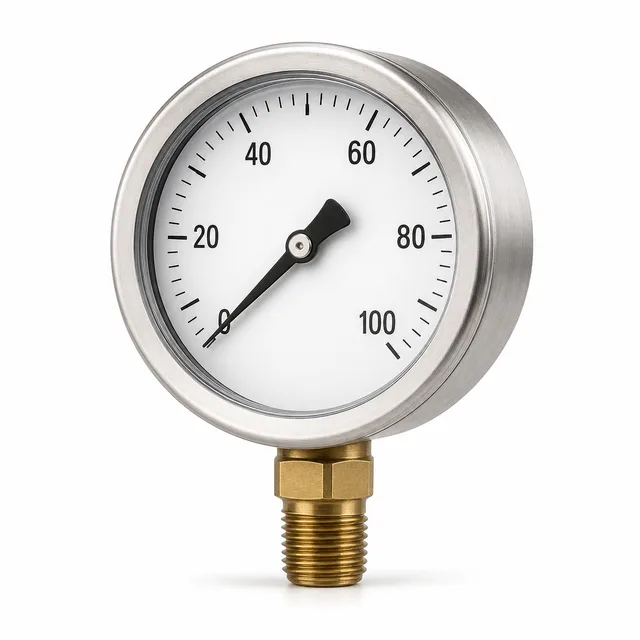 Glycerin-Filled Stainless Steel Pressure Gauge
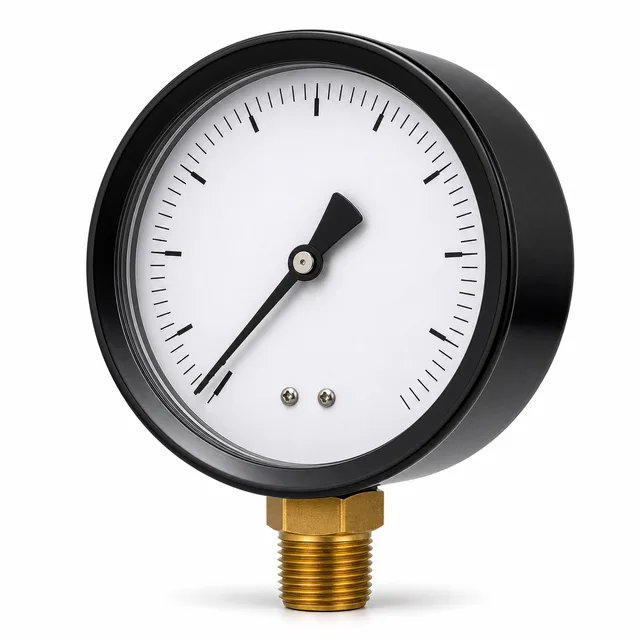 Black Case Dry Pressure Gauge, Brass Internals
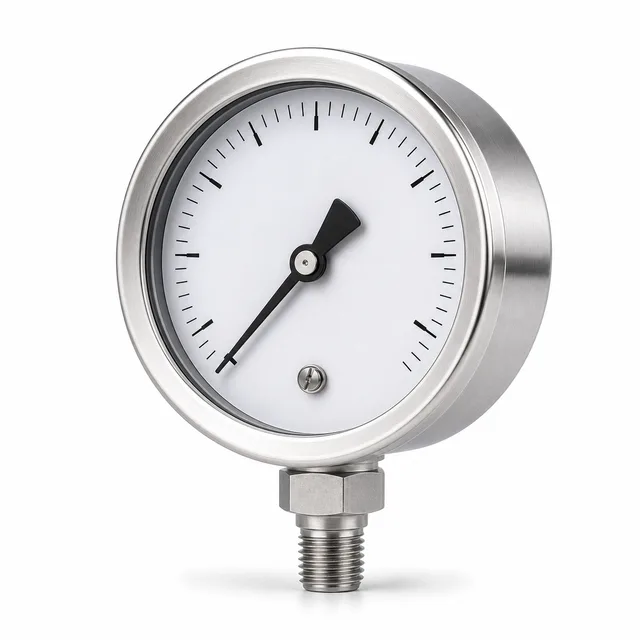 Calibratable Dry Stainless Steel Pressure Gauge
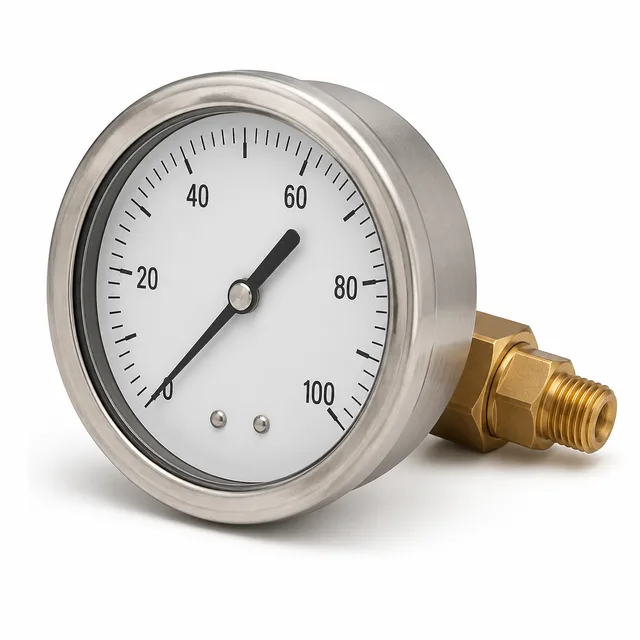 Dry-Damped Stabilizer Pressure Gauge
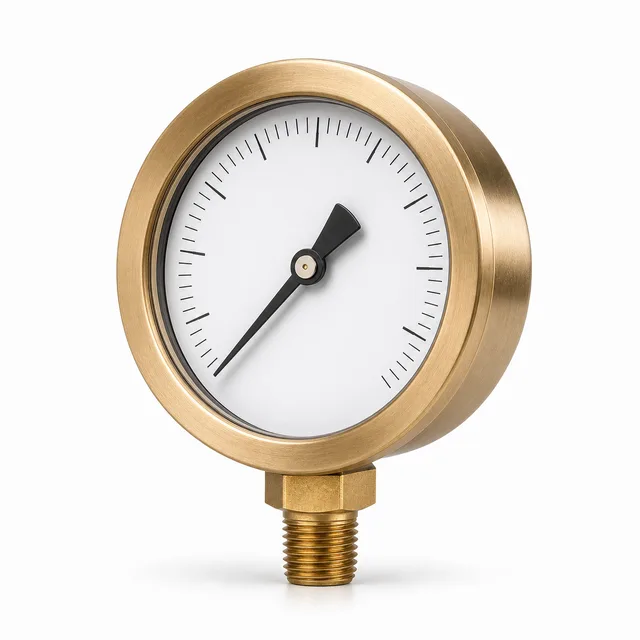 Low-Pressure Capsule Gauge, in H2O Scale
Updated: July 22, 2026
The dimensions, thicknesses, pressures, temperatures and other characteristics stated in this data sheet are theoretical nominal reference values, compiled from publicly available technical sources: international standards (ASME, ASTM, API, MSS, ISO and NTC, depending on the product) and published engineering literature. They are average approximations intended to guide selection, not a certificate of conformity for any given lot.
Actual values may vary due to conditions inherent to the manufacturing process — dimensional and wall-thickness tolerances (in pipe, typically ±12.5%), surface finish and residual stresses from forming or welding — and to factors inherent to the raw material — chemical composition variations within the ranges allowed by the standard, inclusions or heat-to-heat differences. They may also be affected by in-service events not foreseeable at design time: water hammer, vibration, thermal and mechanical fatigue, corrosion and operating overpressures, which can cause the element to fail before its estimated service life.
To know the certified behavior of a specific lot, TECTUL supplies upon request the manufacturer's mill test certificate (MTC) issued per the product standard; for critical applications, laboratory testing of the lot can also be arranged. In the absence of such certification, the data provided here must not be used as the sole criterion in critical or safety applications, or wherever the integrity of the line may compromise the lives of people or property; in such cases, consult our technical team first.