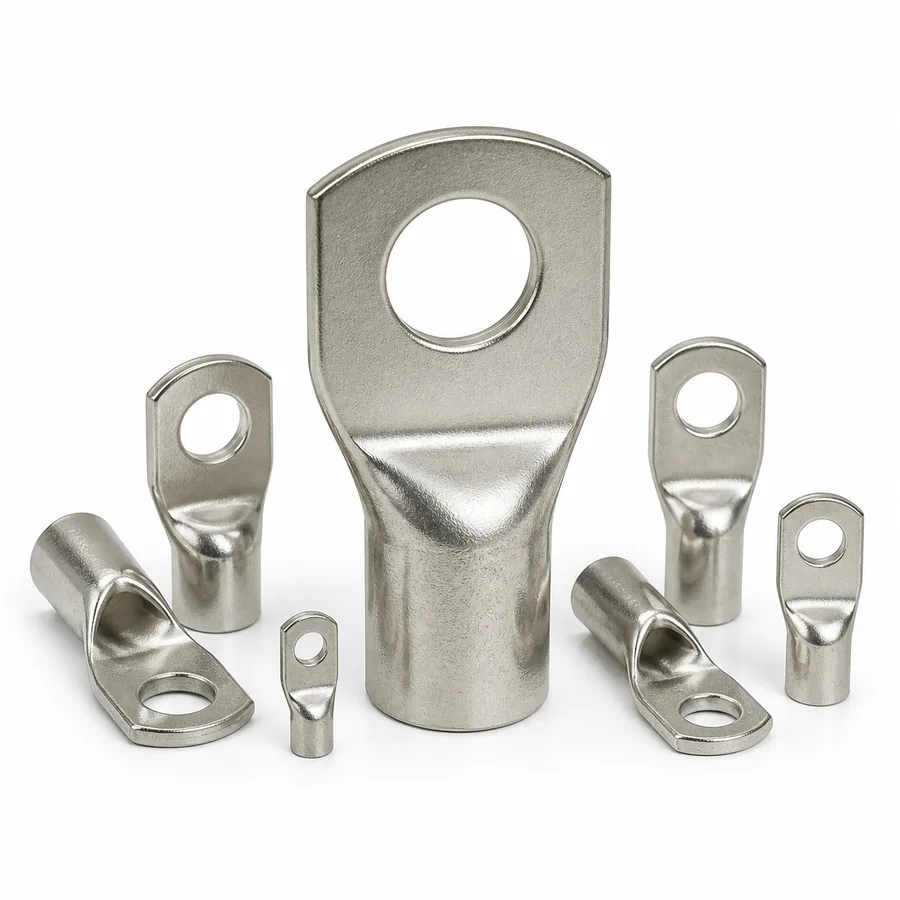
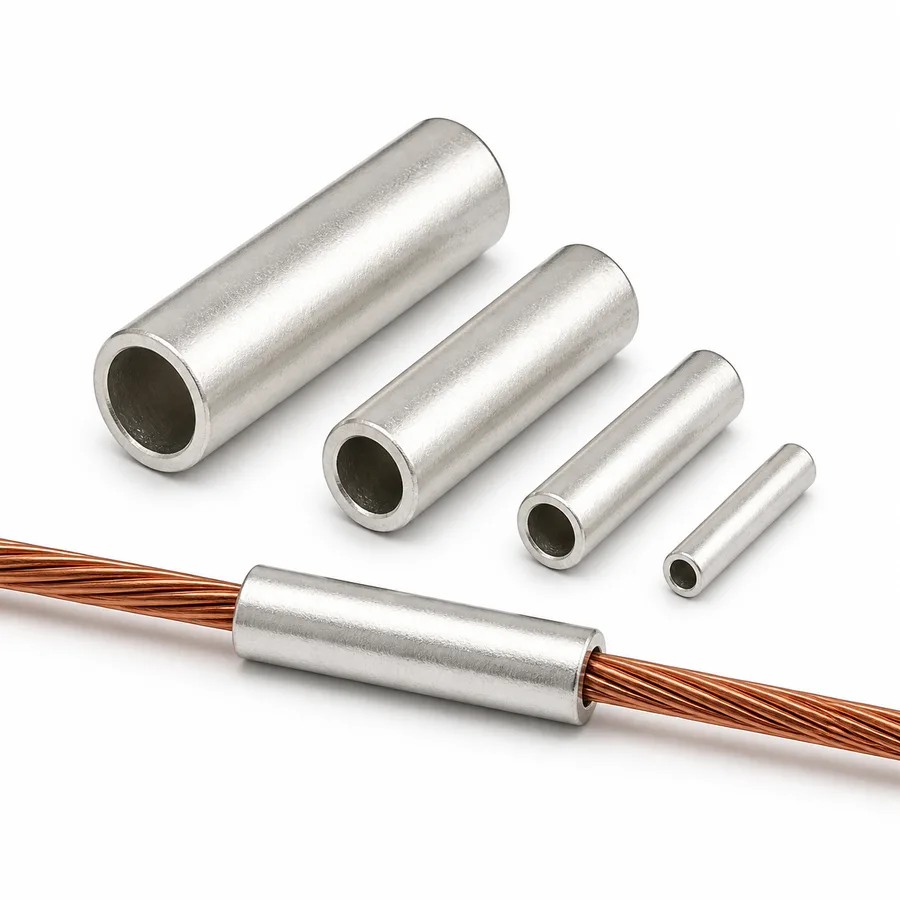
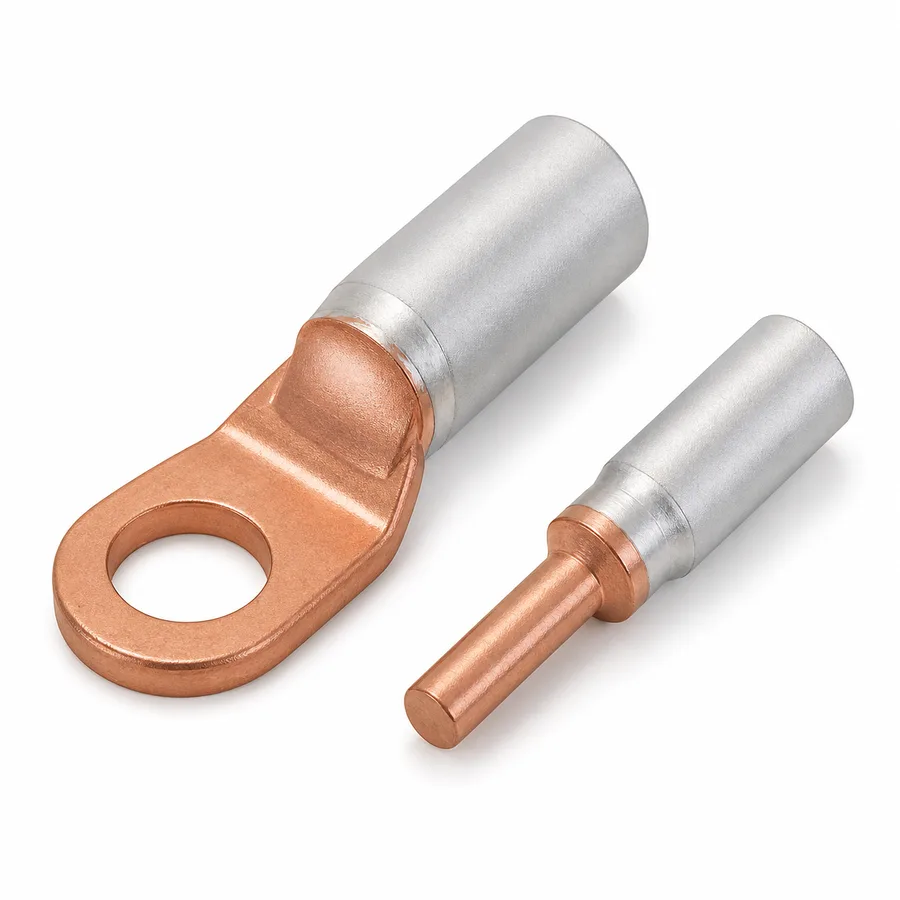
Copper-aluminum bimetallic lug (also pin type) for safe transition between aluminum conductors and equipment with copper busbar.
Tell us the reference or key specification (current, power, gauge, size), quantity and city — a technical advisor sends your quote the same business day.
The bimetallic lug connects aluminum conductors to copper bus bars or equipment through a friction-welded aluminum-copper transition, per UL 486B, blocking the Cu-Al galvanic couple that corrodes direct joints. The aluminum side takes the AA-8000 cable and the copper side bolts to the bus.
The bimetallic lug is a compression terminal designed to connect aluminum conductors to equipment, busbars or connection points associated with copper, avoiding the use of unsuitable accessories for the transition. At TECTUL it is quoted as a copper-aluminum lug, including eye and pin-type configurations according to the application. Its key difference from the copper compression lug is the material: the bimetallic lug addresses the joint between dissimilar metals, where accessory selection, conductor preparation and correct crimping are critical to reduce heating, oxidation and contact failures. It is a common solution in service entrances, panels, industrial maintenance and feeders where aluminum cable must terminate in equipment with copper contact.
We dispatch to Bogotá, Medellín, Cali, Barranquilla and all of Colombia. Request a quote via WhatsApp for your bimetallic lug with gauge, conductor type, connection equipment and quantity.
| Property | Aluminum | Copper |
|---|---|---|
| Conductivity (IACS) | ≈61 % | 100 % |
| Density | 2.70 g/cm³ | 8.96 g/cm³ |
| Surface oxide | Insulating alumina — requires inhibitor paste and brushing | Poorly conducting but not insulating oxide |
Due to its lower conductivity, aluminum needs a larger section for the same ampacity (in practice, about two AWG sizes up). Building aluminum conductors must be AA-8000 series alloy per NTC 2050 (310-106), and Al-Cu joints use a bimetallic lug or a connector listed for both metals.
Ampacity equivalence example (NTC 2050 table 310-16, 75 °C column): 100 A is achieved with 3 AWG copper or with 1 AWG aluminum — two sizes apart for the same current.
The price is quoted via WhatsApp according to gauge, configuration, quantity and availability. TECTUL does not publish fixed values for this reference.
It is used to make a proper transition between an aluminum conductor and a copper-associated connection point, such as busbars or electrical equipment.
The copper lug is used in copper-compatible connections; the bimetallic lug is intended for copper-aluminum transitions and should not be replaced without validation.
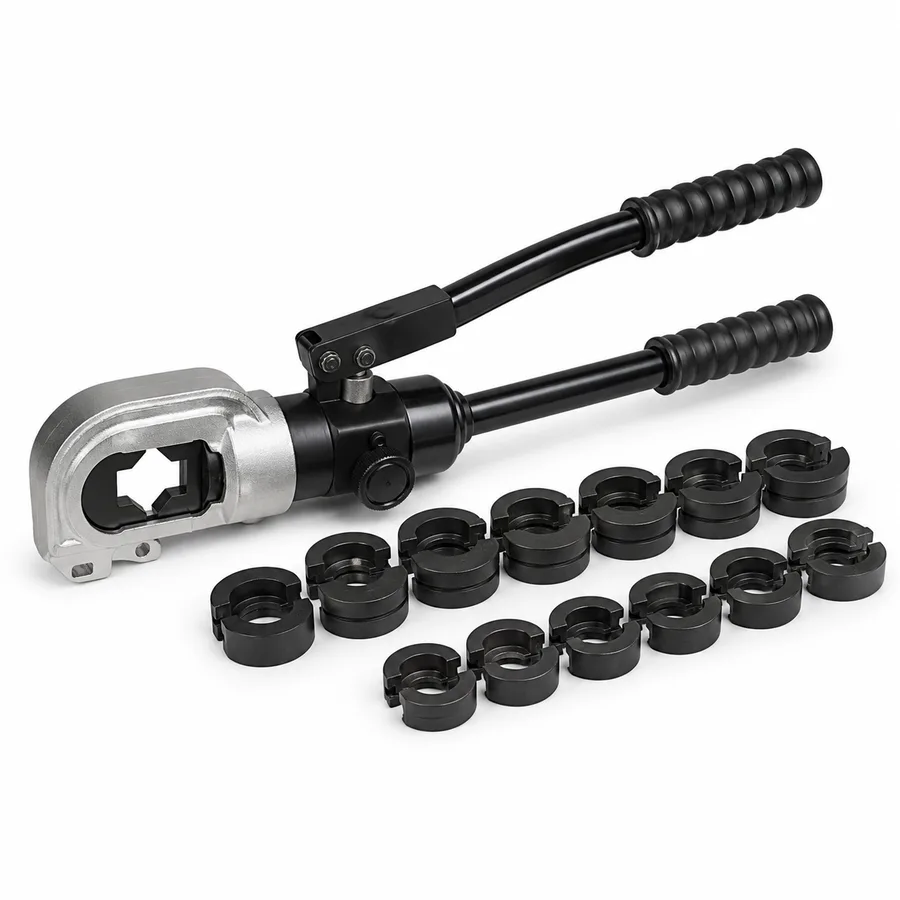
The conductor is prepared, inserted into the corresponding barrel, crimped with the compatible die and fastened to the equipment avoiding contaminated surfaces.
Yes. The lot also indicates pin-type bimetallic lug; the choice depends on the terminal block or equipment where it will connect.
Conductor gauge, cable material, eye or pin type, bolt diameter if applicable, quantity and destination city.
Because the copper-aluminum galvanic couple corrodes the aluminum in the presence of moisture and the joint loosens and overheats with thermal cycles; the bimetallic lug interposes a friction-welded transition that removes the direct contact.
The aluminum alloy family NTC 2050 (310-106) requires for building conductors: it creeps far less at terminations than the old 1350 aluminum, the historical cause of connection failures.
Updated: July 22, 2026