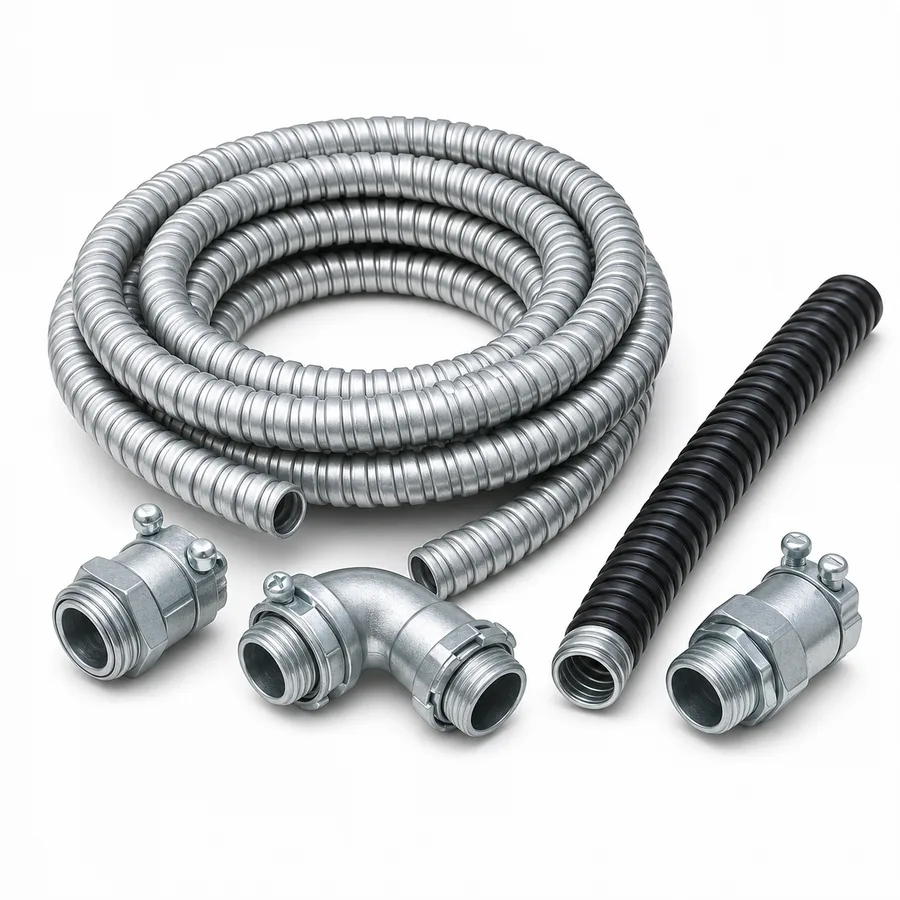
Flexible metallic conduit with or without PVC jacket (liquidtight) and straight and angled connectors, for motors and equipment with vibration.
Tell us the reference or key specification (current, power, gauge, size), quantity and city — a technical advisor sends your quote the same business day.
Flexible metal conduit is interlocked steel-strip raceway: type FMC per UL 1 (NTC 2050 article 348) and, with a PVC cover, liquidtight type LFMC per UL 360 (article 350), for final connections to motors and vibrating equipment. Commercial diameters 3/8" to 4".
American flexible conduit is a metallic raceway used to route electrical conductors to equipment that requires movement, variable alignment or vibration absorption, such as motors, pumps, machines, auxiliary panels and junction boxes. At TECTUL it is quoted as an industrial line with metallic versions and options with PVC liquidtight jacket, as well as straight and angled connectors to properly close the entry into boxes or equipment. It differs from EMT conduit because it is not intended as a straight rigid exposed run, but as a final flexible connection; and it differs from IMC conduit because it prioritizes mechanical adaptation in areas with movement, not structural rigidity. For proper selection, confirm the environment, connector type, diameter required by conductor fill and compatibility with the enclosure. In Colombian electrical installations it must be integrated into the design according to RETIE and NTC 2050, validating continuity, mechanical protection and fastening method.
We dispatch to Bogotá, Medellín, Cali, Barranquilla and all of Colombia. Request a quote via WhatsApp for liquidtight flexible conduit indicating diameter, approximate length, work environment and required connector type.
| Type | Standard | Cover | Use |
|---|---|---|---|
| FMC (bare flex) | UL 1 | None | Dry interiors, flexible runs |
| LFMC (liquidtight) | UL 360 | Continuous PVC | Outdoors, washdown, oils — with sealed connectors |
Motor connections use straight or angled (45°/90°) listed connectors for each type. As a grounding path, NTC 2050 (art. 250) accepts flexible conduit only up to 1.8 m and 20 A circuits: safe practice is pulling an internal grounding conductor.
We do not publish a fixed price because it depends on diameter, jacket, length and connectors. TECTUL quotes via WhatsApp according to the actual project need.
Yes. It is one of its most common applications when a flexible connection is required between rigid raceway, box or panel and the motor or equipment with vibration.
EMT is rigid and used in straight runs or exposed raceways. Flexible conduit is used in the final section where there is vibration, movement or difficult alignment.
Yes. The PVC liquidtight option is used when greater protection against moisture, splashing or demanding industrial environments is needed.
It is cut to the required length, the end is protected, it is coupled with a straight or angled connector and fastened to the box, panel or equipment without forcing the bending radius.
Indicate diameter, length per section, whether you want it with or without PVC, connector types, delivery city and environmental conditions.
Bare (FMC) in dry interiors; liquidtight (LFMC, PVC-covered with sealed connectors) where there is water, washdown, oils or weather — such as motor drops in process plants.
Only in short runs: NTC 2050 accepts it as a grounding path up to 1.8 m on circuits of 20 A maximum with listed connectors; industrial practice always pulls a grounding conductor inside.
Updated: July 22, 2026